FounderHQJul 5, 202613 min read
Boost SEO With a Lean Founder Publishing Loop
Boost SEO without chasing random tactics. Use this lean weekly loop to find search signal, fix crawl and indexation basics, improve useful pages, add internal links, and refresh...


If you are an early-stage founder, “boost SEO” probably does not mean “become an SEO specialist.” It means getting more of the right people to find useful pages without adding another unsustainable growth project. The strongest move is not a giant checklist; it is a small publishing loop your team can run every week: find existing search signal, fix discoverability blockers, improve one page or cluster, add useful internal links, measure what changed, and refresh when content slips.
Boosting SEO is not one tactic; it is a small operating loop
SEO improves when several basics work together. Google describes Search as a process of crawling, indexing, and serving results: crawlers discover pages, Google analyzes and stores page information in its index, and then Search returns information relevant to a user’s query (Google Search Central). For a founder, that means the work is not just “write more posts.” Your page has to be discoverable, indexable, useful, connected to related pages, and worth revisiting as the market and search results change.
A lean SEO loop has six parts: discoverability, intent match, content usefulness, internal links, measurement, and refresh. If one part is broken, adding more content often creates more content debt. A page that answers the wrong intent will underperform. A useful page with no internal links can be hard for users and crawlers to find. A page that once ranked can decay if the examples, structure, or references become stale.
For small product teams, the goal is to build a durable growth asset rather than another pile of disconnected tactics. That is the same operating principle behind choosing the right growth asset first: diagnose the constraint, improve the asset that can compound, and avoid adding work the team cannot maintain.
FounderHQ fits this operating view of growth at the company-context level: it helps early-stage product teams build product journeys, compose founder-led content, and keep company context in one focused operating system. For SEO specifically, that context matters because stronger articles usually come from real product decisions, customer language, positioning, and examples—not generic keyword coverage.
Start with the page or cluster that already has signal
The fastest place to look is usually not a blank content calendar. Start with pages that already show some evidence of demand: impressions in Google Search Console, a few clicks from non-branded queries, a ranking page that has slipped, or a product-relevant article that prospects already mention in conversations.
Use a simple founder decision rule: if a page already gets relevant impressions, improve it before creating five net-new articles. Existing impressions suggest that Google can associate the page with a query. Your job is to make the page more useful, clearer, and better connected to the rest of the site.
Prioritize pages with business-relevant intent. A high-volume query that attracts the wrong reader can distract a tiny team. A lower-volume query that maps to a real buyer problem, product education moment, onboarding question, or category narrative may be more useful. For example, a product-led startup might prioritize an article that explains a core workflow over a broad glossary page that brings unqualified traffic.
A practical triage list looks like this:
Signal | What it means | Action |
|---|---|---|
High impressions, low clicks | The page is visible but not compelling enough in results | Rewrite title, meta description, intro, and opening answer |
Ranking just outside page one | The page may need depth, examples, or stronger internal links | Improve content and add relevant links |
Formerly strong page declining | Content may be stale or competitors now answer better | Refresh examples, structure, sources, and sections |
Important page with no impressions | Discovery, indexing, or intent may be weak | Check technical basics and internal links first |
Check whether Google can discover, crawl, and index the page
Before rewriting a page, make sure it can be found and understood. Google’s SEO Starter Guide says Google is a fully automated search engine that uses crawlers to explore the web and add pages to its index, and that Google primarily finds pages through links from pages it already crawled (Google SEO Starter Guide). If your page is orphaned, blocked, or technically confusing, better copy alone may not solve the problem.
Run this minimum technical SEO basics check:
- The URL returns a successful status and is not broken.
- The page is not blocked by robots.txt when it should be public.
- The page is not marked
noindexif you want it in search. - The canonical tag points to itself or to the intended canonical URL.
- The page is included in a sitemap where appropriate.
- The important content loads in a way users and crawlers can access.
- The page has at least a few relevant crawlable internal links pointing to it.
This does not require an enterprise audit. For a founder, the point is to remove obvious blockers before spending hours expanding a draft. If the page cannot be discovered or indexed, the rest of the SEO work has a weaker foundation.
Technical checks are also where many teams discover accidental content debt: old redirects, duplicate pages, broken internal links, thin category pages, or important pages buried deep in the site. Fix the constraint closest to discovery first, then improve the content.
Match the page to the searcher’s real intent
A page can target the right keyword and still fail if it answers the wrong job. Searchers may want a definition, checklist, comparison, template, tutorial, pricing guidance, troubleshooting help, or purchase research. The format matters because it tells the reader, quickly, “this page understands what I came here to do.”
For a query like “boost SEO,” the reader is usually looking for practical improvement guidance. A broad definition of SEO is too shallow. A dense enterprise technical audit is too much. A product pitch is too early. The useful answer is a prioritized workflow that helps the reader decide what to do next.
Diagnose the job behind the query
Ask: what would the reader consider a successful visit? For a query like “boost SEO,” success usually means leaving with a repeatable SEO checklist a small team can run. For a comparison query, success might mean understanding trade-offs. For a “how to” query, success might mean completing a task. For a “best tool” query, success might mean narrowing options.
Use the results page as format evidence
Look at the current search results for patterns, not for copy to imitate. Are ranking pages mostly guides, checklists, videos, templates, product pages, or short definitions? If most results are practical guides, your page needs clear steps. If results include examples and templates, a generic essay will feel incomplete.
Avoid intent mismatches
Common founder SEO mistakes include turning every informational article into a sales page, writing a glossary when the reader needs a workflow, or publishing advanced advice before the basics are clear. Match the page to the reader’s current task first; product relevance can appear through examples, internal links, and the next logical step.
Improve the content before publishing more content
Once the page is discoverable and the intent is clear, upgrade the page itself. Start with the opening. The first few paragraphs should confirm the query, explain the practical outcome, and give the reader a reason to keep going. If the page makes readers wait through a long preamble, tighten it.
Content improvement usually means making the page more specific, not just longer. Add missing subtopics, update outdated references, include examples from the product or market, clarify definitions, and make headings scannable. If the page makes a claim that depends on external evidence, cite a source the reader can follow.
Use on-page basics as a quality gate:
- One clear H1 that matches the page topic.
- A title tag that is specific, not clever at the expense of clarity.
- A meta description that explains the outcome, not just the keyword.
- Natural use of the primary and related keywords.
- Descriptive headings that help the reader scan.
- A concise URL when possible.
- Image alt text that describes the image accurately.
- Examples, frameworks, or decision criteria that show real understanding.
Do not stuff keywords. Do not invent statistics. Do not publish AI-shaped summaries that could apply to any company in the category. For founder-led SEO, E-E-A-T often comes from concrete product context: the trade-offs you made, the customer language you heard, the workflow you tested, and the decision criteria your reader can reuse.
Here is a simple illustrative workflow. A small analytics startup notices that its “event tracking checklist” page has relevant impressions but few clicks. Instead of starting a new keyword sprint, the founder rewrites the title around the reader’s job, adds a short “which events should you track first?” section, links to the page from two related onboarding articles, and logs the change in the weekly scoreboard. The team does not declare victory the next day; it revisits the page later to see whether impressions, clicks, and qualified product signups moved in the right direction.
Build a small topic cluster instead of isolated posts
A topic cluster is a connected set of pages around one business-relevant theme. You do not need a huge content calendar to start. For a startup, three to five pages around one theme can be enough to make the site more useful and easier to navigate.
Think in terms of a hub and supporting pages. The hub explains the main problem or workflow. Supporting pages answer adjacent questions in more depth. Each supporting page links back to the hub, and the hub links out to the supporting pages where useful.
For a founder-led SEO publishing cluster, the pieces might look like this:
Page | Role in the cluster |
|---|---|
SEO publishing workflow | Hub page that explains the operating loop |
Keyword research for startups | Supports prioritization and search intent |
Outline quality checklist | Improves draft quality before publishing |
Indexing and internal links | Helps pages get discovered |
Content refresh workflow | Keeps useful pages current |
AI-search citations | Extends the content into answer-engine visibility |
This kind of connected work is easier when product journeys, founder-led content, and company context live in one focused operating system. The advantage for small teams is not that one tool magically guarantees rankings; it is that each asset can start from the same operating memory instead of a blank page.
Use internal links to make your best pages easier to find
Internal links help both readers and search engines move through your site. Google’s documentation says links are a crucial resource for helping pages be discovered, and its link best practices explain that links should be crawlable anchor elements with href attributes (Google link best practices).
For a founder, internal linking is one of the highest-leverage SEO habits because it turns isolated articles into a system. When you publish or refresh a page, ask: what existing pages should point to this? What hub should it support? What related article should a reader visit next?
Use descriptive anchor text. “Click here” does not tell the reader or search engine much. “SEO publishing workflow,” “weekly growth scoreboard,” or “content atomization system” are clearer because they describe the destination. Anchor text should still read naturally in the sentence; forced exact-match anchors can make the page feel mechanical.
A simple internal-link checklist:
- Add 2 to 5 contextual links from relevant pages when they exist.
- Link supporting articles back to the hub page.
- Link from high-traffic or high-authority pages to priority pages when relevant.
- Avoid broken links and unnecessary redirect chains.
- Use sentence-level links that help the reader continue the task.
- Revisit internal links when you refresh an article.
For example, if your SEO article is part of a broader founder growth system, it may naturally connect to a Friday growth scoreboard for weekly review or a content atomization system for turning one strong piece into platform-native distribution.
Create content that can be cited by humans and answer engines
Useful SEO content is increasingly structured like a reference: clear definitions, practical steps, examples, cited claims, and visible reasoning. That does not mean every article needs to be academic. It means a reader should be able to quote, share, or reuse a section because it says something specific.
Add a concise answer near the top when the query calls for it. Use tables when they make trade-offs easier to compare. Include examples when the advice would otherwise feel abstract. Add FAQ-style sections only when they answer real follow-up questions, not as filler.
Structured data can also help search engines understand a page. Google says structured data provides explicit clues about page meaning, but it should describe visible content on the page and should not be added to blank or misleading pages (Google structured data documentation). Treat schema as clarification, not a shortcut.
For early-stage teams, the most defensible content often comes from company context: product decisions, customer objections, onboarding learnings, internal frameworks, and founder point of view. A focused operating system like FounderHQ can help teams keep product journeys, founder-led content, and company context connected as inputs for stronger pages.
Measure the loop weekly, not obsessively
SEO measurement should create better decisions, not a daily anxiety ritual. Rankings fluctuate, and early-stage teams rarely have enough data to interpret every movement. A weekly review is usually enough to spot useful trends and decide the next improvement.
Track a small scoreboard:
- Pages improved this week.
- Pages indexed or still waiting.
- Internal links added.
- Queries gaining impressions.
- Pages gaining or losing clicks.
- Average position movement for priority queries.
- Conversion or signup signals when available.
- Refresh candidates for next week.
The goal is to connect SEO work to an operating cadence. If a page improved after you clarified intent, added examples, and linked it from related articles, log that. If a page lost visibility after a competitor published a stronger guide, log what changed. The learning compounds only if the team preserves decisions instead of rediscovering them every week.
This is where SEO overlaps with the broader founder challenge: staying consistent while context keeps changing. A small scoreboard keeps the loop visible and prevents the team from restarting every time the calendar gets crowded.
A 2-hour weekly SEO boost workflow for founders
You do not need a full SEO day to make progress. Start with a two-hour weekly loop and protect it like a product ritual. The point is not to finish every SEO task; it is to create steady improvement across pages that matter.
Use this workflow as a starting point. The visual below turns the cadence into a simple weekly sequence your team can reuse.
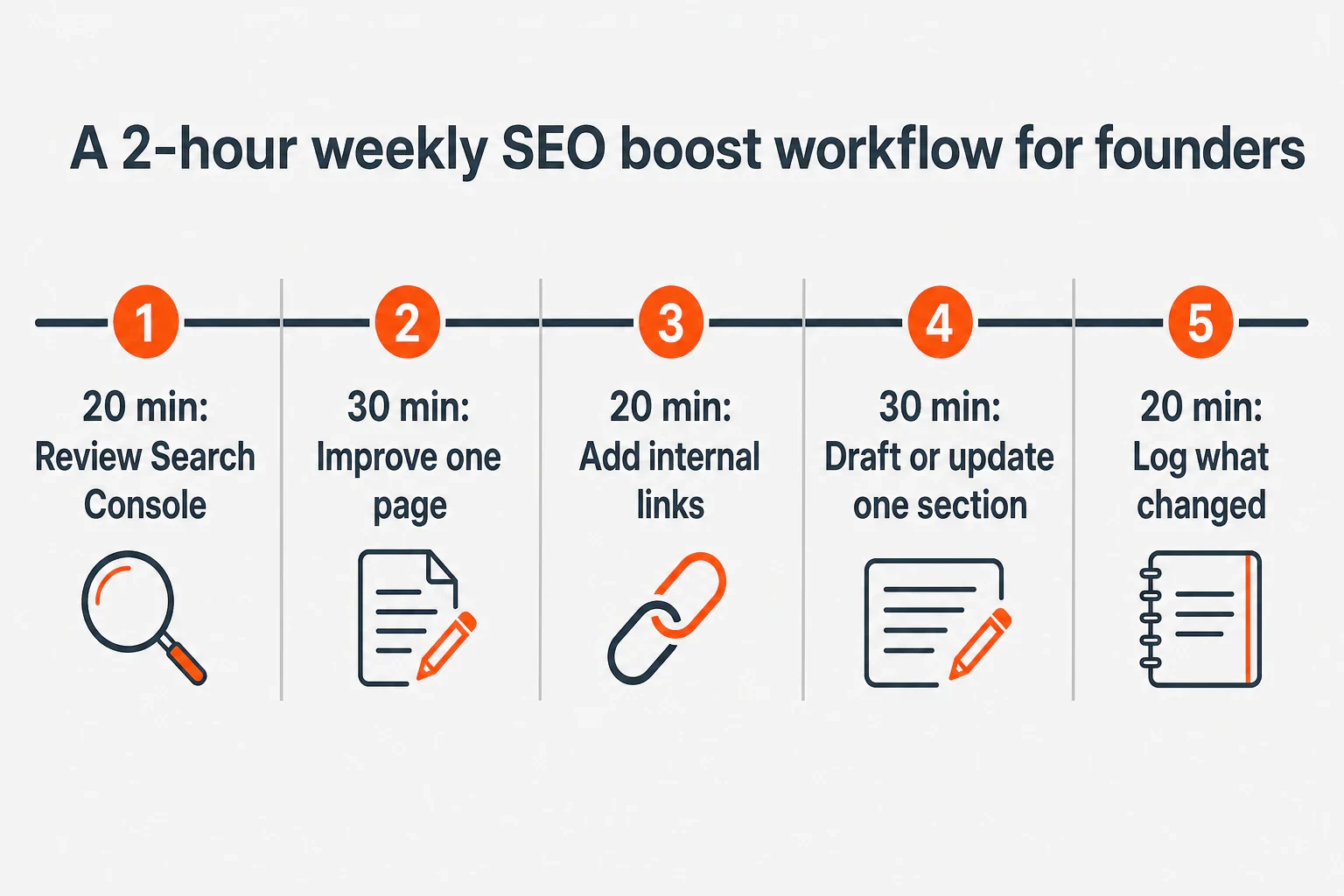
1. Spend 20 minutes reviewing Search Console
Look for pages with impressions, pages gaining or losing clicks, and queries where your site is close but not yet earning enough traffic. Pick one page or cluster to improve. Do not pick five.
2. Spend 30 minutes improving one page
Rewrite the intro, clarify the opening answer, add a missing section, update a stale example, or tighten headings. Choose the improvement that best matches the page’s current constraint.
3. Spend 20 minutes adding internal links
Find relevant pages that should point to the improved page. Add natural, descriptive links. Then make sure the improved page links to the right hub, supporting article, or product-relevant next step.
4. Spend 30 minutes drafting or updating one supporting section
If the cluster needs depth, add a section to an existing article or draft a focused supporting page. Keep it narrow: one adjacent question, one clear job, one useful answer.
5. Spend 20 minutes logging what changed
Record the URL, query, changes made, internal links added, and what you expect to learn. Review the same page again in a later weekly cycle rather than judging it immediately.
What not to do this week: do not rewrite five pages at once, chase a broad keyword with no product relevance, add schema for content that is not visible, or buy links because a checklist made SEO feel urgent. Pick one constraint, improve one asset, and preserve the learning.
Decision | Refresh an existing page | Create a new page |
|---|---|---|
The page already has relevant impressions | Yes | Not first |
The page answers the intent but lacks depth | Yes | Usually no |
The query is adjacent but meaningfully different | Maybe | Yes |
The current page would become unfocused if expanded | No | Yes |
The topic supports an important hub | Maybe | Yes |
You have no evidence of demand or relevance | Not yet | Not yet |
Conclusion
To boost SEO as a founder, do not chase every tactic in the market. Run the smallest loop that makes your site easier to discover and more useful over time: choose a page with signal, fix crawl and indexation basics, match intent, improve the content, add internal links, measure weekly, and refresh deliberately. That cadence will not guarantee rankings, but it gives a small product team a realistic way to turn company context into compounding search assets.
Recommended Videos
A helpful Google Search Central discussion on setting website goals, understanding customers, planning content, checking technical basics, and measuring SEO impact.
Related articles

Application Onboarding Process: Definition, Steps, and When to Use It
A practical seven-step application onboarding process for moving new users from signup to first meaningful value without unnecessary setup or generic tours.

In-App Analytics for Onboarding: Definition, Metrics, and When to Use It
In-app analytics for onboarding turns events, funnels, segments, and user feedback into decisions about the path from signup to first value.

In-App Guidance for Onboarding: Definition, Examples, and When to Use It
In-app guidance helps users complete meaningful tasks inside a product. This guide explains the main patterns and how to match each one to an onboarding blocker.