FounderHQJul 1, 202611 min read
Bootstrap Marketing: Build a Proof Loop Before You Add More Channels
Bootstrap marketing works best when it turns customer proof into useful assets, founder-led distribution, product journey improvements, and reusable company context.

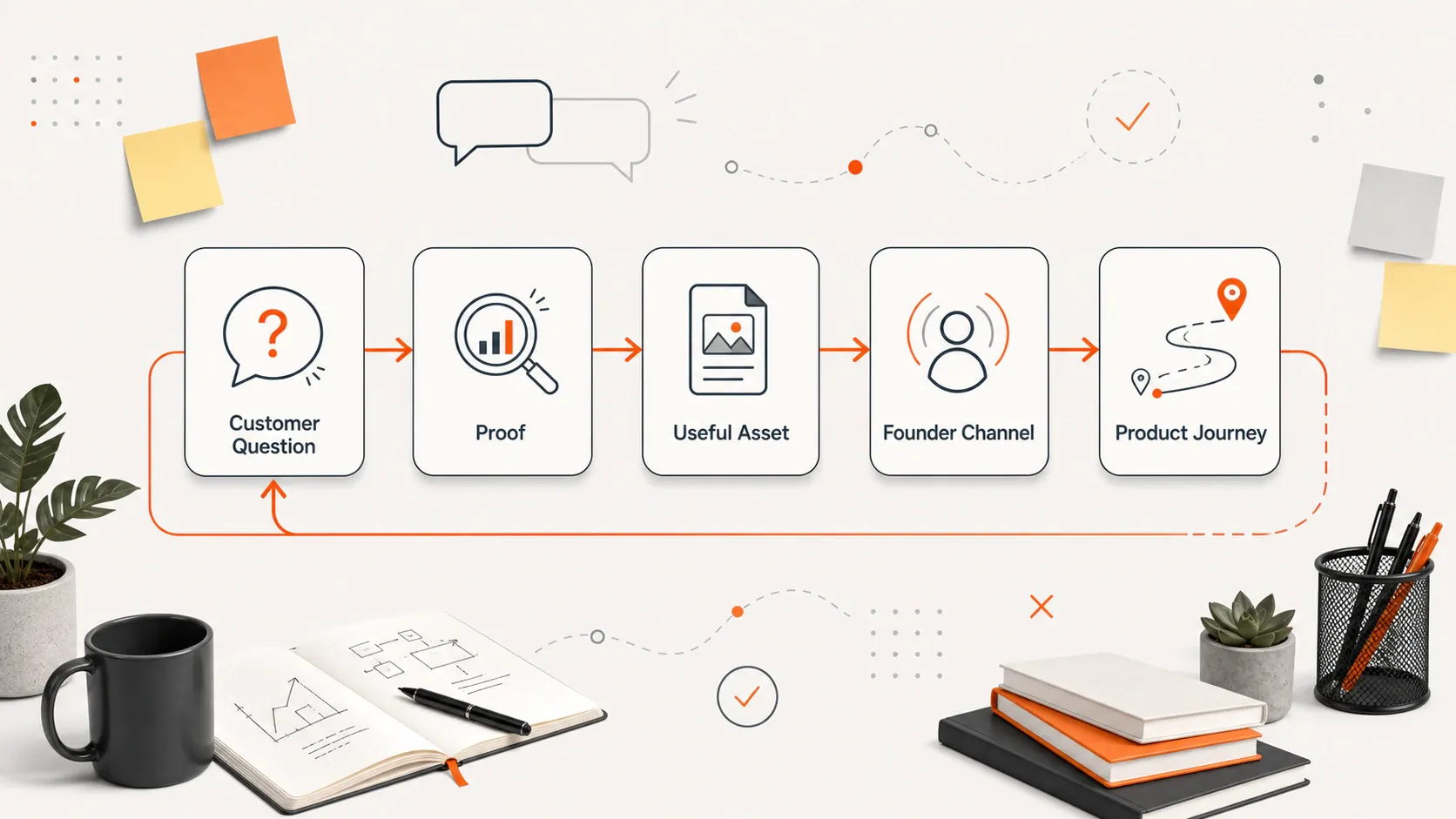
Bootstrap marketing is not just marketing with no budget. For an early-stage founder, the real constraint is usually sharper: limited attention, limited proof, and no reliable system for turning what you learn from customers into content, messaging, and product improvements. The goal is not to do every free tactic. The goal is to build a small proof loop: choose one painful customer question, collect real evidence, publish one useful answer, distribute it through one founder-led channel, feed the response back into the product journey, and preserve the learning for the next cycle.
What bootstrap marketing is — and what it is not
Bootstrap marketing is disciplined resource allocation when money, team capacity, and audience are constrained. It uses founder time, customer insight, owned channels, and compounding assets instead of relying primarily on paid acquisition.
It is not a dare to do every free tactic at once. Paid acquisition buys attention. Random free tactics chase attention. Bootstrap marketing earns attention by being specific, useful, and consistent enough that each cycle teaches the team something about the customer and the product.
That distinction matters because the channels themselves are not the strategy. HubSpot’s 2026 channel research reports that B2B marketers commonly use website/blog/SEO, email marketing, and organic social media, with website/blog/SEO and email also ranking highly by marketer-reported ROI (HubSpot). BrightLocal’s 2025 SMB research found that 36% of SMBs say cost holds them back from investing in marketing channels (BrightLocal). Together, those signals point to a practical reality: founders need channels that can compound, but they also need a way to choose and improve them without burning scarce time.
Why most bootstrap marketing breaks: it separates marketing from proof
Most bootstrap marketing breaks before the founder runs out of tactics. It breaks when the founder sits down to write with no proof source: no customer phrases, no objection patterns, no usage notes, no clear product implication. Every post, page, or email starts from a blank page, so the work feels heavier each time.
Visibility work and learning work are not the same thing. A post can get impressions and still fail to clarify the message. A community answer can get likes and still teach nothing about activation. A blog post can rank for a low-intent query and still miss the painful question that actually moves a buyer.
This is especially important for small, owner-led teams. U.S. Census Bureau research on startup dynamics notes that among nearly 30 million registered U.S. businesses, fewer than six million have employees beyond the business owners (U.S. Census Bureau). For many founders, marketing is not delegated to a growth department; it is folded into the same week as product, support, sales, and onboarding.
That is why bootstrap marketing should be tied to proof from the start. If the content does not help you understand the customer, sharpen the product journey, or improve the next conversation, it is probably too detached from the operating reality of the company.
The bootstrap marketing proof loop
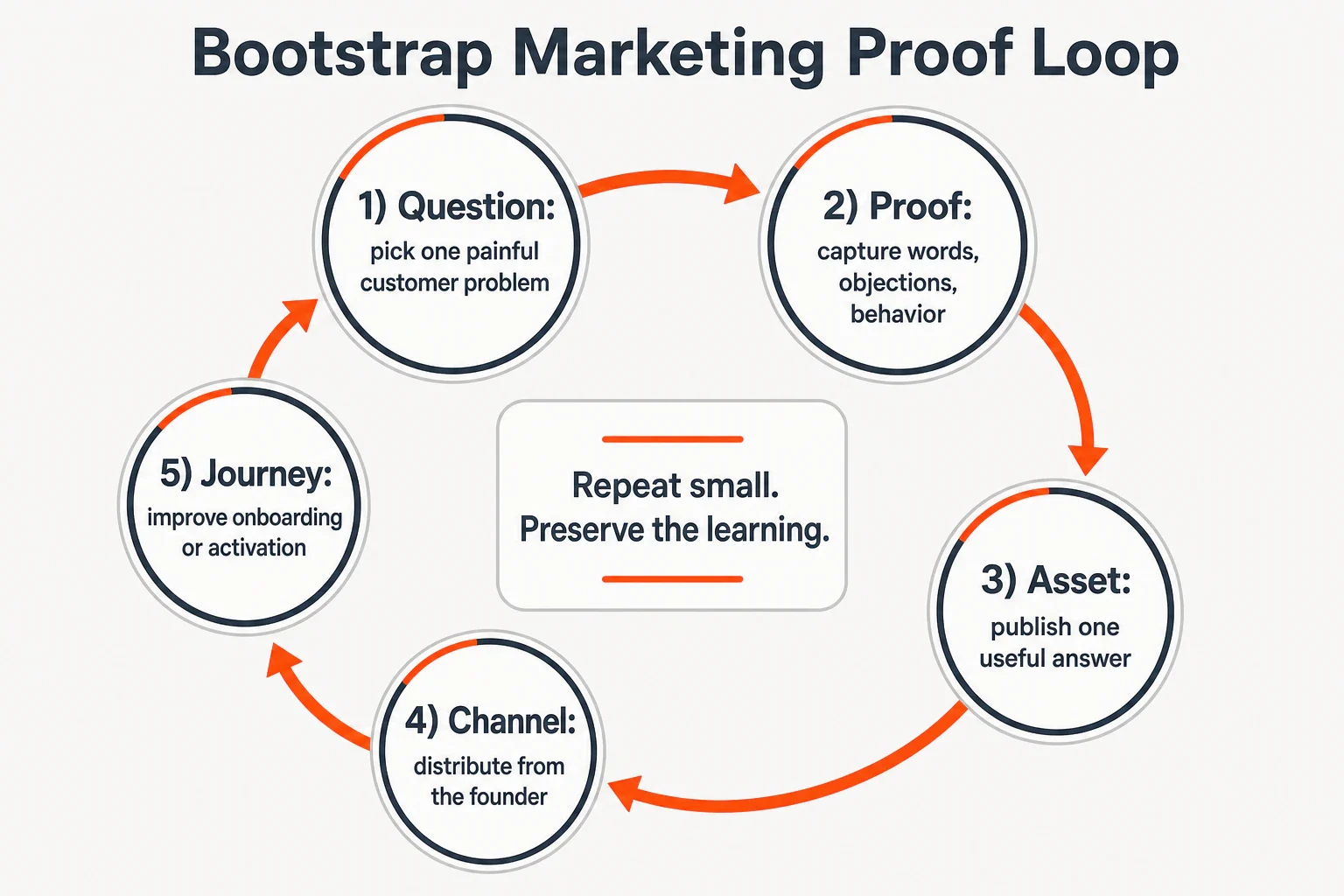
The proof loop is a small operating system for turning customer learning into market-facing assets and product improvements. It has five steps: choose one painful customer question, capture proof, publish one useful asset, distribute through one founder-led channel, and feed responses back into the product journey.
The loop is intentionally narrow. One audience segment. One pain point. One asset. One primary channel. One review of what changed. That constraint is what makes it runnable for a solo founder or a tiny product team.
Use the loop below as the mental model for the rest of the article: the point is not to publish more; it is to make each published asset carry evidence forward.
Step 1: Choose one painful customer question
Start with a question your target customer already feels. For a B2B SaaS or product team, that might be: “How do I onboard users without a customer success team?”, “How do I explain this new category?”, “What makes a buyer switch from spreadsheets?”, or “Why do users sign up and never reach first value?”
Good bootstrap marketing begins with a question that is frequent, urgent, tied to product value, and answerable from real experience. If the question is too broad, you will produce generic advice. If it is too detached from your product, you may earn attention that never turns into useful learning.
Look for the question in places where the customer is already exposing friction: sales calls, support tickets, onboarding drop-offs, community threads, LinkedIn replies, founder DMs, demo objections, and internal notes from failed or stalled deals.
A quick selection test: if answering the question would help a prospect make progress even if they do not buy today, and would also reveal something about your onboarding, messaging, or activation, it is a strong candidate for the loop.
Step 2: Capture proof before you create content
Proof does not have to mean a polished case study. At the bootstrap stage, proof can be customer phrases, repeated objections, workflow screenshots you have permission to use, anonymized before/after examples, product usage patterns, demo notes, or founder decisions made after customer conversations.
Use a lightweight capture template before drafting anything:
- Customer words: What phrase did they actually use?
- Context: What were they trying to do?
- Objection or friction: What slowed them down?
- Product implication: What should onboarding, activation, or the product explain better?
- Marketing implication: What should the next asset answer?
- Next asset idea: What is the smallest useful thing to publish?
This protects the work from becoming generic thought leadership. It also protects the founder from over-sharing. Anonymize private details, remove customer-identifying context unless you have explicit permission, and focus on patterns rather than exposing individual accounts.
The practical benefit is leverage: once proof is captured, the next post, page, onboarding step, or founder narrative starts from evidence instead of memory.
Step 3: Turn the proof into one useful asset
Do not turn every signal into a campaign. Turn the strongest proof into one useful asset: a problem explainer, teardown, checklist, decision guide, onboarding email, FAQ section, comparison page, short founder post, or product walkthrough.
The conversion path is simple: raw proof → founder point of view → practical artifact → distribution excerpt → product or onboarding implication. That path keeps the asset grounded in customer reality instead of drifting into a generic tactics list.
For example, if three prospects ask how to evaluate a new workflow tool, publish a decision guide. If new users misunderstand the first setup step, write a short onboarding email and a founder post explaining the mistake. If buyers keep comparing you to a spreadsheet, create a practical “when spreadsheets break” explainer.
HubSpot’s 2026 State of Marketing research identifies repurposing content across channels as an active trend for marketers (HubSpot). For bootstrap marketing, the lesson is not to copy-paste everywhere. It is to adapt one proof-backed idea into the format each channel deserves.
Step 4: Distribute through one founder-led channel
Choose the channel where you can reliably show up and where customers already ask the problem question. That might be LinkedIn, a niche community, email, search, founder DMs, or a partner audience. The best channel is not the trendiest one; it is the one where your proof can start conversations with the right people.
Founder-led marketing is useful here because early-stage buyers often need to understand the reasoning behind the product, not just the product itself. A Forbes Business Council piece on founder-led marketing argues that founders should be actively involved in brand voice and market presence, especially for startups (Forbes). Treat that as a directional principle: the founder’s perspective is strongest when it is specific, useful, and connected to real customer learning.
A 30-minute distribution checklist is enough for one loop:
- Publish the useful asset.
- Extract one founder-led post from the core insight.
- Answer three relevant community or social threads without pitching.
- Send the asset to five warm contacts who have asked about the topic.
- Log every reply, objection, and follow-up question.
Keep distribution secondary to learning. The aim is not to stretch one asset into endless fragments; it is to expose one proof-backed answer to the right people and see what comes back.
Step 5: Feed responses back into the product journey
This is the step most bootstrap marketing skips. The replies, objections, and questions should not only inform the next post. They should improve the product journey.
If people ask the same setup question, add that explanation to onboarding. If they misunderstand the value proposition, revise the landing-page hero or demo script. If they need to see a workflow before they believe the product can help, create a guided demo or activation flow around that workflow.
For early-stage product teams, this is where marketing becomes more than visibility. It becomes a way to improve activation. The market tells you where the journey is unclear; the product journey gives you a place to resolve that confusion.
FounderHQ’s fit is in this operating motion: FounderHQ helps early-stage product teams build product journeys, compose founder-led content, and keep company context in one focused operating system. The useful distinction is consolidation. The proof, draft, narrative decision, and journey idea should not live in four disconnected places if the same founder has to reuse them next week.
A 14-day bootstrap marketing proof-loop plan
A two-week loop is long enough to collect proof and short enough to avoid turning marketing into a vague side project. Use this plan when you need movement without adding more channels.
Day | Action | Output | Evidence to capture |
|---|---|---|---|
1 | Pick one customer question and define the audience segment | One question and one ICP slice | Why this question matters now |
2–3 | Collect proof from calls, messages, usage notes, and existing drafts | Proof notes | Customer words, objections, behavior patterns |
4–5 | Draft one useful asset and one founder-led distribution post | Asset draft and post draft | Claims that need proof, examples to anonymize |
6–8 | Publish, distribute, and start conversations | Live asset and replies | Replies, saves, DMs, community follow-ups |
9–11 | Identify the journey or messaging update the responses point to | One product or message change | Repeated confusion, activation gaps, buying questions |
12–14 | Update the journey, preserve the learning, and choose the next loop | Updated asset, journey note, next question | What changed and what to test next |
The table is deliberately small. A bootstrap marketing plan fails when it creates more planning surface area than the founder can maintain.
What to measure when you cannot measure revenue yet
Early loops often will not produce clean revenue attribution. That does not mean you should fly blind. Measure whether the loop created better learning and better activation.
Track leading indicators such as qualified replies, repeated objections, saves or bookmarks, demo mentions, email replies, community follow-ups, activation-step completions, and language prospects repeat back to you.
Vanity metrics are not useless, but they are incomplete. A high-impression post with no qualified replies may be a reach signal, not a proof signal. A low-impression post that generates three thoughtful buyer DMs may be more valuable for the next product journey update.
Use a tiny scoreboard with four columns: signal, source, what it taught us, next change. If a metric does not help you decide what to publish, clarify, or improve next, it probably does not belong in this loop.
Common bootstrap marketing mistakes
Mistake 1: Picking too many free channels at once
Free channels are not free when they consume founder attention. Choose one primary channel for each loop, then add another only when the first one has produced a repeatable learning pattern.
Mistake 2: Publishing before collecting customer language
If the asset could have been written by anyone in your category, it is probably missing proof. Start with the phrases, objections, and examples customers already gave you.
Mistake 3: Treating marketing as separate from onboarding and activation
Content should not live in a vacuum. If the market keeps asking the same question, your onboarding, demo, or activation path may need to answer it earlier.
Mistake 4: Saving assets but not the reasoning behind them
A finished post is useful. The reason it exists is more useful. Preserve the customer question, proof pattern, and product implication so the next asset can build on the same learning.
Mistake 5: Copying funded-company playbooks
A playbook built for a team with budget, brand awareness, and specialized roles may collapse under founder constraints. Bootstrap marketing should fit the operating cadence of the team that actually has to run it.
Where FounderHQ fits in the loop
FounderHQ is a unified growth stack for early-stage product teams: a focused operating system that brings product journeys, founder-led content, and company context together. That positioning matters for bootstrap marketing because the loop crosses all three areas.
The proof you capture should inform the content you publish. The replies to that content should inform the product journey. The decisions made along the way should become reusable company context instead of disappearing into scattered notes, drafts, and chat threads.
For a founder, the benefit is not “more tools.” It is a cleaner path from knowledge to shipped assets: customer proof becomes a useful answer, the answer creates market signal, the signal improves activation, and the learning is preserved for the next cycle.
Conclusion
Bootstrap marketing compounds when the learning is preserved. Spending less is only part of the advantage; the bigger advantage is learning faster and reusing that learning across content, messaging, onboarding, and product journeys. Choose one painful customer question this week, run the smallest proof loop around it, and let the result tell you what to publish, clarify, and improve next.
Related articles
Application Onboarding Process: Definition, Steps, and When to Use It
A practical seven-step application onboarding process for moving new users from signup to first meaningful value without unnecessary setup or generic tours.
In-App Analytics for Onboarding: Definition, Metrics, and When to Use It
In-app analytics for onboarding turns events, funnels, segments, and user feedback into decisions about the path from signup to first value.
In-App Guidance for Onboarding: Definition, Examples, and When to Use It
In-app guidance helps users complete meaningful tasks inside a product. This guide explains the main patterns and how to match each one to an onboarding blocker.