FounderHQJul 4, 202612 min read
Bootstrap Marketing: Run a Two-Week Experiment Lab Before You Commit to a Channel
Bootstrap marketing works best when founders treat limited budget as a reason to test more carefully, not to chase every free tactic. Use this two-week experiment lab to validat...

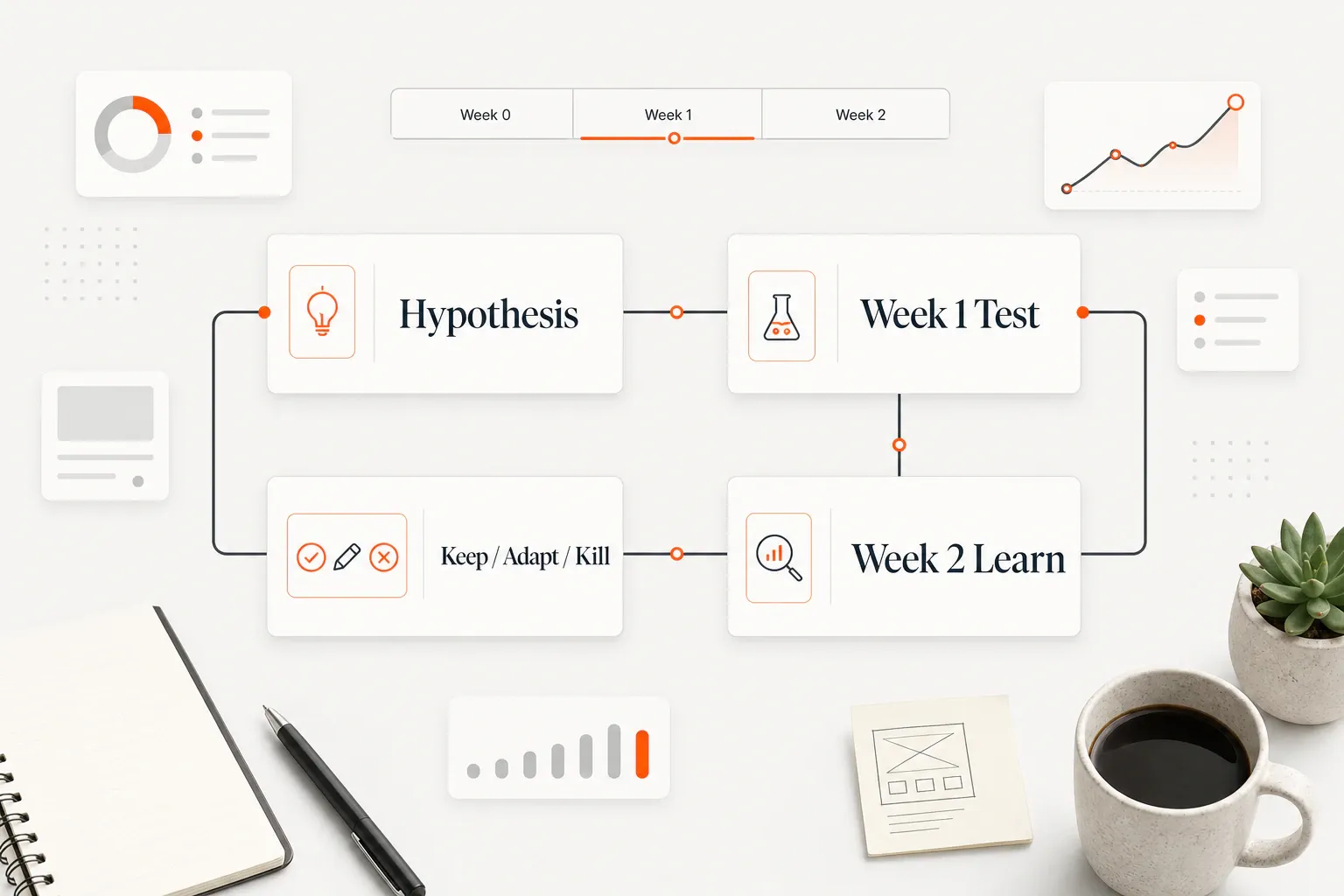
Bootstrap marketing is not a giant list of free tactics. For an early-stage founder, it is a way to buy learning with time instead of cash: choose one buyer-intent hypothesis, test it manually, capture the language and behavior it produces, then decide whether the channel deserves more effort. That distinction matters because the U.S. Small Business Administration frames marketing as work that takes time, money, and preparation, and recommends using a marketing plan to turn strategy into action (SBA). On a tiny team, your first plan does not need to be a 40-page strategy. It needs to be a two-week experiment that protects your focus.
What bootstrap marketing really means when founder time is the budget
Bootstrap marketing means acquiring attention, learning, and customers with limited cash by using founder time, customer proximity, organic distribution, and tight feedback loops. It is common in bootstrapped startup marketing because a founder often has more direct access to customers than money for paid acquisition.
The trap is treating “low budget marketing strategies” as permission to do everything free: post on LinkedIn, write SEO articles, answer Reddit threads, launch on directories, send cold emails, start a newsletter, build in public, ask for partnerships, and publish short videos all at once. That is not bootstrap marketing. That is budget-free fragmentation.
A better definition: bootstrap marketing is the smallest disciplined experiment that can prove whether a channel contains buyer intent. The goal is not to become active everywhere. The goal is to find the one place where the right people are already asking, searching, replying, or taking the next step.
This is why the first bootstrap marketing decision should happen before the cadence, content calendar, or 90-day operating loop. You are not yet trying to scale a channel. You are trying to answer one question: “Is this channel worth more founder time?”
Why most no-budget marketing fails before the channel has a fair test
Most startup marketing with no budget fails because the founder never isolates the variable. One week is LinkedIn. The next week is cold outreach. Then comes a Product Hunt draft, three community comments, an SEO article, and a partnership idea. After 30 days, the founder feels busy but cannot tell which channel produced real signal.
Current bootstrapped marketing guidance repeatedly points toward similar channels: founder-led content, direct outreach, community participation, SEO, partnerships, newsletters, Product Hunt-style launches, and product-led loops. Recent guides also warn against spreading effort across too many platforms before a channel has enough evidence to judge (Monolit, Okara).
The problem is rarely a shortage of tactics. It is weak experiment design. Founders often skip three things: a clear buyer-intent hypothesis, a defined activation signal, and a kill rule. Without those, every channel looks “promising” and every weak result can be explained away.
A fair test is narrow enough to learn from. It defines the audience, problem, channel, asset, distribution action, leading signal, activation signal, time budget, and decision rule before the work begins.
The two-week bootstrap marketing experiment lab
The lab is intentionally small: one audience, one painful problem, one channel, one useful asset or outreach motion, and one next-step signal. Two weeks is not enough to prove a channel will scale. It is enough to learn whether the channel contains the kind of buyer intent your tiny team should keep investigating.
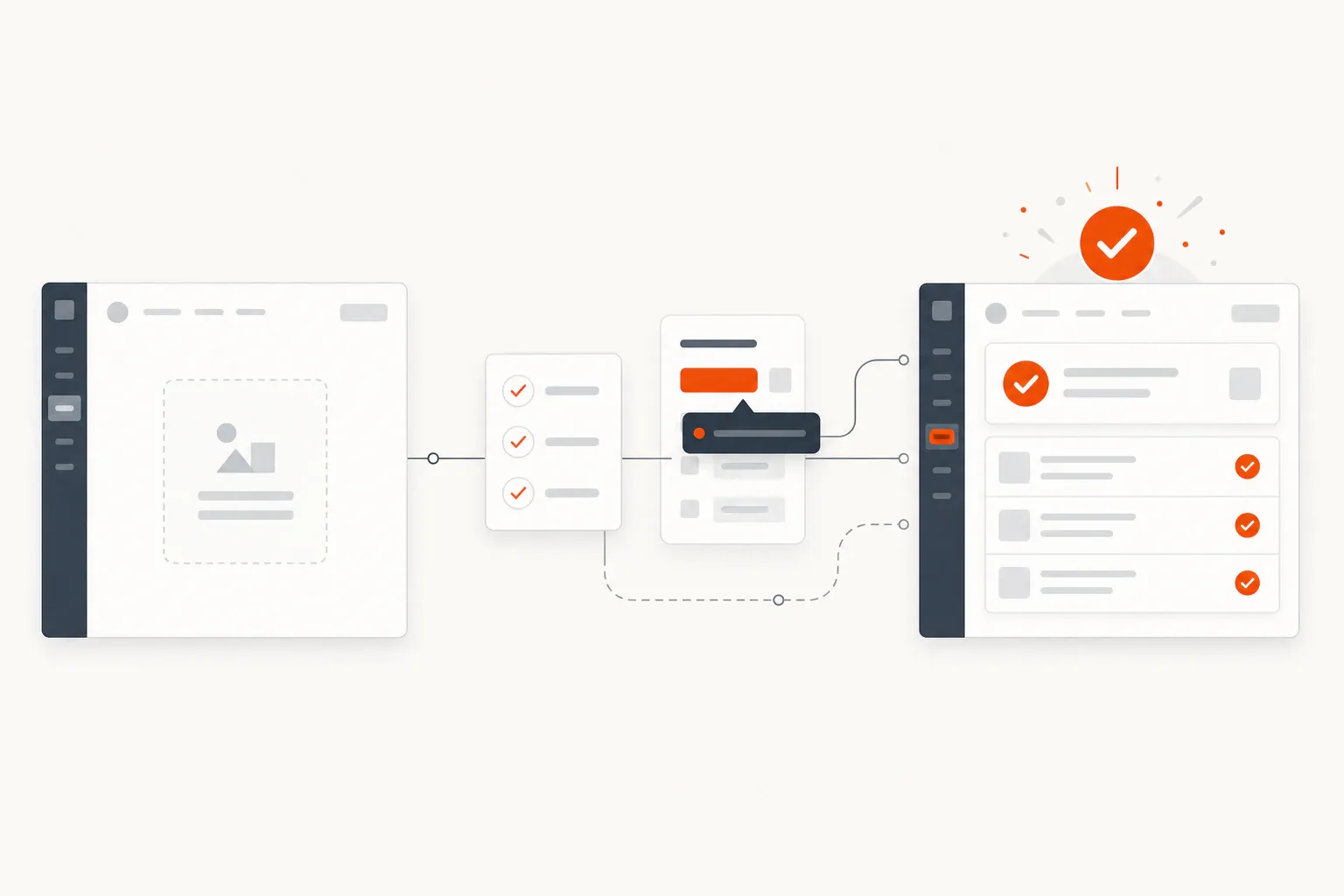
Use the flow below as the operating model. The point is not to make marketing feel scientific for its own sake. The point is to stop founder energy from disappearing into unfocused activity.
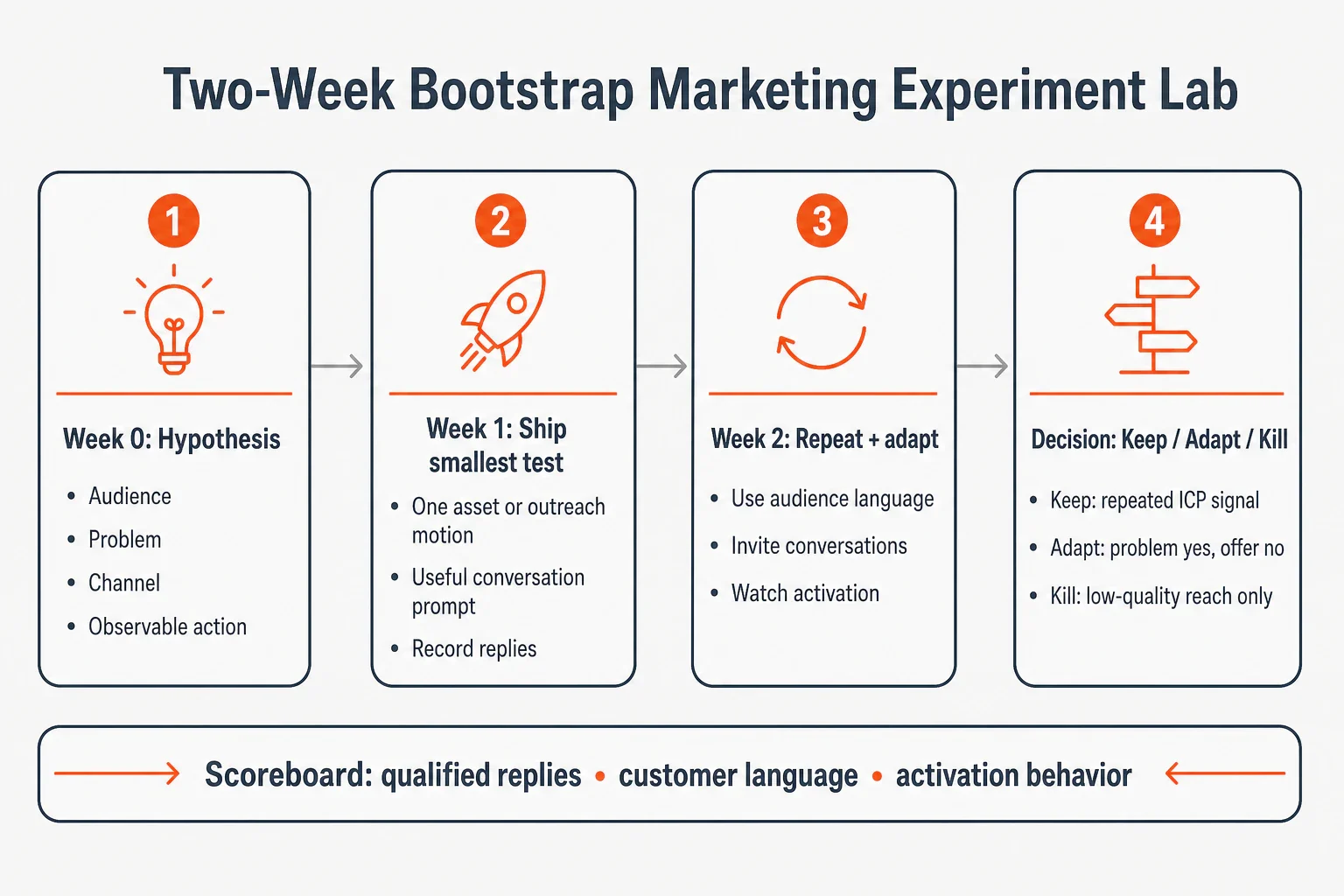
Week 0: Write the hypothesis
Before you publish, reply, DM, or build anything, write one sentence: If we help [audience] with [problem] on [channel], they will [observable action].
Examples: “If we help seed-stage product managers diagnose onboarding drop-off on LinkedIn, they will ask for the checklist or share their own activation problem.” Or: “If we help Shopify app founders compare pricing-page mistakes in a niche Slack group, they will request a teardown.”
The observable action matters. “Get awareness” is too vague. “Receive five qualified replies from people who own the problem” is specific enough to judge.
Week 1: Ship the smallest useful test
Create the smallest artifact that can start the right conversation: a founder-led post, a community answer, a short teardown, a manual outbound note, a problem-first landing page, or a one-page guide. Do not build a full campaign yet.
Then distribute it in the narrowest relevant way. For example, post once and leave ten thoughtful replies where your audience is already discussing the problem. Or send a small batch of highly personalized messages to people who have publicly described the pain. Keep the volume low enough that you can read every response carefully.
Week 2: Repeat, adapt, and listen
In the second week, do not simply repeat the same wording. Rewrite using language from actual replies, objections, searches, or conversations. If people describe the problem differently than you do, use their words. If they engage with the pain but ignore the offer, test a sharper next step.
By the end of Week 2, you should have enough qualitative signal to choose keep, adapt, or kill. Not enough certainty forever. Enough evidence to decide whether the next block of founder time belongs here.
Pick the experiment by buyer intent, not channel popularity
The best first channel is not the one trending on founder Twitter. It is the one where your specific buyer is already showing intent. Intent can look like a search query, a complaint in a community, a public request for tools, a job-to-be-done discussion, a comparison question, or a manual workaround.
Channel | Best-fit audience | Proof of buyer intent | Smallest two-week test | Expected signal | When not to use it |
|---|---|---|---|---|---|
Direct outreach | Narrow B2B ICP with identifiable buyers | People have the title, trigger, or public problem | 20–40 thoughtful messages or warm intros | Replies, calls, specific objections | You cannot identify the buyer or personalize the note |
Communities | Buyers ask questions in public groups | Threads show recurring pain or workaround requests | 10 useful answers plus one lightweight resource | Follow-up questions, DMs, resource requests | The community bans promotion or the audience is mostly peers, not buyers |
Founder-led LinkedIn/X | Buyers follow operators and founders in the category | Similar problem posts earn qualified comments | 2–4 posts plus targeted replies | ICP comments, profile visits, DMs, saved language | You only get founder-peer engagement with no buyer relevance |
SEO pain-point content | Buyers search for the problem or alternative | Long-tail queries show task, comparison, or migration intent | One focused article or landing page | Search impressions, qualified clicks, return visits | The query is too broad or dominated by high-authority publishers |
Partnerships | Adjacent tools, services, or communities share the audience | Partner audience already trusts the category | One co-created resource or partner email draft | Warm replies, intros, qualified signups | The partner has access but no audience-problem fit |
Product-led loop | Users naturally invite, share, or segment others | The product action creates visible value for another user | One share, referral, or waitlist mechanism | Invites, shared links, segmented signups | The product has not reached first value reliably |
Intent-driven channels are especially useful for organic marketing for startups because they begin from existing behavior. A founder does not need to manufacture demand from scratch; they need to enter the conversation with something useful and watch whether the right people move closer.
The signals to measure when revenue is too early
Revenue is the cleanest signal, but it is often too slow for a two-week early-stage experiment. That does not mean you should fall back to vanity metrics. Likes, impressions, and follower counts can help diagnose reach, but they should not decide whether a bootstrap marketing channel earns more time.
Track signals that show the right audience is leaning in:
- Qualified replies: people in your ICP respond with context, not generic praise.
- Problem-language repetition: buyers repeat the same pain, trigger, objection, or workaround.
- Conversation requests: people ask to talk, see an example, or compare their situation.
- Waitlist or demo intent: people take the next step after consuming the asset.
- Activation behavior: users do something that moves them toward first value.
- Return behavior: the same people come back, ask follow-up questions, or share the resource.
The SBA recommends tracking marketing costs and comparing marketing and sales costs to the revenue they generate where possible (SBA). In a two-week founder experiment, treat time as the main cost. If a test takes six founder hours, the question is not “did it go viral?” The question is “did six hours produce enough qualified learning or activation to justify another six?”
HubSpot’s small business marketing guide cites SimpleTexting research that 75% of small businesses have a marketing plan and that businesses with a structured plan are 6.7 times more likely to report success than those without one (HubSpot). For a tiny product team, the useful takeaway is not to overbuild planning. It is to document the experiment clearly enough that decisions are not made from memory.
A keep, adapt, or kill decision rule for tiny teams
Your decision rule should be written before the experiment starts. Otherwise, you will be tempted to keep every channel alive because “it might work with more consistency.” Sometimes that is true. Often it is how founders accumulate half-dead marketing motions.
Keep the channel
Keep going if the test produces repeated ICP-relevant conversations, stronger customer language, or early activation from the right users. The bar should match your capacity. A solo founder may decide that three high-quality conversations are enough to extend the test. A 3-person team may require more.
Keeping a channel does not mean scaling it immediately. It means the next experiment should go deeper: sharper asset, clearer audience, better follow-up, or a more consistent distribution rhythm.
Adapt the channel
Adapt when people engage with the problem but not the offer, or when the audience is right but the format is wrong. For example, a post about onboarding mistakes may earn strong comments but no demo requests. That may mean the problem resonates, but the next step is too large. Try a checklist, teardown, or short diagnostic instead.
Adaptation is also the right choice when replies reveal better language than your original positioning. If the audience keeps saying “activation drop-off” while your copy says “onboarding optimization,” use the phrase they use.
Kill the channel
Kill the test if the audience is wrong, the founder cannot sustain the motion, or the only signal is low-quality reach. A post with broad founder engagement but no buyer conversation is not necessarily a win. A community that drives traffic but no relevant replies may be the wrong room.
Killing a channel is not failure if you preserve the learning. Write down why it was killed, what signal was missing, and what you would need to see before testing it again.
How to turn experiment learning into reusable company context
The most valuable output of a bootstrap marketing experiment is not always the channel decision. Often it is the customer language you would have missed by staying inside your product roadmap.
After each experiment, capture:
- The audience segment tested
- The problem wording buyers used
- The hooks that earned qualified replies
- The objections that repeated
- The channel mechanics that worked or failed
- The activation friction you observed
- The keep, adapt, or kill decision
- The next experiment hypothesis
This is where operating context matters. FounderHQ helps early-stage product teams build product journeys, compose founder-led content, and keep company context in one focused operating system. For bootstrap marketing, that means experiment learning can feed future journeys, posts, market narratives, and follow-up instead of disappearing into scattered docs.
The benefit is practical: future marketing starts from evidence, not a blank page. A reply from an ICP buyer can become a sharper LinkedIn post. A recurring objection can become a landing-page section. A confusing signup step can become a better product journey. A channel you killed can still improve the next one.
Example: one two-week experiment for an early-stage SaaS founder
Imagine a founder building a tool that helps product teams improve activation. The founder suspects product managers care about onboarding drop-off, but they do not yet know whether LinkedIn is a useful channel for reaching them.
The hypothesis: If we help B2B SaaS product managers identify onboarding drop-off patterns on LinkedIn, they will ask for the checklist, share their own activation problem, or request an example journey.
Week 1 asset: a short teardown called “Five onboarding moments where users quietly drop.” Distribution: one founder-led post, ten thoughtful replies to product managers discussing activation or onboarding, and five warm DMs to people who previously posted about user drop-off.
Week 1 signals: the founder tracks qualified comments, DMs, requests for the checklist, and the exact phrases people use. If replies focus on “users never reach the aha moment,” that phrase gets captured.
Week 2 adaptation: the founder rewrites the asset around the audience’s language: “Where users lose the aha moment.” They invite five conversations and offer a lightweight teardown of one onboarding flow. They watch whether people ask for the teardown, join a waitlist, or try a simple product journey example.
Decision: if the test produces several relevant product-manager conversations and clearer activation language, keep the channel for another two-week cycle. If people like the post but no buyers engage, adapt the audience or format. If engagement comes mostly from founders selling to founders, kill LinkedIn as the primary test for now and move to communities or direct outreach.
Bootstrap marketing experiment template
Copy this template before you start your next startup marketing experiment:
Field | Fill this in before the test |
|---|---|
Audience | Who exactly owns or feels the problem? |
Problem | What painful situation are they already trying to solve? |
Channel | Where are they already asking, searching, replying, or comparing? |
Buyer-intent evidence | What proves this is not just a popular channel? |
Asset or motion | What is the smallest useful thing you will ship? |
Distribution action | What will you do manually in Week 1 and Week 2? |
Leading signal | What reply, request, or behavior would indicate interest? |
Activation signal | What next step shows movement toward first value? |
Time budget | How many founder hours will you spend? |
Keep rule | What signal earns another cycle? |
Adapt rule | What signal means problem yes, offer or format no? |
Kill rule | What signal means this is not worth more time now? |
Learning captured | What language, objections, and decisions will you preserve? |
End each week with five review questions: What did people repeat? What did they resist? What did they ask for? What did they ignore? What did they do next?
That is the discipline behind bootstrap marketing. You are not trying to look active. You are trying to learn faster than your budget would otherwise allow.
Conclusion
Before you commit to a channel for 60 or 90 days, run one two-week experiment. Choose one audience, one problem, one channel, one useful test, and one activation signal. Then make the decision you promised yourself you would make: keep, adapt, or kill. Bootstrap marketing compounds when founder time creates reusable evidence, not when every free tactic gets a permanent place on the calendar.
Recommended Videos
A useful companion for SaaS founders who want a practical way to think about low-cost marketing channels, customer intent, and choosing where to focus first.
Related articles
Application Onboarding Process: Definition, Steps, and When to Use It
A practical seven-step application onboarding process for moving new users from signup to first meaningful value without unnecessary setup or generic tours.
In-App Analytics for Onboarding: Definition, Metrics, and When to Use It
In-app analytics for onboarding turns events, funnels, segments, and user feedback into decisions about the path from signup to first value.
In-App Guidance for Onboarding: Definition, Examples, and When to Use It
In-app guidance helps users complete meaningful tasks inside a product. This guide explains the main patterns and how to match each one to an onboarding blocker.