FounderHQJul 5, 202612 min read
Build in Public Signal Triage: Turn Public Replies Into Better Product Decisions
Build in public works best after the post goes live. This guide shows founders how to triage replies, separate useful signal from noise, and route the strongest learning into pr...

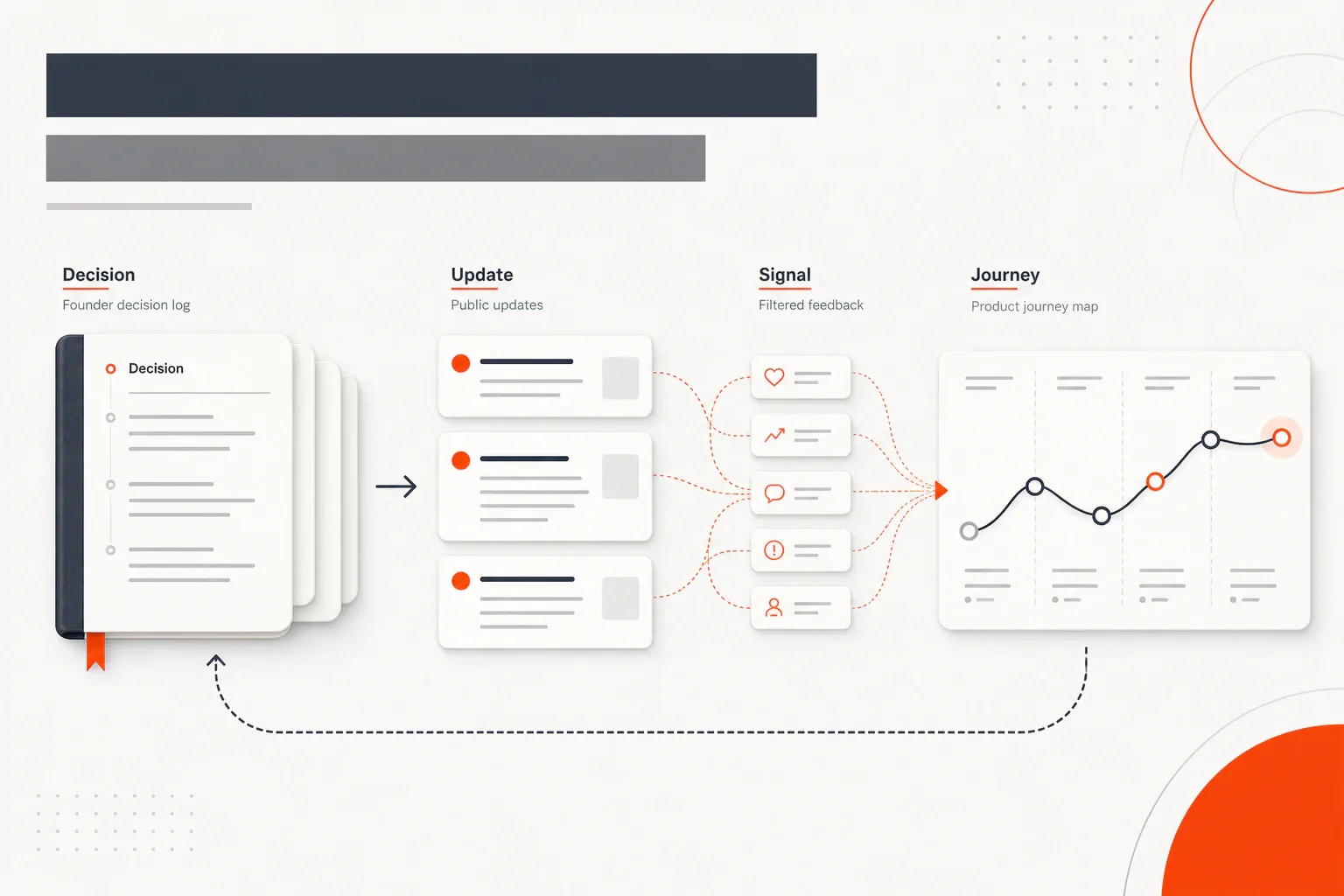
Build in public is often treated like a posting habit: share a ship, collect likes, repeat. That misses the highest-leverage part of the work. For an early-stage founder, the real value starts after the update goes live: who replied, what pattern showed up, which objections came from the right people, and what should change in the product journey as a result.
Build in public is not just posting what you shipped
At its simplest, build in public means making product work visible while it happens: decisions, progress, experiments, failures, lessons, and selected metrics. Current guides increasingly describe the stronger version as workflow transparency rather than performance content. Truve’s 2026 guide, for example, distinguishes workflow-in-public updates from daily vanity screenshots and polished wins without reasoning (Truve).
That shift matters because a generic launch update rarely teaches the reader anything. “We shipped onboarding v2” is an announcement. “We removed the team-invite step from onboarding because solo founders were getting stuck before first value” is a decision. The second version shows context, a trade-off, and a place where the audience can respond with useful experience.
This article focuses on the part founders most often underbuild: the post-publication triage system. The goal is not to publish more. The goal is to make every public update easier to learn from.
The founder problem: visibility without learning is another content treadmill
The trap is easy to miss. A founder starts building in public, posts more consistently, gets a few encouraging comments, and feels momentum. But nothing changes in the product, the positioning, or the customer journey. The content is visible; the company is not learning.
This happens when the feedback loop is broken after publication: the team treats applause as validation, gives the same weight to every comment, overreacts to one loud reply, or lets the strongest signal disappear in notifications, DMs, and screenshots.
A healthier operating cadence is narrower: publish one decision, tag the responses, score the useful signals, choose the operating change, and save the reasoning where the team can reuse it. The public post is only the trigger. The triage work is where the product learning happens.
Step 1: Choose the operating layer you will build in public
Before you post, choose the layer of the company you are willing to make partially visible. If you try to share everything, the updates become scattered and the risk surface grows. If you share nothing concrete, the posts become generic.
Good operating layers for an early-stage product team include:
- Product decisions: why you chose one feature, flow, or constraint over another.
- Onboarding experiments: what you changed in the first-value path and why.
- Positioning tests: how you are describing the problem and which language is confusing people.
- Customer discovery: anonymized patterns from conversations, not private details.
- Shipping cadence: what changed this week and what you learned from the work.
The decision rule is simple: share the layer where audience feedback can improve the product without exposing customer data, security details, competitive intelligence, private financials, or negotiations. Gallopeer’s transparency framework makes a similar point: building in public is not a binary choice between total secrecy and radical openness; founders can choose a level of transparency based on stage, risk, and competitive position (Gallopeer).
Step 2: Capture decisions before you turn them into posts
The best build-in-public posts usually begin as operating notes, not social ideas. Keep a lightweight decision log that captures the raw material while it is fresh:
- Date: when the decision happened.
- Decision: what changed or what you chose.
- Options considered: the realistic alternatives.
- Why now: the constraint, signal, or user pain that forced the decision.
- Evidence used: calls, replies, usage patterns, support questions, demos, or founder judgment.
- Trade-off: what you gained and what you gave up.
- Feedback needed: the specific question an ICP reader could answer.
This keeps build in public close to the actual company-building work. You are not inventing content from a blank page; you are translating real decisions into useful public context.
Decision-level transparency is also more useful to the reader. Michael Batko describes decisions as an underrated category because they show the reasoning behind the work and invite people to challenge that reasoning (Michael Batko). That is exactly the point: the post should create a better conversation than “congrats.”
This is also where a focused operating system helps. FounderHQ positions itself as a focused operating system for early-stage product teams to build product journeys, compose founder-led content, and keep company context in one place. That fits a decision-to-content workflow where the raw decision, the public update, and the resulting signal need to stay connected.
Step 3: Publish selective updates that ask for the right kind of signal
A useful build-in-public post does not need to be long. It does need to make the trade-off visible. Use this structure:
- Context: What part of the product, journey, or message are you working on?
- Decision: What did you choose?
- Trade-off: What did you give up by choosing it?
- What changed: What will users experience differently?
- What you are watching: Which behavior, reply pattern, or objection will tell you whether it worked?
- Specific question: What should the right reader respond to?
The specific question is where many posts fail. “Thoughts?” invites broad opinions. “Which step would block you from reaching first value?” invites product signal. “Would this message make you book a demo?” invites people to perform interest. “What word makes the promise unclear?” gives you language you can actually use.
Public guidance is consistent on the privacy boundary: share decisions, lessons, failures, progress, and selected metrics when they create value; keep customer identities, detailed unit economics, security issues, internal team matters, legal issues, and negotiation details private. Averi’s guide explicitly recommends editorial judgment over radical transparency, especially for B2B teams handling customer trust (Averi).
Step 4: Sort replies into signal, noise, and content fuel
Publishing is not the finish line. It is the start of the listening phase. After a post gets replies, DMs, saves, shares, or silent clicks, sort what came back before you change the product.
Use this triage model:
- Product signal: feedback from someone who resembles the intended user and describes a real workflow, pain, objection, or desired outcome.
- Messaging signal: repeated confusion about the problem, category, value proposition, audience, or next step.
- Audience signal: proof that a topic earns attention from the right market, even if it does not change the product yet.
- Partnership signal: inbound from people who can distribute, advise, integrate, or introduce.
- Content fuel: a useful question, phrase, objection, or analogy that should become a future post, FAQ, landing-page section, or sales explanation.
- Noise: off-ICP advice, edge-case requests, applause, dunking, engagement bait, or interesting comments that are not decision-relevant.
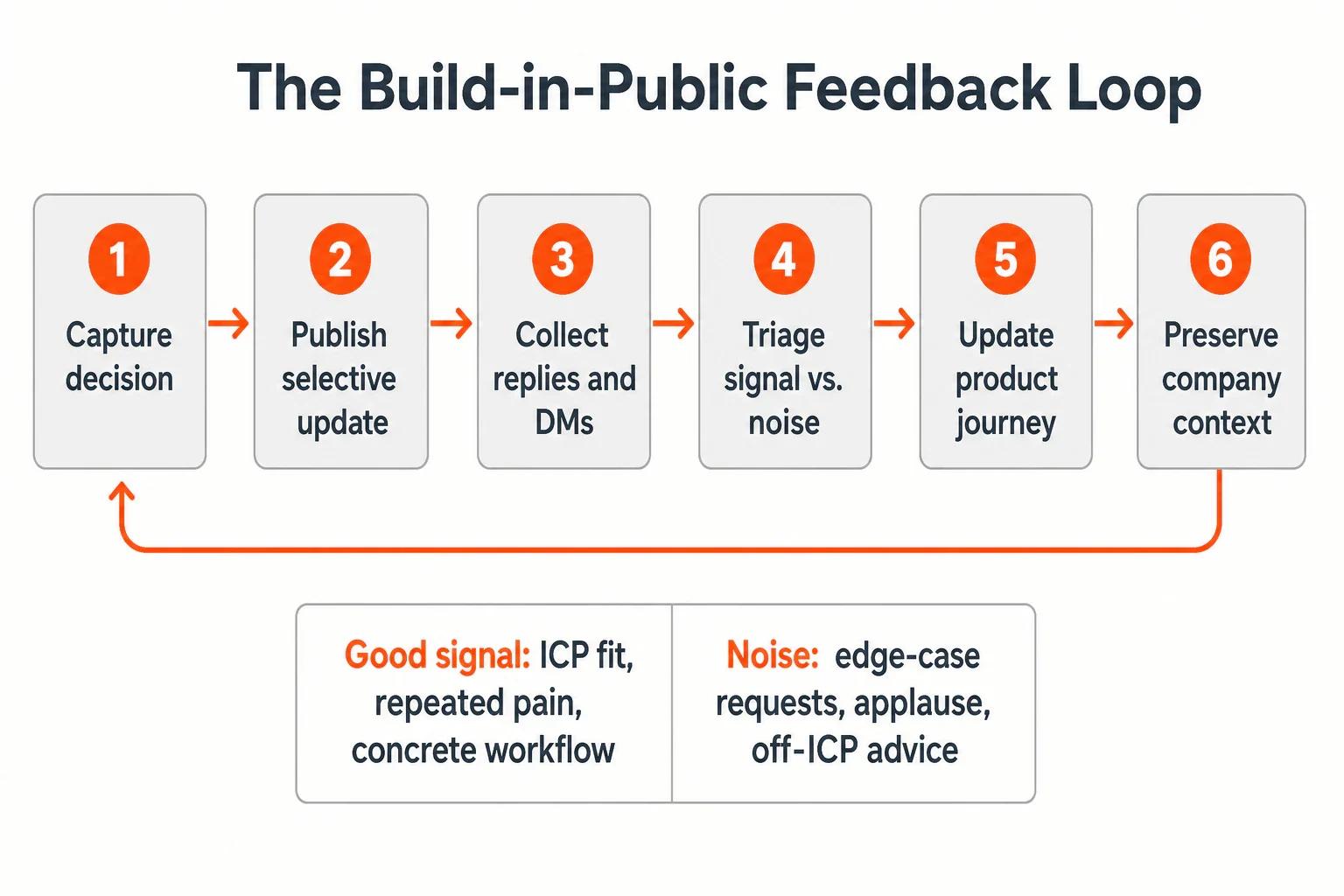
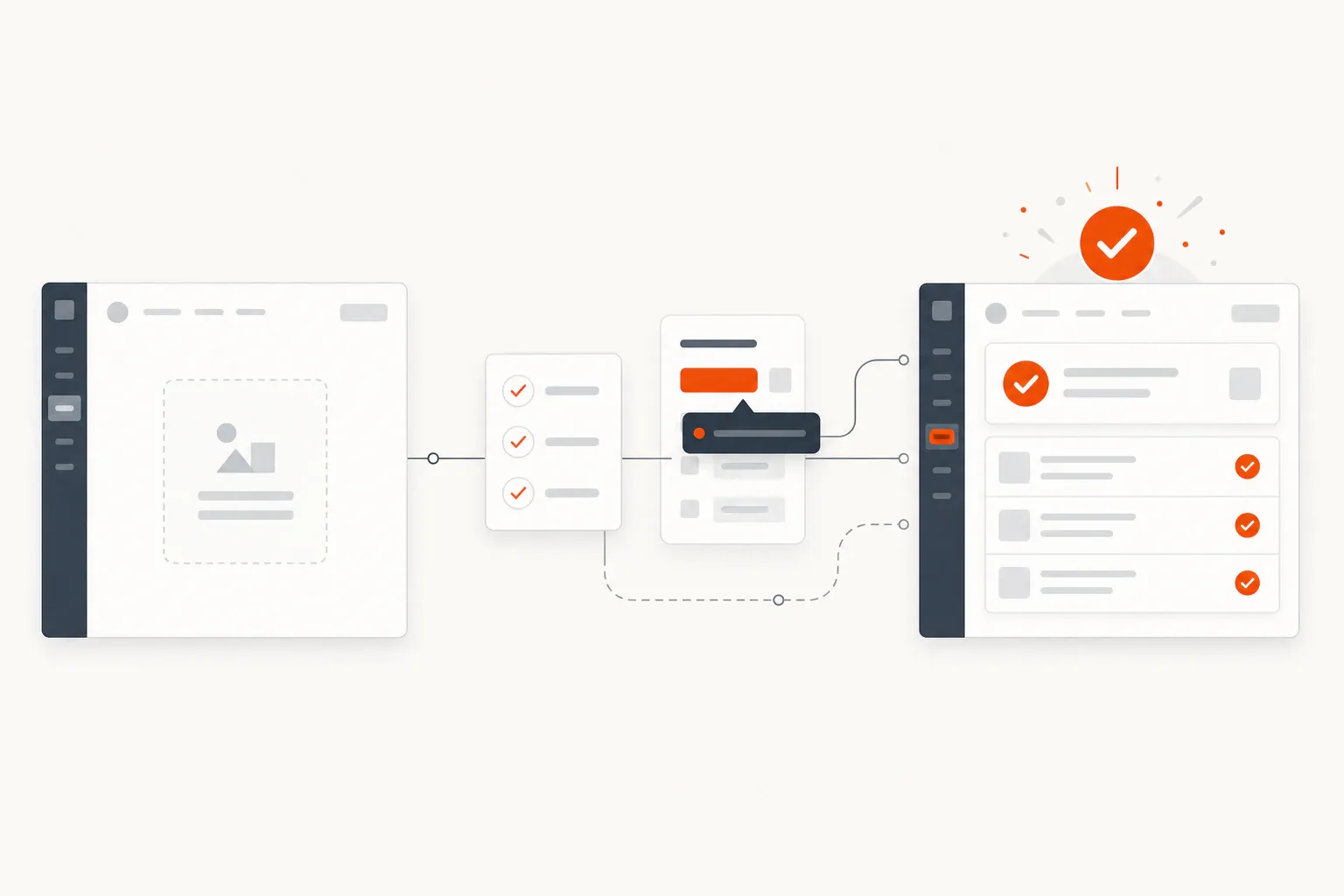
This is the triage loop in one view: publish a decision, collect responses, tag each reply, score the useful ones, make a product or messaging update, and preserve the reasoning as company context.
A practical tagging rule helps. Do not tag a reply as product signal unless it contains at least one of these: a concrete workflow, a clear blocker, a repeated objection, a buying or usage context, or language from someone who resembles the user you are building for.
For example, imagine a founder posts that they removed a setup step from onboarding. One reply says, “Nice!” Another says, “I would still stop here because I do not know what data to import first.” A third says, “Can you add dark mode?” The first is encouragement. The third may be a feature request, but it is probably not tied to the decision. The second is product signal: it identifies a specific point of confusion in the first-value path. That reply can become a product journey note: add an import-choice explanation before the empty state, then watch whether new users reach the next step with fewer questions.
Step 5: Feed the best signals back into the product journey
Once you have sorted the replies, decide what should actually change. Early-stage teams should look for repeated patterns, not isolated requests. One loud comment can point to an insight, but it should not automatically rewrite the roadmap.
Score useful feedback with five questions:
- Source fit: does the person match the user or buyer we are building for?
- Frequency: have we heard this pattern before in replies, demos, support questions, onboarding, or sales conversations?
- Severity: is this blocking adoption, activation, trust, or comprehension?
- Effort: can we test a small version before committing deeply?
- Stage fit: does this matter now, or is it a later-stage optimization?
Turn the score into a decision threshold. If a reply has strong source fit and high severity, write it down even if it appears once. If the same objection appears across several ICP-fit replies, turn it into a product or messaging test. If a request has weak source fit, high effort, and no repeated pattern, park it instead of letting it hijack the roadmap.
From there, turn the signal into a concrete operating change. That might mean rewriting onboarding copy, changing the first-value path, removing a confusing step, adding a demo explanation, updating a landing page section, adjusting a research question, or changing the next public update.
Use a simple decision record: signal observed → source fit → evidence → decision → owner → next review date. That format keeps the team honest. It separates “someone said this online” from “we saw a pattern from the right people and made a bounded product decision.”
The important part is to close the loop. If public feedback lives only in a notification feed, it decays. If it becomes product journey context, it compounds.
A weekly build-in-public signal review for a tiny team
You do not need a daily posting machine to build in public well. For a solo founder or 2–3 person team, one or two decision-level updates per week can be more useful than daily low-context posts.
A realistic weekly cadence:
- Monday: choose one real decision worth documenting.
- Tuesday or Wednesday: publish one selective, decision-level update with a specific question.
- Thursday: review replies, DMs, saves, and conversations. Sort them into product signal, messaging signal, audience signal, partnership signal, content fuel, and noise.
- Friday: update the product journey, message source of truth, or next experiment based on the strongest pattern.
Use this Friday checklist before the week disappears:
- What did we learn?
- Who said it?
- Does that person match our ICP?
- Is this a one-off request or a repeated pattern?
- What product journey, message, or research question should change?
- What are we deliberately not changing yet?
- Where will this context live so we can reuse it later?
This cadence keeps build in public from becoming a second job. The content comes from decisions you already had to make, and the review turns replies into operating input.
What to measure when the goal is learning, not just reach
Likes and follower growth can tell you whether a post traveled. They do not prove the product got sharper. If the goal is learning, measure the quality of signal coming back.
Useful learning metrics include:
- Replies from people who match the intended user or buyer.
- DMs that describe a specific workflow or pain.
- Repeated objections that show where the product or message is unclear.
- Demo requests tied to a specific decision or use case.
- Onboarding questions that reveal a missing step.
- Changes made because of public feedback.
- Customer language worth reusing in posts, landing pages, demos, or product journeys.
Save the language people use. A phrase from an ICP reader is often more valuable than a clever headline you wrote yourself. Over time, those phrases become reusable company memory: sharper hooks, clearer onboarding copy, better sales explanations, and more grounded founder-led content.
Build-in-public boundaries: what not to turn into content
Selective transparency is the safer default for most founders. Share your thinking, trade-offs, lessons, and non-sensitive trends. Protect anything that belongs to or affects someone else.
Keep these categories private unless you have a clear reason and explicit permission:
- Customer names, usage patterns, results, screenshots, or private conversations.
- Security vulnerabilities before they are resolved.
- Detailed unit economics, customer concentration, retention cohorts, or channel-level CAC.
- Fundraising terms, investor negotiations, acquisition conversations, or partnership terms.
- Internal team conflict, compensation details, legal issues, and HR matters.
- Roadmap specifics that create unnecessary competitive or customer risk.
Several current build-in-public guides make this same distinction. BuildInPublic.so frames the modern practice as selective transparency, with a default-to-private stance for customer data, security issues, legal matters, and anything that affects others (BuildInPublic.so). The Bootstrapped Founder also warns that exact numbers, feature specifics, and system architecture can create avoidable risk as a company becomes more visible (The Bootstrapped Founder).
Safer rewrites are usually easy:
- Replace a customer name with an anonymized pattern.
- Replace exact sensitive revenue detail with a directional trend.
- Replace a full roadmap with the decision behind the next experiment.
- Replace a private screenshot with a written lesson.
- Replace “here is our playbook” with “here is the trade-off we are navigating.”
Templates: three posts that create useful feedback
Use templates as scaffolding, not scripts. The point is to make the decision clear enough that the right people can respond with useful context.
Product decision post
We chose [X] over [Y] for [specific audience/workflow].
The trade-off: [what we gave up].
The reason: [evidence, constraint, or pattern].
Now we are watching [behavior or signal].
If you have handled [similar workflow], where would this break?
Onboarding experiment post
Users were getting stuck at [step] before reaching [first value moment].
We changed [specific part of the journey] so the next step is [clearer/faster/more guided].
The risk is [what might get worse].
If you were new to this product, which part would still feel unclear?
Messaging test post
We used to describe this as [old message].
Now we are testing [new message] because people kept misunderstanding [problem/category/outcome].
Which version makes the problem clearer, and what word feels off?
The build-in-public loop should make the product sharper
The useful question is not “Did this post perform?” It is “What did this post teach us that can improve the product, journey, or message?”
If the answer is nothing week after week, the system needs adjustment. Ask a more specific question. Tag replies faster. Separate ICP-fit feedback from general encouragement. Stop treating applause as evidence. Preserve the best signal where the team can reuse it.
Build in public works best when it turns public visibility into private clarity: sharper product decisions, stronger founder-led content, better onboarding, and company context that compounds instead of disappearing into the feed.
Conclusion
Pick one public update this week and treat the replies like operating input, not social validation. Tag what comes back, score the strongest signal, choose one product journey or messaging update, and save the reasoning. That is when build in public stops being a content obligation and starts becoming a product-learning system.
Related articles
Application Onboarding Process: Definition, Steps, and When to Use It
A practical seven-step application onboarding process for moving new users from signup to first meaningful value without unnecessary setup or generic tours.
In-App Analytics for Onboarding: Definition, Metrics, and When to Use It
In-app analytics for onboarding turns events, funnels, segments, and user feedback into decisions about the path from signup to first value.
In-App Guidance for Onboarding: Definition, Examples, and When to Use It
In-app guidance helps users complete meaningful tasks inside a product. This guide explains the main patterns and how to match each one to an onboarding blocker.