FounderHQJul 5, 20269 min read
Build in Public as a Founder Decision Log, Not a Performance Habit
Build in public works best when it starts from real product decisions, not a blank content calendar. Here is a lightweight decision-log system founders can use to publish useful...

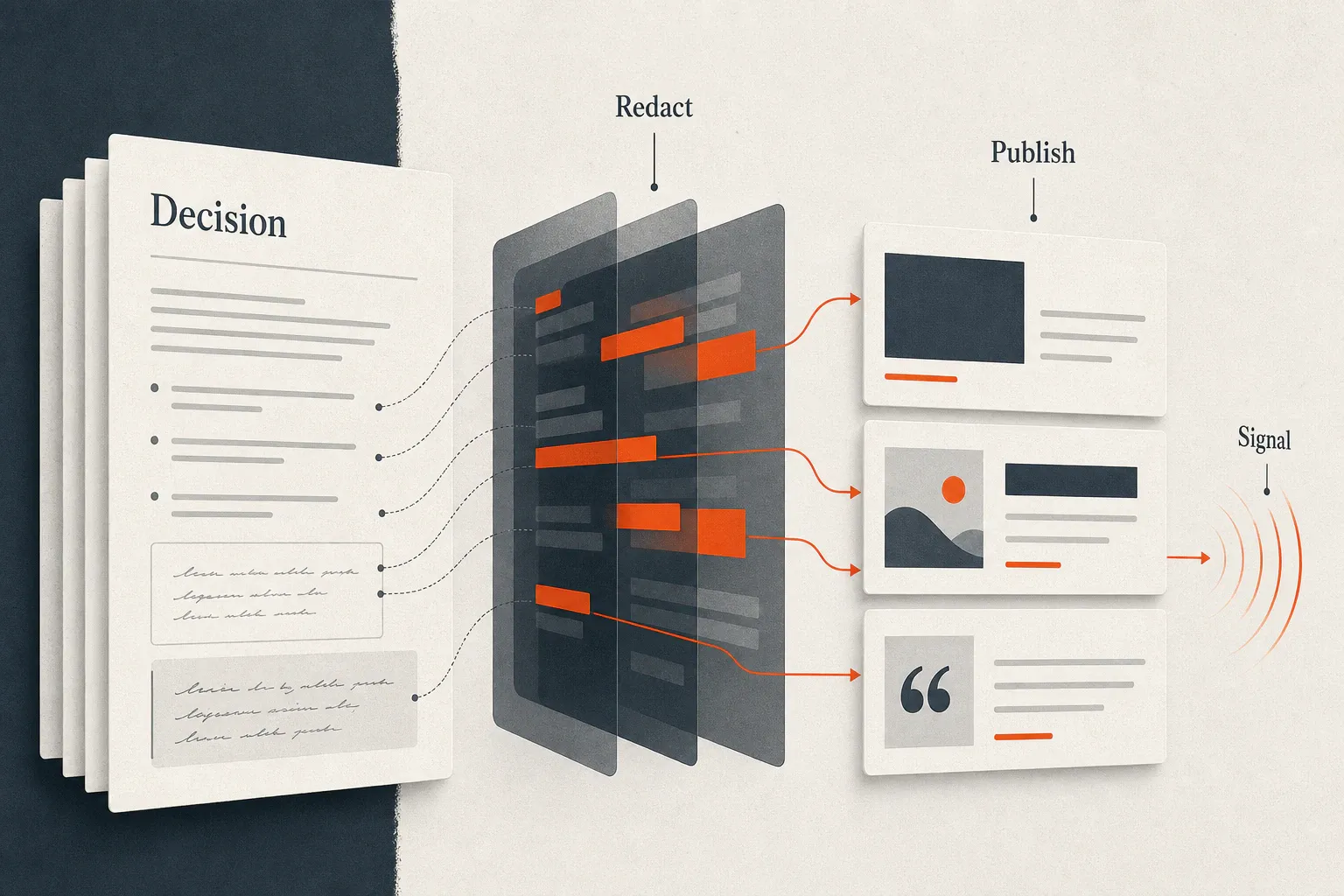
Most build-in-public advice makes the habit sound like a posting problem: share more, ship more, show up every day. For early-stage founders, the harder problem is usually upstream. What is actually worth sharing? Which details are safe? How do you remember why a decision was made after the week has already moved on? The answer is not a louder content calendar. It is a private product decision log that turns real work into useful public updates without exposing everything.
What build in public actually means
Build in public means sharing selected parts of the startup-building process while the work is still happening. That can include product decisions, milestones, lessons, mistakes, experiments, customer feedback themes, and sometimes metrics. Mercury describes it as inviting people into how a company is built from the start, while still choosing what stays private.
The important word is selected. Building in public is a spectrum, not a requirement to publish every internal debate, metric, roadmap bet, or user conversation. Buffer’s long-running Open approach shows one end of the transparency spectrum, with public finances and salaries; most early-stage teams will operate with narrower boundaries.
Done well, building in public can help founders create early distribution, invite feedback, build trust, and make the company feel more human while the product is still evolving. Done carelessly, it can create copycat risk, expose customer information, confuse investors, or consume the very founder time that should be going into product work.
The real bottleneck is the source system, not the post
A weak build-in-public post usually has one of two problems. Either it is too vague — “big week, lots learned” — or it is too exposed — sharing raw details that should have stayed inside the company. Both problems happen when the founder starts from the post box instead of from the operating context.
A decision log fixes that. It gives every public update a private source of truth: what changed, why it changed, what options were considered, what constraint shaped the decision, what evidence mattered, and what signal came back afterward.
The log does not exist so every entry becomes content. Most entries should remain private. Its job is to preserve the reasoning behind product work so the founder can later decide what is useful, safe, and worth publishing.
The decision-log principle: capture before you publish
Use a simple rule: every build-in-public update should trace back to a captured decision, experiment, customer signal, product change, or lesson learned. If there is no source entry, the post is probably commentary rather than operating context.
A lightweight decision-log entry can include:
- Date: when the decision or signal happened
- Product area: onboarding, activation, pricing, positioning, support, growth, or another area
- Decision made: what changed or what the team chose
- Options considered: what alternatives were on the table
- Constraint: time, team capacity, customer confusion, technical debt, cash, positioning, or learning speed
- Evidence used: customer conversation themes, product usage patterns, support requests, sales objections, or founder judgment
- What changed: the actual product, message, journey, or operating choice
- Safe to share: the public lesson, trade-off, or artifact
- Must stay private: customer data, exact economics, security details, internal disagreement, unreleased strategy, or sensitive roadmap detail
- Follow-up signal: replies, DMs, user behavior, objections, or next test
Here is the operating loop in visual form: capture the decision, redact it, publish one useful lesson, triage the response, and preserve the resulting signal back into company context.
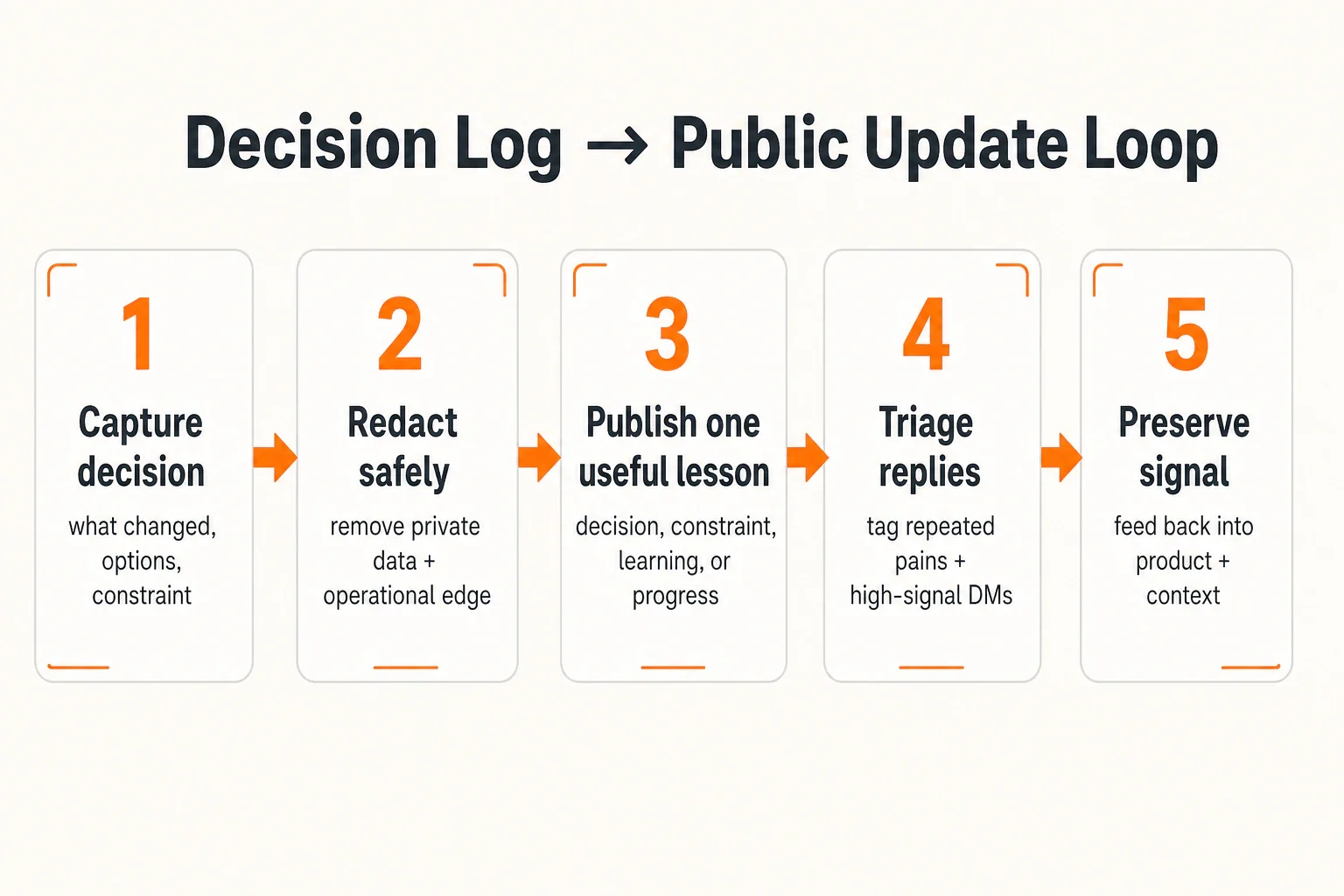
What to share from a decision log
The best decision-log posts are specific enough to teach but edited enough to protect the company. Four post types are especially useful for early-stage founders.
1. Decision posts
Decision posts explain why the team chose one path over another. They work because they show judgment, not just activity. A simple template:
“Last week we chose [decision] over [alternative]. The deciding constraint was [constraint]. We cared less about [secondary priority] and more about [primary priority] because [reason]. The next thing we are watching is [next signal].”
2. Constraint posts
Constraint posts show the trade-off behind a product or go-to-market choice. For example, a founder might explain why the team simplified an onboarding path, delayed a feature, or narrowed a launch audience. The point is not to dramatize scarcity. It is to show how real constraints shape good decisions.
3. Learning posts
Learning posts summarize what changed after a customer conversation, support thread, failed launch, or confusing demo. Bubble’s guide emphasizes that sharing early ideas and inviting feedback can surface blind spots before they become expensive mistakes. A learning post turns that feedback into a clear takeaway.
4. Progress posts
Progress posts share a visible ship, demo, milestone, or before-and-after improvement. The key is context. “We shipped X” is weaker than “We shipped X because users were getting stuck at Y, and the next test is whether Z becomes clearer.”
What not to share: the redaction layer
Selective transparency is the default. Value Add VC argues that founders can share the journey, failures, and frameworks while protecting the operational edge. The Bootstrapped Founder makes a similar point: make the journey interesting to follow without making the business easy to clone.
Before publishing, remove:
- Customer names, screenshots, or identifying details unless you have explicit permission
- Private user data, even if it feels anonymized
- Security-sensitive architecture or operational vulnerabilities
- Exact acquisition economics, channel-level economics, or retention details that reveal your playbook
- Internal team disagreements or performance issues
- Unreleased strategic bets that would be costly to expose early
- Anything that could embarrass, expose, or surprise a user
The practical test is simple: share the reasoning, lesson, and constraint; hold back the recipe when the recipe is the moat.
How to turn one logged decision into three useful assets
A decision log reduces blank-page friction because the raw material already exists. You are not inventing content; you are editing real operating context.
One private entry can become three assets:
- A short social post: the sharp decision, constraint, or lesson in plain language.
- A deeper newsletter or blog paragraph: the broader narrative for people already following the company.
- An internal narrative note: the updated product, positioning, or customer-context insight the team should remember later.
Do not copy and paste the same update everywhere. Adapt the idea to the surface. A short-form social post can carry the decision. LinkedIn can carry the lesson and founder context. A newsletter or blog can preserve the fuller story. The source stays the same; the shape changes.
How to use replies and DMs without letting the audience run the product
Building in public creates feedback, but public feedback is not a roadmap vote. A loud reply from a non-customer should not outweigh a repeated pain from the people you are actually building for.
Use a simple triage model:
- Ignore: drive-by opinions with no context, no use case, and no clear relationship to your ideal customer.
- Tag: repeated pains, objections, confusing language, or feature requests that show up more than once.
- Invite: high-signal commenters into a real conversation when they match the user profile you care about.
- Map: useful replies back to product journeys, onboarding friction, positioning, or content ideas.
- Preserve: save the signal in your company context so it can inform future decisions instead of disappearing into a feed.
Dench’s reflection on building in public is a useful reminder that public attention is not automatically transformative and that writing takes real time. Treat replies as one signal source, then compare them against actual customer conversations, usage patterns, and strategy.
A weekly 30-minute decision-log workflow
For a tiny team, one decision-level update per week is usually more credible and sustainable than daily low-context posting.
Try this 30-minute loop on Friday afternoon or Monday morning:
- Review the week: scan product work, customer conversations, support notes, launches, and founder decisions.
- Pick two entries: choose one decision that may become a public update and one that should remain private but still be preserved.
- Add context: write the options considered, constraint, evidence, and next signal.
- Run redaction: remove customer details, sensitive strategy, exact economics, and anything that creates unnecessary exposure.
- Publish one useful update: share the lesson, trade-off, progress, or question.
- Capture the response: tag high-signal replies, objections, and DMs back into the log.
The goal is not to become a full-time creator. It is to make your real operating cadence visible in a way that helps the right people understand how you think.
Where FounderHQ fits in the workflow
FounderHQ helps early-stage product teams build product journeys, compose founder-led content, and keep company context in one focused operating system. That makes it a natural place to keep the source context close to the public output: product decisions, audience signals, drafts, and journey notes all living against the same company memory.
That matters because build in public is not just a content habit. It is a context habit. When the reasoning behind a product journey, the founder’s narrative, and the audience response stay connected, the next update starts from accumulated learning instead of a blank page.
For teams trying to reduce tool sprawl, the useful question is not “Where should we post?” It is “Where do we preserve the thinking that makes the next post, product decision, or launch message sharper?”
Build-in-public FAQ
What does build in public mean?
Build in public means sharing selected parts of the startup-building process as it happens. That can include decisions, lessons, milestones, failures, product changes, customer feedback themes, and sometimes metrics.
Is building in public still worth it for startups?
It can be, especially when the team uses it to build trust, learn faster, and create early distribution. It is less useful when it becomes performative posting or when it exposes sensitive information without a clear benefit.
What should founders share when building in public?
Founders should share useful decisions, constraints, lessons, progress, and trade-offs. The strongest updates help the audience learn how the founder thinks, not just what the founder shipped.
What should founders avoid sharing publicly?
Avoid customer-identifying details, private user data, sensitive security information, internal team issues, unreleased strategic bets, and exact operational economics that would expose the company’s edge.
How often should a founder build in public?
Start with one decision-level update per week. A sustainable cadence beats daily low-context posts, especially for solo founders and small teams.
Do you need to share revenue to build in public?
No. Revenue can be one form of transparency, but it is not required. Many founders can create more useful content by sharing decisions, lessons, constraints, and progress without publishing financial details.
Can B2B founders build in public without exposing customer data?
Yes. B2B founders can share anonymized patterns, lessons, product decisions, and constraints while keeping customer names, screenshots, contracts, and sensitive workflow details private.
Conclusion
Build in public works best when it is grounded in real work and bounded by good judgment. A founder decision log gives the habit a source system: capture the decision, redact what should stay private, publish one useful lesson, and preserve the signal that comes back. That is how public building becomes more than visibility. It becomes a repeatable way to turn product work into trust.
Related articles
Application Onboarding Process: Definition, Steps, and When to Use It
A practical seven-step application onboarding process for moving new users from signup to first meaningful value without unnecessary setup or generic tours.
In-App Analytics for Onboarding: Definition, Metrics, and When to Use It
In-app analytics for onboarding turns events, funnels, segments, and user feedback into decisions about the path from signup to first value.
In-App Guidance for Onboarding: Definition, Examples, and When to Use It
In-app guidance helps users complete meaningful tasks inside a product. This guide explains the main patterns and how to match each one to an onboarding blocker.