FounderHQJul 5, 202612 min read
Build in Public Without Leaking Your Strategy: A Practical Sharing Map for Founders
Build in public works best as selective transparency, not an open company diary. Use this four-zone sharing map to publish useful founder-led content without exposing customer d...

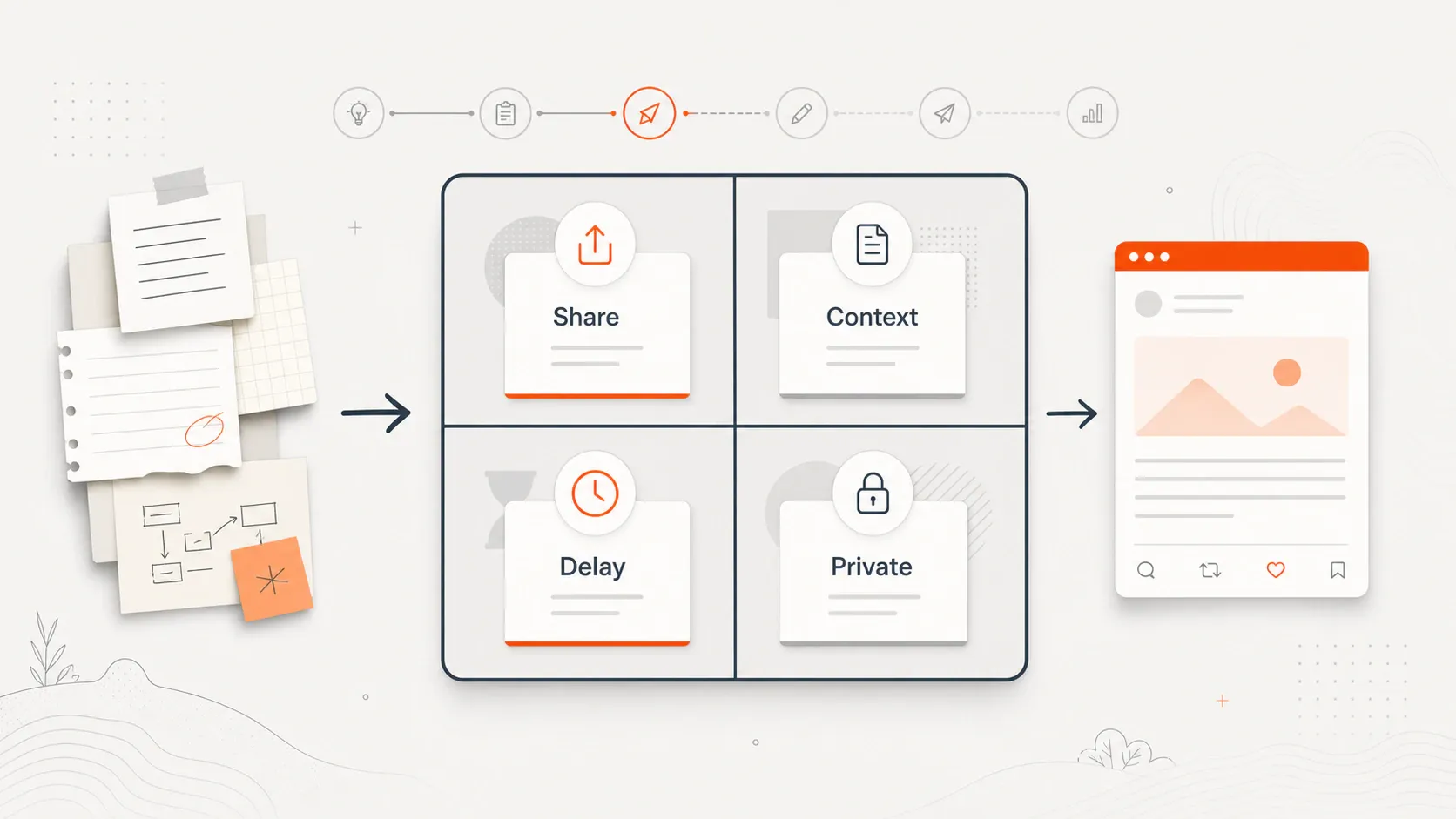
Build in public can help early-stage founders earn trust, attract feedback, and make the company feel more human before the product is fully mature. It can also create avoidable risk if every roadmap idea, customer detail, metric, or internal debate becomes public content. The better approach is selective transparency: share the parts of the building process that help your audience learn while protecting customers, strategy, and timing.
What build in public means now
Build in public means sharing parts of the company-building process while the work is happening: product decisions, milestones, experiments, customer learning, mistakes, and progress. It is not the same as publishing every internal note or turning the company into a live dashboard.
Mercury describes building in public as a spectrum, from light process narration to more transparent sharing of metrics, roadmap decisions, or lessons learned. That framing matters because it turns build in public from an identity into a set of choices: what to share, when to share it, and how much detail to reveal. Mercury also notes the upside of public progress: distribution before launch, earlier feedback, and trust from showing the work.
For founders, the useful question is not “Should we build in public?” It is “Which part of our operating system can we safely make visible?” A founder can share product lessons without exposing the exact roadmap, share customer objections without naming customers, and share a pricing trade-off without publishing the full pricing model.
Why founders build in public
Founders build in public because early-stage companies need trust before they have a long track record. Public learning gives people a reason to follow the journey before launch. It also gives the founder a way to explain the market, show judgment, and invite better conversations.
The strongest benefits are practical: - Early distribution: people can discover the product before the launch moment. - Sharper learning: public articulation can surface objections, edge cases, and blind spots. - Founder credibility: readers can see how the founder thinks, not just what the product claims. - Recruiting and partnership signal: potential teammates and partners can understand the company’s standards and direction. - Reusable narrative: good public updates become raw material for posts, articles, onboarding copy, and sales conversations.
This is why build in public often overlaps with founder-led content. HubSpot defines founder-led content as content created by or directly shaped by the founder, and says it can make a company feel more human by showing the founder’s thinking, expertise, and vision. HubSpot also warns against turning the founder into a full-time content creator; the goal is a repeatable system that supports the company.
That is also where FounderHQ’s product direction fits naturally: FounderHQ helps early-stage product teams build product journeys, compose founder-led content, and keep company context in one focused operating system. For build in public, the operating habit matters more than any single post.
The risk: public does not mean unfiltered
The same openness that makes build in public useful can create problems when it becomes unfiltered. Common failure modes include vague hype, leaking roadmap timing, exposing customer details, turning revenue into performance, or building a founder persona that is impossible to sustain.
Mercury warns that sharing too much too early can expose strategic thinking to competitors, especially in crowded markets. The Bootstrapped Founder makes a similar argument from a bootstrapped SaaS perspective: as a company grows, public metrics, specific feature plans, and tactical details can become easier for competitors to copy or exploit. The Bootstrapped Founder recommends being careful with numbers and specifics, especially when the upside of sharing is no longer worth the exposure.
The practical rule: decide your sharing boundary before you start posting consistently. If you decide in the moment, the boundary will move based on excitement, frustration, or the pressure to keep the audience engaged.
The build-in-public sharing map
Use a four-zone map before anything becomes a post. The goal is to sort raw company context into what can be shared now, what needs explanation, what should wait, and what should remain private. The map below is the simplest version to keep next to your draft.
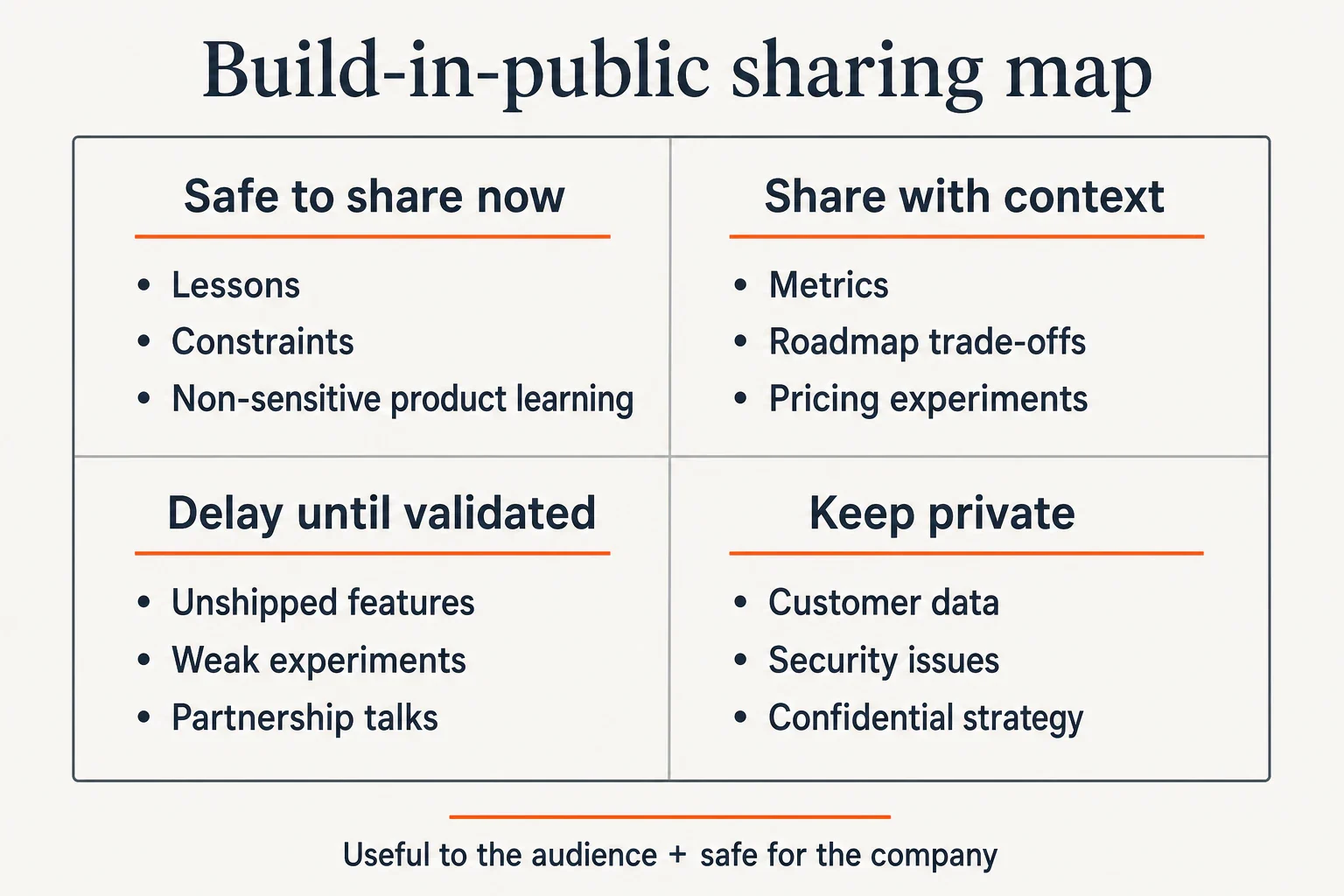
Zone 1: Safe to share now
These are updates that help the audience learn without exposing sensitive leverage. Examples include a customer problem you are exploring, a non-sensitive product lesson, a before-and-after workflow observation, a broad constraint, a lesson from a failed experiment, or a public launch learning.
Safe updates usually teach a pattern rather than reveal a playbook. For example: “We removed a signup step after watching early users hesitate at account creation. The lesson was to ask for commitment after first value.” That is specific enough to be useful, but it does not publish the full funnel, user list, or next experiment.
Zone 2: Share with context
Some updates are useful only when wrapped in explanation. Metrics, roadmap decisions, pricing experiments, hiring lessons, and customer objections can all become strong founder-led content, but numbers without context often become vanity updates or misleading signals.
A metric with context sounds like: “Trial users kept asking whether the product was for solo founders or small teams, so we rewrote the onboarding copy around team size before changing the product.” The lesson is the positioning ambiguity, not a raw conversion number detached from the decision.
Zone 3: Delay until validated
Delay anything that could give away timing, strategy, or an unproven direction. This includes unannounced positioning shifts, features that are not shipped, channel tests a competitor could copy quickly, partnership discussions, or experiments with weak data.
Delayed does not mean never. It means the learning may be more valuable after the risk window closes. Once the feature is live, the partnership is announced, or the experiment has enough evidence, the founder can publish the lesson without handing out the playbook in advance.
Zone 4: Keep private
Some information should not become public content. Keep customer-identifying data, security issues, unreleased strategic plans, exact acquisition economics by sensitive channel, confidential investor or partner details, and internal team conflict private. Team compensation is also private unless the company has intentionally adopted a transparent operating model, as Buffer has done publicly since 2013 with finances, salaries, and other metrics. Buffer is a notable transparency example, not a default template for every startup.
Choose one operating layer to share
Do not build in public about everything at once. A small product team should pick one operating layer that is useful to the audience, close enough to real work to stay authentic, and safe enough to sustain.
Good public layers include: - Product decisions: why you chose one path over another. - Customer learning: objections, confusion, repeated questions, and jobs-to-be-done patterns. - Founder lessons: constraints, mistakes, and operating changes. - Growth experiments: high-level channel lessons without exposing exact tactics too early. - Launch process: how you prepared, what surprised you, and what you would repeat. - Onboarding improvements: friction observed and the principle behind the fix. - Market education: what buyers misunderstand and how you explain it.
The layer should match both your audience and your own capacity. If your buyers are operators on LinkedIn, a thoughtful weekly product-learning post may be more useful than a daily stream of short build notes. If your audience is technical and active on X, concise decision updates may be easier to sustain.
What to post: useful formats that do not leak too much
The safest build-in-public posts teach a decision, a constraint, or a lesson. They are specific enough to be useful but not so specific that they reveal customer identities, exact funnel data, or unshipped strategy.
Format | Safe version | Unsafe version |
|---|---|---|
Problem observed | “Three early users hesitated at the same onboarding step, so we are simplifying the first action.” | “Here is the full session recording and account list from our beta users.” |
Trade-off considered | “We chose a narrower onboarding path because first value mattered more than showing every feature.” | “Here is our entire Q3 roadmap and the features we cut.” |
Constraint faced | “A tiny team can’t support five channels, so we chose one primary channel and one archive.” | “Here is the exact channel that is converting cheapest for us this month.” |
Mistake learned | “We launched copy that sounded clear internally but confused first-time users.” | “This named customer churned because we mishandled their setup.” |
Feature shipped | “We shipped a shorter waitlist flow after seeing people abandon long forms.” | “Here is the exact feature we are launching next week to beat a competitor.” |
Metric with context | “The direction improved after we changed the promise, but the lesson was about clarity, not the number.” | “Here is our full acquisition dashboard by source and conversion step.” |
Audience question | “Which onboarding moment made you trust a new product faster?” | “Should we build this unannounced feature before our competitor does?” |
Monthly recap | “Three things we learned about first-value moments this month.” | “Every internal problem, conflict, metric, and roadmap decision from this month.” |
Specificity is still important. Vague updates like “building is hard” or “big things coming” do not help the reader. A better update names the constraint, the decision, and the lesson while redacting details that would create risk.
Where to build in public
Build in public can happen on X/Twitter, LinkedIn, niche communities, newsletters, blogs, podcasts, or video. The right channel is not the one with the loudest build-in-public culture; it is the one where your audience already pays attention and where you can show up consistently.
Failory recommends thinking about both channel-market fit and channel-founder fit: choose a channel where potential customers already are, and choose a format the founder is comfortable creating. Failory lists Twitter/X, LinkedIn, newsletters, and other channels as common places founders share the journey.
For many B2B founders, a practical setup is one primary social channel plus one owned archive. For example, publish short decision notes on LinkedIn, then turn the best monthly lessons into a blog or newsletter. That keeps the public conversation active while preserving the company’s best thinking in a durable place.
A 30-minute weekly workflow for selective transparency
You do not need a heavy content operation to build in public safely. You need a weekly selection habit.
Use this 30-minute workflow: 1. Capture raw work for 10 minutes. Pull from product notes, customer calls, support conversations, onboarding friction, launch work, and founder decisions. 2. Sort for 5 minutes. Put each item into the four zones: share now, share with context, delay, or keep private. 3. Redact for 5 minutes. Remove names, exact metrics, screenshots, private roadmap timing, and anything that would reveal sensitive tactics. 4. Draft for 7 minutes. Write one post around the lesson, not the drama. 5. Save the internal learning for 3 minutes. Keep the unredacted lesson in your internal context so the company learns even if the public post is shortened.
A useful review prompt is: What did we learn this week that would help the right audience think better without exposing something we should protect? That question keeps the focus on usefulness and safety, not on performing transparency.
Examples: turning real work into safe public updates
Here are five hypothetical examples an early-stage product team could use without inventing results or exposing sensitive details.
Example 1: Onboarding change
Raw internal note: Several early users hesitated when asked to create an account before seeing value. Remove: session details, user names, exact conversion data. Public version: “We moved account creation later in onboarding after seeing users hesitate before they understood the value. The lesson: ask for commitment after the first useful moment, not before.” Why it is safe: it shares the principle without exposing the full funnel.
Example 2: Waitlist learning
Raw internal note: Waitlist signups responded better when the page named the workflow pain instead of the feature set. Remove: exact signup numbers and acquisition source. Public version: “Our waitlist copy got clearer when we stopped describing the product as a feature bundle and started naming the weekly workflow it improves.” Why it is safe: it teaches positioning without revealing performance data.
Example 3: Pricing confusion
Raw internal note: Prospects asked whether the product was priced for solo founders or small teams. Remove: prospect names, proposed pricing, and private packaging details. Public version: “Pricing confusion is often positioning confusion. If buyers cannot tell whether the product is for a solo founder or a small team, the pricing page is doing too much work.” Why it is safe: it shares a lesson without publishing the pricing model.
Example 4: Feature prioritization
Raw internal note: The team chose a smaller onboarding improvement over a larger dashboard feature because first value was the bottleneck. Remove: roadmap timing and unshipped feature details. Public version: “We chose a smaller onboarding improvement over a larger feature because the current constraint is first value. Early teams should fix the moment of activation before expanding the surface area.” Why it is safe: it explains the trade-off, not the roadmap.
Example 5: Launch lesson
Raw internal note: The launch produced questions from the wrong audience because the announcement was too broad. Remove: channel-specific performance and internal debate. Public version: “A broad launch can create broad confusion. Next time, we would write the launch around one specific buyer, one painful workflow, and one first action.” Why it is safe: it turns a launch miss into a reusable lesson.
When not to build in public
Building in private is a valid choice. Build in public is a tool, not a moral obligation. A founder should stay more private when the product is regulated, customer data is sensitive, the distribution tactic is easy to copy, a security issue is unresolved, enterprise procurement details are confidential, team conflict is involved, or fundraising and acquisition conversations are active.
You can still share later. Some of the best posts are retrospectives written after the risk window closes: what you misunderstood, what changed, what principle you would use next time, and what another founder can learn from it.
If you are unsure, apply this test: Would this post help the right audience even if we removed the exact numbers, names, screenshots, and timing? If yes, publish the lesson. If no, the post may be relying on exposure rather than insight.
Start with a simple sharing policy
Before you publish another build-in-public update, write a one-page sharing policy. It does not need legal language. It needs boundaries your team can actually use.
Use this template: - Audience: who should learn from these updates? - Public operating layer: what part of the company will we make visible? - Allowed topics: what is safe to share now? - Context topics: what can be shared only with explanation? - Delayed topics: what should wait until validated or shipped? - Private topics: what will not become public content? - Redaction rules: what must be removed before publishing? - Review cadence: when do we choose the week’s public lesson? - Owner: who decides when something is too sensitive?
For the first week, keep it small: choose one channel, pick one public layer, publish one useful post, save one internal learning, and update the sharing map based on what felt useful and safe. That is enough to start building in public without turning your company into an open diary.
Conclusion
The best build-in-public strategy is not radical disclosure. It is a disciplined habit of turning real company work into useful public learning. Share the lesson, protect the leverage, and keep the company’s private context intact. When founders treat transparency as an operating choice instead of a performance habit, build in public becomes safer, sharper, and easier to sustain.
Related articles
Application Onboarding Process: Definition, Steps, and When to Use It
A practical seven-step application onboarding process for moving new users from signup to first meaningful value without unnecessary setup or generic tours.
In-App Analytics for Onboarding: Definition, Metrics, and When to Use It
In-app analytics for onboarding turns events, funnels, segments, and user feedback into decisions about the path from signup to first value.
In-App Guidance for Onboarding: Definition, Examples, and When to Use It
In-app guidance helps users complete meaningful tasks inside a product. This guide explains the main patterns and how to match each one to an onboarding blocker.