FounderHQJul 4, 202611 min read
How to Grow LinkedIn Followers as a Founder: A Practical System for Attracting the Right Audience
A practical guide for early-stage founders who want to grow LinkedIn followers by earning the right audience, not chasing vanity metrics.

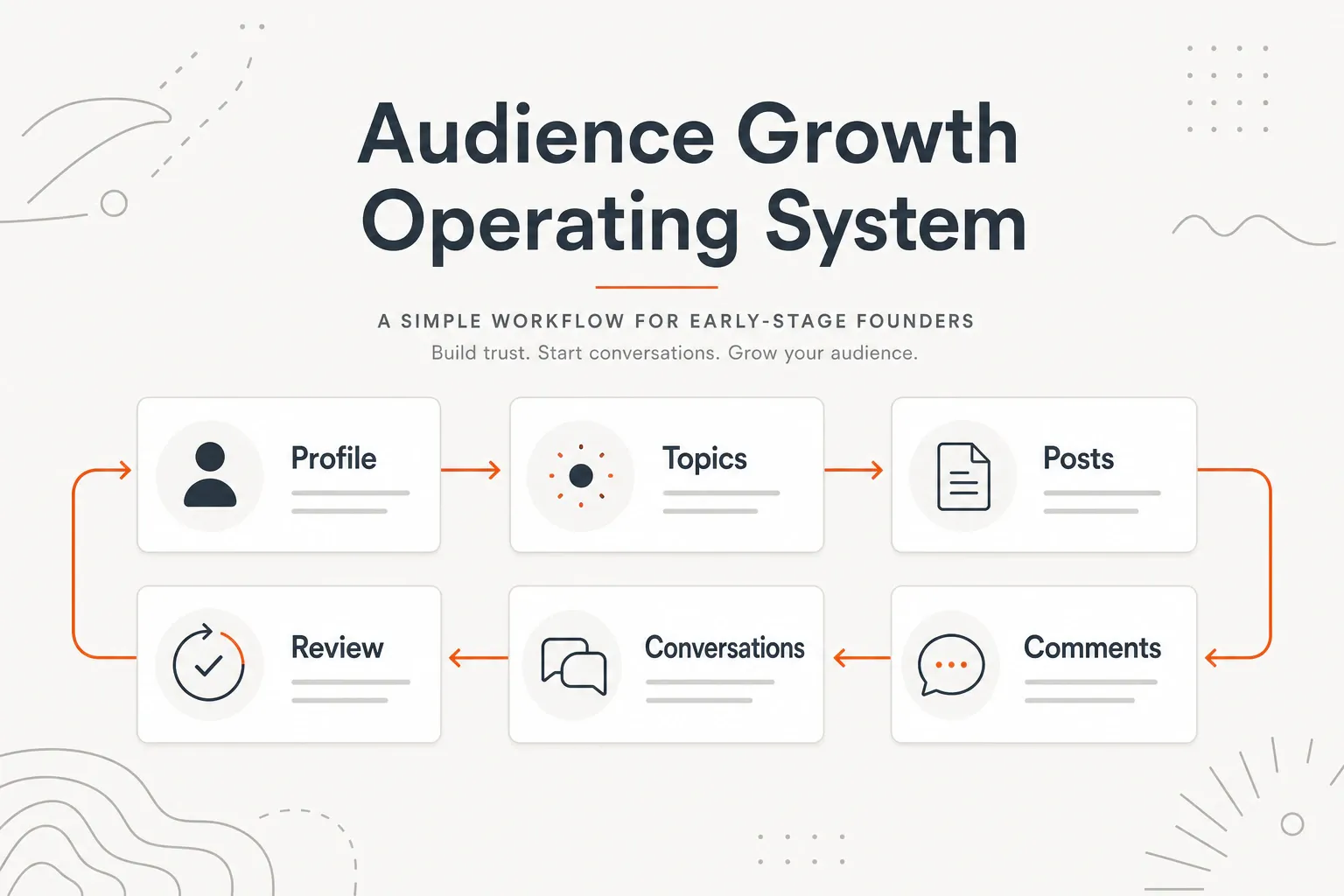
If you want to grow LinkedIn followers as a founder, the goal is not to become broadly popular. The goal is to become easy to understand, useful to the right market, and visible often enough that relevant buyers, peers, partners, candidates, and investors know why they should pay attention. That requires a LinkedIn-specific system: make the profile obvious, choose a narrow topic lane, publish from real founder work, comment where your audience already is, turn profile views and replies into conversations, and review whether new followers are the people you actually want seeing your posts.
Start with the right definition of LinkedIn follower growth
LinkedIn followers and LinkedIn connections are not the same thing. A connection is a mutual relationship. A follower can subscribe to your content without you accepting a connection request. For a founder, that distinction matters because follower growth is primarily about distribution and trust, while connections are about relationship access.
The better question is not “How do I get more followers?” It is “Which people should repeatedly see my product learning, market point of view, and founder judgment?” A small audience of relevant operators, buyers, and category peers is usually more valuable than a large audience that has no reason to remember what you build.
This is also why hacks age badly. LinkedIn has said its feed systems are designed to personalize content using signals such as profile information, skills, industry, geography, post text, author information, engagement behavior, and member engagement history. It has also said it is reducing generic content and engagement bait while taking action against comment automation and engagement pods. The practical takeaway: build signals of relevance and trust, not artificial activity.
Before posting more, make your profile worth following
Your LinkedIn profile is the landing page for every post, comment, profile view, and DM. If a relevant person clicks through and cannot quickly tell what you do, who you help, and why your perspective is worth following, more posting will only send more people to a weak conversion surface.
Start with the first three seconds. Your headline should say more than “Founder at [Company].” Use it to connect your role to a market, problem, or point of view. A simple structure works: I help [audience] solve [problem] with [approach/category]. If that feels too salesy, use a point-of-view headline: Building [product/category] for [audience] who believe [market belief].
Then audit the visible LinkedIn surfaces: - Headshot: clear, current, recognizable at small size in the feed and comment threads. - Banner: explain the company or category without clutter. - About section: say what you are building, who it is for, and what you tend to write about. - Featured links: point to the most useful proof, product page, waitlist, demo, article, or newsletter. - Company link: make it easy to inspect the product behind the founder. - Primary action: if your goal is audience growth, make following easy for people who do not need to connect.
LinkedIn’s own Page guidance supports the same principle for company surfaces: Pages with complete information get more weekly views, and companies that post at least weekly see higher engagement with their content. The lesson applies to founder profiles too: clarity comes before cadence.
Choose a narrow topic lane so LinkedIn and readers know why to follow
A founder can talk about many things. A follower needs a reason to expect something specific. Pick two or three connected topics that sit at the intersection of your product, your market, and your lived operating work.
For an early-stage product founder, useful lanes might be: - The customer problem you are learning about. - The product decisions you are making. - The market shift your company is built around. - The workflows your buyers are trying to improve. - The operating lessons you are earning while building.
The mistake is topic whiplash: fundraising one day, productivity the next, hiring the next, then a generic leadership quote. Some variety is healthy, but if every post teaches the audience a different reason to remember you, you become harder to follow. On LinkedIn, that also weakens the consistency between your headline, About section, post history, comments, and Featured links.
A simple test: if someone read your last ten posts without seeing your profile, could they guess what kind of company you are building and who you are trying to help? If not, narrow the lane.
Build a founder-led content mix that earns follows
Follower growth comes from repeated useful encounters. That does not mean every post needs to be a polished essay. It means your content should consistently help the right reader think more clearly about a problem they already care about.
Use a weekly mix, not random inspiration
A practical founder-led LinkedIn content strategy can be simple: 1 broad market insight, 2–3 tactical posts, 1 story or decision log, and occasional product or company proof. The mix keeps the account from becoming either too abstract or too promotional.
Replace generic “how to” with specific “how I”
Generic advice is easy to ignore because it sounds detached from consequence. Founder-led content is stronger when it comes from real work: a customer question, a trade-off, a product decision, a failed assumption, a pricing conversation, or a launch lesson. Instead of “How to improve onboarding,” write “What changed when we stopped treating onboarding as a tour and started treating it as a first-value path.”
A practical template: take one real customer objection, remove identifying details, then turn it into a post with four parts: what they asked, why the question matters, what your team changed or is testing, and what other founders should watch for. That keeps the post grounded in work without pretending a single anecdote is universal proof.
Match format to the idea
Text posts are useful for sharp opinions, lessons, and stories. Documents or carousels can teach a framework. Short videos can make a founder more recognizable. Polls can surface market language when used thoughtfully. Newsletters can compound a recurring point of view. Comments can work as standalone micro-posts when they add substance.
Do not over-optimize for rumored algorithm tricks. Optimize for clarity, specificity, and repeatability. If a post could have been written by any founder in any category, it is unlikely to make the right person follow you.
Use comments as distribution, not afterthoughts
Comments are one of the most underused ways to grow a LinkedIn audience because they let you show up where the right people already spend attention. A founder with a small audience can still become visible to customers, investors, operators, and category voices by leaving useful comments consistently.
Set aside 10–20 minutes per workday. Comment on posts from people your audience already reads: customers, adjacent founders, operators, investors, creators in your category, and thoughtful company leaders. The goal is not to “boost engagement.” The goal is to create repeated, relevant exposure in the feed, notification tabs, and profile hover cards of the people you want to recognize your name.
Use a higher bar than “Great post.” A useful comment should do at least one of four things: - Add a concrete example. - Offer a respectful disagreement. - Ask a clarifying question that moves the conversation forward. - Compress the idea into a mini-framework others can use.
Avoid engagement pods, automated comments, and fake conversation loops. LinkedIn has publicly said it is acting against comment automation, engagement pods, and unauthorized third-party tools that create inauthentic engagement. For founders, those tactics also damage the thing you are trying to build: trust.
Turn profile views and replies into conversations
Follower growth is more useful when it creates conversations. A post that generates a few thoughtful replies from people in your market may be more valuable than a post that earns a large number of passive likes from the wrong audience.
Once a week, review the people who viewed your profile, followed you, commented thoughtfully, or sent connection requests. Look for relevance before volume. Are they in your target market? Do they work at companies you can learn from? Are they peers who can sharpen your point of view? Are they candidates, partners, or investors worth knowing?
When there is clear context, send a short, manual, non-pushy note. For example: “Thanks for engaging with the post on onboarding. Curious what part of that problem you are seeing on your side?” Or: “Saw you viewed my profile after the post on founder-led content. Happy to compare notes if you are working through something similar.”
Keep this human. Do not turn profile views into a mass automation sequence. The advantage of founder-led LinkedIn is that the founder can notice context, ask better questions, and learn from the market directly.
Post on a cadence a busy founder can actually sustain
Consistency matters, but the right cadence is the one you can maintain during a real operating week. A founder who posts twice a week for six months will usually build more trust than a founder who posts daily for two weeks and disappears.
Choose one of three cadences: - Minimum viable cadence: 2 posts per week. Best if you are just starting or have heavy product/customer work. - Steady cadence: 3 posts per week. Best for most founders who want LinkedIn to become a serious channel. - Aggressive cadence: 5 posts per week. Best if you already have an idea capture system and can engage without sacrificing product work.
Fixed publishing days help more than perfect timing. Start with a schedule you can remember: Tuesday and Thursday for minimum viable, Monday/Wednesday/Friday for steady, or every weekday for aggressive. After you have enough posts to review in LinkedIn analytics, adjust based on audience response rather than guessing from one post.
A lightweight weekly workflow: - Monday: extract ideas from customer calls, product decisions, support questions, and market notes. - Tuesday: draft two or three posts. - Wednesday: publish and spend time in comments. - Thursday: rewrite the strongest idea into a second format or sharper angle. - Friday: review profile views, follower quality, comments, saves, shares, and DMs.
Measure follower quality, not just follower count
Follower count is visible, but it is not the full scoreboard. Founders need to know whether the right people are paying attention and whether LinkedIn is creating useful market signal.
Track a weekly scoreboard with a few practical fields: - Net new followers. - Profile views. - Followers who match your ideal customer profile. - Comments from target buyers or respected category voices. - Saves and shares on posts with durable value. - DMs or replies that create learning. - Meeting requests or warm introductions. - Topics that generated the most useful conversations.
Review monthly, not emotionally after every post. One post can underperform for reasons you cannot see. A month of posts will show clearer patterns: which topics create profile visits, which stories create replies, which tactical posts earn saves, and which product mentions create useful conversations.
A useful Friday review can be as simple as this: choose the post that created the best profile views or replies, copy the strongest audience question, and turn it into next week’s post, product note, or positioning update. That keeps LinkedIn from becoming a separate performance habit and makes it part of how the company learns.
This is where follower growth becomes a LinkedIn operating loop. The best replies, objections, and questions should not disappear into the feed. Save them as reusable company context: better hooks, sharper positioning, clearer product language, stronger articles, and better launch messages.
A 30-day LinkedIn follower growth plan for founders
Use the first month to build the system before you judge the channel. The goal is not to go viral in 30 days. The goal is to make your profile clearer, your topic lane more memorable, and your weekly loop easier to repeat.
Week 1: clarify the audience and profile
Define who should follow you: target buyers, users, partners, candidates, investors, or category peers. Rewrite your headline and About section for that audience. Update your banner, featured links, company link, and Follow settings. Build a list of 25–50 relevant people whose posts you will read and comment on.
Week 2: publish from real founder context
Publish 2–3 posts from actual work: a customer objection, a product decision, a market observation, or a lesson from a recent launch. Comment daily on target accounts. Reply to every thoughtful comment on your own posts.
Week 3: test repeatable formats
Choose one repeatable format and run it twice. Examples: a decision-log post, a tactical checklist, a customer-objection breakdown, a “what we changed” post, or a product-learning story. The goal is to find a format that is easy to produce from work you already do.
Week 4: review and tighten
Review follower quality, profile views, comments, DMs, and saved/shared posts. Identify which topics attracted the right people. Keep the formats that created useful conversations. Drop the formats that only created shallow engagement.
Where FounderHQ fits naturally
For early-stage teams, the hardest part of LinkedIn is rarely writing one post. It is preserving the company context that makes the next post sharper: customer language, product decisions, positioning changes, launch lessons, and the founder’s real point of view.
FounderHQ helps early-stage product teams build product journeys, compose founder-led content, and keep company context in one focused operating system. In a LinkedIn workflow, that means the raw material for posts does not have to live across scattered notes, call transcripts, draft docs, and memory.
A practical loop looks like this: capture product decisions and customer language, turn them into LinkedIn drafts, preserve what resonated, and reuse the strongest learning in articles, journeys, launch messaging, and follow-up. That does not guarantee follower growth, but it does make the work more consistent and less dependent on a blank page.
Conclusion
The most durable way to grow LinkedIn followers as a founder is to become repeatedly useful to a clearly defined audience. Make the profile obvious. Stay in a recognizable topic lane. Publish from real work. Comment where your market already gathers. Turn attention into conversations. Review follower quality every week. Do that long enough, and LinkedIn becomes less of a performance habit and more of a founder-led learning and distribution system.
Related articles
Application Onboarding Process: Definition, Steps, and When to Use It
A practical seven-step application onboarding process for moving new users from signup to first meaningful value without unnecessary setup or generic tours.
In-App Analytics for Onboarding: Definition, Metrics, and When to Use It
In-app analytics for onboarding turns events, funnels, segments, and user feedback into decisions about the path from signup to first value.
In-App Guidance for Onboarding: Definition, Examples, and When to Use It
In-app guidance helps users complete meaningful tasks inside a product. This guide explains the main patterns and how to match each one to an onboarding blocker.