FounderHQJul 18, 202621 min read
Grow Startup Buyer’s Guide: Choose the Right Growth System
To grow a startup, choose the repeatable growth system that fixes the current bottleneck before adding more channels, tools, or headcount.

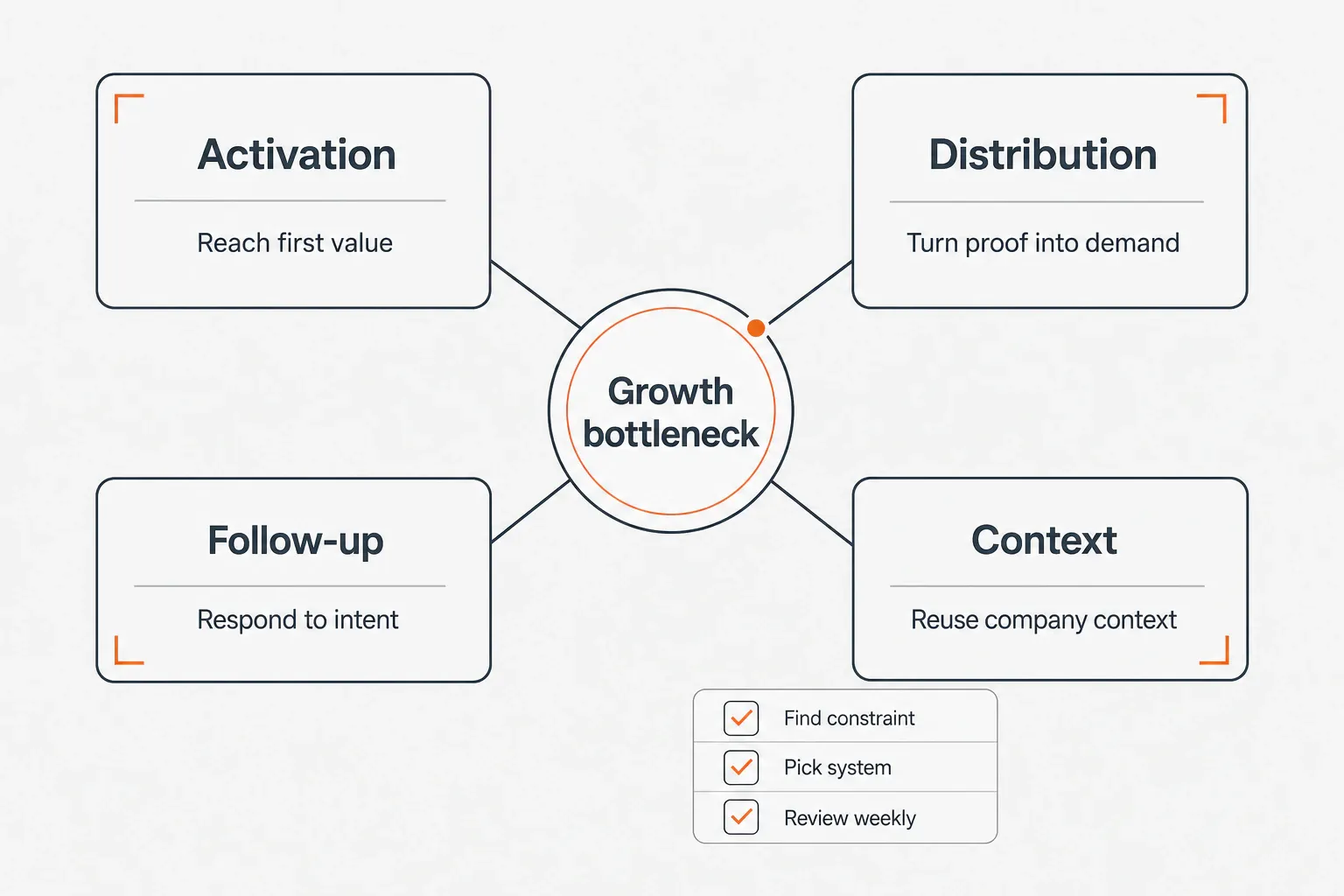
TL;DR: If you searched “grow startup” because another tool, hire, or channel looks tempting, do not buy a generic growth stack first. Pick the smallest repeatable system that fixes the current bottleneck: activation, distribution, follow-up, or company context. Startup Genome found premature scaling in 70% of its dataset, and properly scaled startups grew about 20x faster.
Key takeaways
- The right growth system is the one that makes your current bottleneck repeatable, measurable, and easier to improve each week.
- Choose an activation system when qualified users arrive but fail to reach first value; more acquisition will only make the leak more expensive.
- Choose a distribution system when customer proof exists but the market does not hear a consistent founder-led message.
- Choose a follow-up system when signups, demo requests, waitlist answers, or content replies show intent but do not get timely next steps.
- Choose a company-context system when messaging, customer language, decisions, and drafts are scattered enough that every growth asset starts from a blank page.
If you searched “grow startup” this quarter, I would not start by buying another channel tool. I would choose the smallest growth system that makes the current buying decision clear: activation, distribution, follow-up, or company context.
That distinction matters because many growth purchases are disguised guesses. A founder feels pressure to post more, run ads, hire an agency, install automation, or subscribe to an all-in-one stack. Some of those moves are right later. Bought too early, they create a cleaner dashboard around the wrong problem. Startup Genome’s premature-scaling research found that 70% of startups in its dataset showed premature scaling and that startups that scaled properly grew about 20 times faster than those that scaled prematurely (Startup Genome). Treat that as a dataset-specific warning, not a universal law.
This buyer’s guide compares the four systems I would shortlist before spending more money: activation, distribution, follow-up, and company-context memory. It will help you decide what to build manually, when a point tool is enough, and when a consolidated operating system is justified. The goal is not to crown one universal winner. The goal is to help you buy or build the next system your stage can actually use.
Decision criteria: what actually matters before you buy
A growth system is worth buying only when it improves a workflow the founder already understands. I use five criteria before comparing tools or operating models: bottleneck fit, evidence quality, weekly owner, repeatability, and learning value.
Criterion | Why it matters | How to weigh it | What happens if you ignore it |
|---|---|---|---|
Bottleneck fit | The system must fix the leak that blocks growth now. | Highest weight; no fit means no purchase. | You improve a metric that is not constraining growth. |
Evidence quality | The team needs proof the problem exists. | Look for behavioral data, customer calls, demo notes, or repeated objections. | You buy for anxiety instead of signal. |
Weekly owner | A tiny team needs one person accountable for the loop. | Prefer systems the founder or operator can run every week. | The tool becomes shelfware. |
Repeatability | Growth improves when the same workflow gets better over time. | Choose workflows that can be run, reviewed, and tightened. | Every campaign starts from scratch. |
Learning value | Early growth work should teach the team who wants what and why. | Favor systems that preserve signal, not just output. | You scale activity while losing customer understanding. |
This is also why I would cut three popular options from the first shortlist for many early teams: a full paid-acquisition stack, a broad agency retainer, and a senior growth hire. First Round Review’s 2025 founder-led growth piece frames the early-stage reality directly: many founders are “not ready for a Head of Growth” yet (First Round Review). A founder who has not identified the repeatable loop usually needs a tighter system before a bigger team.
The build-vs-buy rule is simple: build manually when the workflow is still being discovered, buy a point tool when one mature workflow has a clear owner, and consider a consolidated operating system only when several connected workflows keep losing context between tools. Buying before those triggers appear usually turns uncertainty into software spend.
Shortlist: which growth system should you build or buy next?
The shortlist is an editorial buying framework, not an industry-standard taxonomy: buy or build the system that matches the repeated work your team keeps dropping, rebuilding, or doing inconsistently. The table below applies the same criteria to each option before the mini-reviews go deeper.
Use the visual as a quick scan, then use the table for the buying decision.
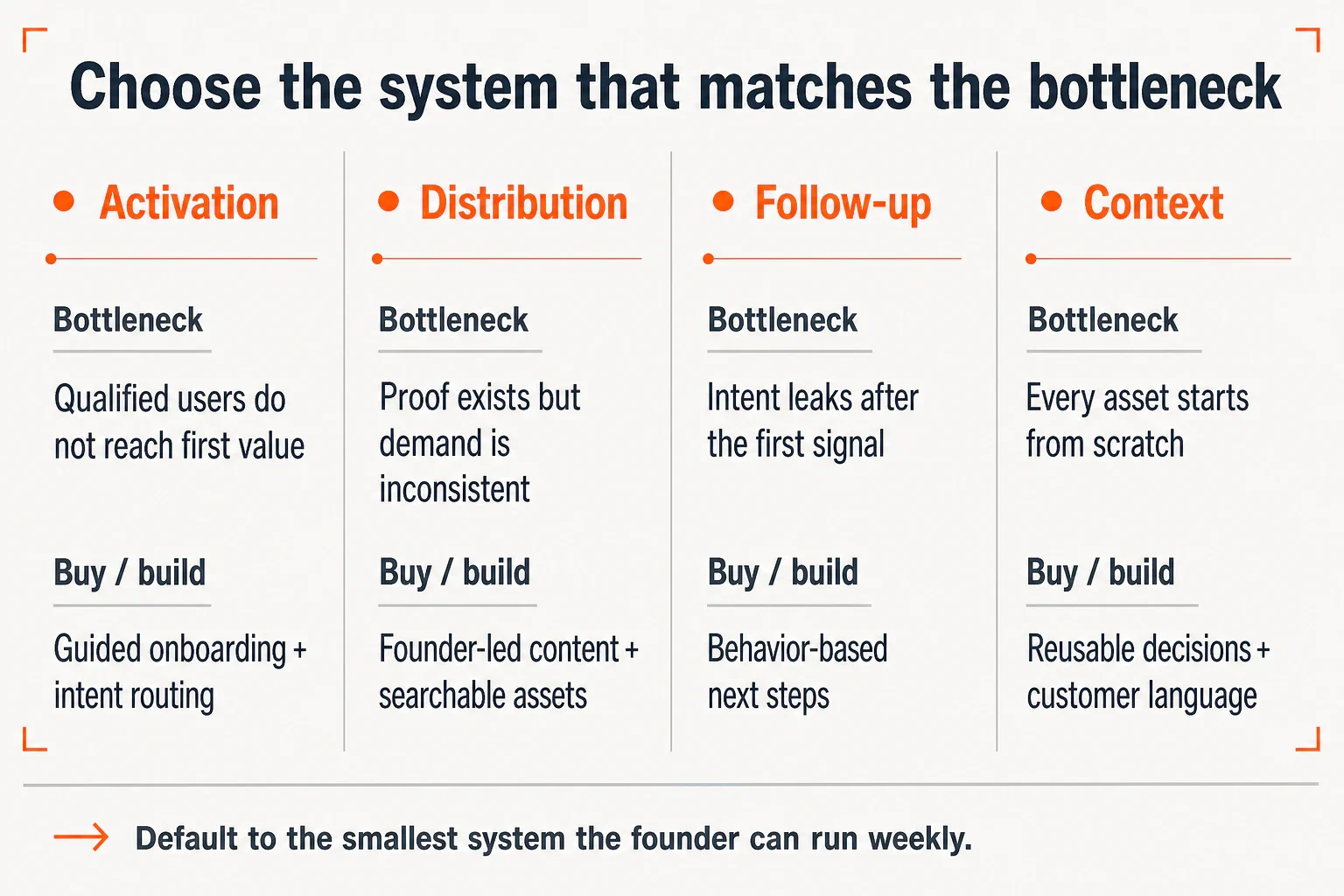
System | Bottleneck fit | Evidence quality | Weekly owner | Repeatability | Learning value | Build-vs-buy trigger | Pricing posture |
|---|---|---|---|---|---|---|---|
Activation system | Strong when qualified users do not reach first value. | Product events, onboarding calls, session notes, drop-off points. | Founder, product lead, or operator. | High if the activation event is clear. | High because it reveals why users fail to reach value. | Build manually until the path is known; buy when branching, segmentation, or analytics save weekly work. | No vendor price to verify; start with founder time plus lightweight analytics, forms, or journey tooling. |
Distribution system | Strong when proof exists but demand is inconsistent. | Customer language, objections, wins, replies, search demand. | Founder or content-owning operator. | Medium to high if raw material is captured. | High when every asset preserves why the message worked. | Build with founder notes first; buy when publishing, scheduling, SEO, or writing support reduces blank-page cost. | No single category price; costs range from founder time to writing, publishing, scheduling, and SEO tools. |
Follow-up system | Strong when intent appears and then goes cold. | Waitlist answers, demo requests, content replies, trial events, slow response timestamps. | Founder, sales owner, or lifecycle operator. | High if triggers and exit rules are narrow. | Medium to high because replies reveal intent quality. | Build manually for one segment; buy automation when triggers, messages, and exit rules are proven. | No vendor price to verify; begin manually, then pay for email or messaging automation when volume justifies it. |
Company-context system | Strong when every growth asset starts from scratch. | Repeated message drift, scattered notes, duplicated drafts, forgotten objections. | Founder or ops owner. | High if the system feeds real assets weekly. | High because it preserves decisions and customer language. | Build in docs while simple; buy when retrieval, reuse, and cross-workflow consistency cost more than the tool. | No single category price; evaluate by coordination cost reduced, not feature count. |
Popular options I would exclude from this first shortlist: paid ads when activation is unproven, a broad agency retainer when the founder cannot yet brief the work, and a specialist point tool when the workflow is not mature enough to specialize. Those options can be right later. They are expensive ways to learn the basics.
Mini-review 1: activation system
An activation system is the right pick when the startup already gets qualified attention but users do not experience value quickly enough. I would choose this before any acquisition expansion if the product has signups, trials, demos, or waitlist users who do not complete the first meaningful action.
Criteria score
Criterion | Assessment |
|---|---|
Bottleneck fit | Best when signups, trials, demos, or waitlist users fail before first value. |
Evidence quality | Strong evidence includes drop-off analytics, onboarding-call notes, and repeated “I don’t get it yet” moments. |
Weekly owner | The founder or product owner should review one activation event and one drop-off point weekly. |
Repeatability | High once the team defines the first meaningful action. |
Learning value | High because every failed activation teaches something about promise, fit, setup, or motivation. |
Strengths
Activation work improves the conversion value of every future channel. First Round Review’s 2025 Superhuman onboarding playbook puts the point bluntly: “Startups live and die by customer retention, and retention starts with activation” (First Round Review). For a founder, that makes activation a buying decision, not just a product-design task.
A good activation system should guide different users by intent, shorten the path to first value, and preserve the answers users give. The minimum version might be a concierge onboarding call, a lightweight checklist, or a branching journey that routes users by role, goal, or urgency. If you need a deeper activation primer, the FounderHQ guide to app onboarding covers the first-value path in more detail.
Concrete decision example
A small B2B product gets 40 trial signups from founder posts, but only six users create the first project. The wrong purchase is a paid social tool or content agency. The right minimum system is a guided activation path for one segment, plus a weekly review of where users abandon setup. The next metric is not traffic; it is signup-to-first-project completion.
Weaknesses
Activation work can become a polishing trap. A founder can spend weeks redesigning onboarding screens without proving that the target user, promise, or value moment is right. The system also loses power if traffic quality is poor; guiding the wrong users faster does not create product-market fit.
Verified pricing posture
Activation is not a single vendor category with one clean price to verify. The first version costs founder time: calls, session review, drop-off notes, and a hand-built path. A low-cost point tool is enough when the team only needs forms, checklists, or basic event tracking. A paid platform becomes justified when the team needs branching flows, segmentation, product analytics, or embedded journeys that one person can review weekly. The “too early” signal is buying a polished onboarding stack before the team can name the activation event.
FounderHQ’s public homepage describes Journeys as quizzes, waitlists, and onboarding flows with branching steps, answer-based routing, and contact attributes for later segmentation (FounderHQ).
Who it is actually for
Choose activation if the sentence “we need more traffic” is hiding a first-value leak. Do not choose it if you have no qualified users to observe yet; in that case, run manual customer search before designing a sophisticated activation path.
Mini-review 2: distribution system
A distribution system is the right pick when the product has proof, customer language, or useful founder insight, but the market does not hear it consistently. I would choose this when demand feels random because the team has no repeatable way to turn learning into public assets.
Criteria score
Criterion | Assessment |
|---|---|
Bottleneck fit | Best when proof exists but does not reach enough qualified people. |
Evidence quality | Strong evidence includes repeated customer phrases, objections, wins, founder insights, and useful replies. |
Weekly owner | The founder or content owner should turn one proof source into one asset each week. |
Repeatability | Medium to high if the workflow captures raw material before writing starts. |
Learning value | High when replies, search queries, and objections feed the next asset. |
Strengths
Distribution is not “post more.” A good distribution system turns customer questions, objections, product decisions, and proof into assets that earn attention. First Round Review’s founder-led growth coverage says founders are responsible for figuring out how the business will grow before handing that work away (First Round Review). That does not mean the founder writes forever; it means the first repeatable message usually comes from direct founder contact with the market.
The buying criteria are cadence, raw material capture, channel fit, and reuse. If a content workflow cannot preserve the reason a message worked, it is output machinery, not a growth system. FounderHQ’s public homepage describes Compose as a writing studio for LinkedIn, X, and Threads grounded in brand voice, and Publish as a loop from keyword research through drafting, publishing, indexing, rank tracking, and refresh queues (FounderHQ).
Concrete decision example
A founder has five customers using the product weekly and three strong quotes from calls, but the website and social feed still explain the product differently. The wrong purchase is a generic posting package that promises volume. The right minimum system is one proof library, one message lane, and one weekly proof-backed asset. The next metric is qualified replies or demo requests from proof-backed content, not impressions.
Weaknesses
Distribution can create vanity motion. Reach, impressions, and follower growth feel productive even when the audience is wrong. A distribution system also fails when there is no proof to distribute. In that case, use a proof loop first; FounderHQ’s guide to building a proof loop before adding channels is the more relevant path.
Verified pricing posture
Distribution is not a single vendor category with a universal verified price. The manual cost is founder time: customer notes, market observations, drafts, publishing, and reply review. A low-cost point tool is enough when the only problem is scheduling, formatting, or basic publishing. Paid writing, SEO, design, or publishing systems become justified when the team already has proof and the bottleneck is turning it into consistent assets. The “too early” signal is paying for content volume before message clarity or proof quality exists.
Who it is actually for
Choose distribution if you have repeated customer language, visible wins, or a sharp point of view that is not reaching enough qualified people. Do not choose it if customers still cannot explain the product’s value after using it.
Mini-review 3: follow-up system
A follow-up system is the right pick when buyer or user intent appears, then goes cold. I would choose this when the team already earns waitlist signups, demo requests, replies, referrals, or trial events, but no one gets a timely next step based on what they did.
Criteria score
Criterion | Assessment |
|---|---|
Bottleneck fit | Best when warm signals exist but response is slow, generic, or forgotten. |
Evidence quality | Strong evidence includes demo requests, journey answers, content replies, trial events, and response-time gaps. |
Weekly owner | The founder, sales owner, or lifecycle operator should review one segment and one trigger weekly. |
Repeatability | High if each sequence has one trigger, one next action, and one exit rule. |
Learning value | Medium to high because replies show which signals indicate real intent. |
Strengths
Follow-up systems turn signal into motion. The practical triggers are concrete: journey answers, signup source, demo request, onboarding progress, inactivity, content reply, product milestone, or pricing-page visit. The system should answer one question: what should happen next for this person, given the signal they just sent?
The strongest follow-up systems start narrow. One segment, one trigger, one message sequence, one exit rule, one weekly review. That is enough to learn whether the next action is a call, a product prompt, a customer story, a reminder, or a handoff. The related FounderHQ guide on email sequences goes deeper on behavior-based follow-up without overbuilding automation.
Concrete decision example
A waitlist gets 120 signups, and 25 people say they want the product for the same urgent job, but all of them receive the same generic launch update two weeks later. The wrong purchase is a complex lifecycle automation suite with ten branches. The right minimum system is one high-intent segment, one same-day founder reply, one short follow-up sequence, and one exit rule when the person books a call or starts onboarding. The next metric is high-intent response rate within one business day.
Weaknesses
Follow-up can turn into spam if the team automates before understanding intent. It also cannot rescue weak positioning. If the first promise is unclear, a longer sequence just repeats confusion. The best early follow-up often starts manually so the founder can hear where buyers hesitate.
Verified pricing posture
Follow-up is not a single vendor category with one verified price. The first version costs founder or operator time: manual replies, a spreadsheet or CRM view, and a short message library. A low-cost email tool is enough when the trigger is simple and volume is low. Paid automation becomes useful when triggers, segmentation, and exit rules are stable enough that automation reduces delay without hiding learning. The “too early” signal is automating a sequence before the team knows the next action a qualified person should take.
FounderHQ’s public site positions follow-up as part of the broader stack alongside funnels, social, SEO, product journeys, content, publishing, and company context (FounderHQ).
Who it is actually for
Choose follow-up if the team already has intent signals and the leak happens after the first touch. Do not choose it if you still do not know who the buyer is or why they care.
Mini-review 4: company-context system
A company-context system is the right pick when growth work slows because decisions, customer language, and drafts are scattered. I would choose this when the team is not short on ideas; it is short on reusable memory.
Criteria score
Criterion | Assessment |
|---|---|
Bottleneck fit | Best when message drift, scattered decisions, and repeated blank-page work slow every asset. |
Evidence quality | Strong evidence includes duplicated drafts, lost customer phrases, inconsistent positioning, and repeated “where did we write that?” moments. |
Weekly owner | The founder or operator should turn one customer signal or decision into reusable context each week. |
Repeatability | High if context feeds pages, onboarding, posts, articles, and follow-up. |
Learning value | High because decisions and customer language stay available for future work. |
Strengths
Context systems reduce the cost of every future asset. A good one preserves positioning decisions, objections, customer phrases, launch notes, founder voice, proof, and product-journey logic. First Round Review’s 2024 product-market-fit guide points to Sean Ellis’s survey benchmark: after benchmarking a hundred startups, Ellis found 40% “very disappointed” responses to be the threshold associated with strong traction (First Round Review). That kind of signal is only useful if the team keeps it somewhere future decisions can use.
For a tiny team, the criteria are retrieval, reuse, and consistency. Can the founder pull the same customer language into a landing page, onboarding flow, post, article, and follow-up? Can the team see why the current ICP, promise, or objection handling exists? If not, growth work keeps resetting.
Concrete decision example
A team rewrites the homepage, onboarding emails, sales replies, and founder posts from scratch every month because customer language lives in call notes, Slack threads, and old docs. The wrong purchase is another isolated writing tool. The right minimum system is a shared context layer with the current ICP, promise, objections, proof, and voice examples. The next metric is the percentage of new growth assets that reuse approved context rather than starting from a blank page.
Weaknesses
Context systems can become graveyards. If no one uses the notes to create assets, guide onboarding, or improve messaging, the system is documentation theater. It also should not replace customer conversations; it should make the learning from those conversations easier to reuse.
Verified pricing posture
Company-context software is not a single vendor category with one verified price. The manual version can be a disciplined doc, notes database, CRM field set, or shared folder. A low-cost setup is enough when the team only needs a single source of truth. A paid operating layer becomes justified when product journeys, founder-led content, SEO publishing, follow-up, and reusable company context need to stay connected. The “too early” signal is buying a knowledge system when no one has a weekly habit of turning context into shipped work.
FounderHQ is relevant when product journeys, founder-led content, SEO publishing, follow-up, and reusable company context need to stay connected in one focused operating layer; its public site positions the product around product journeys, founder-led content, and company context (FounderHQ).
Who it is actually for
Choose context if every growth asset starts with “where did we write that?” Do not choose it if the current constraint is a single isolated task that a specialist point tool can solve cleanly.
Recommendation matrix: choose by the situation, not the category
The best choice depends on the situation you are in this week. If two rows feel true, pick the one closer to revenue or retention first.
Buyer situation | Recommended pick | Why |
|---|---|---|
Qualified signups arrive, but few complete setup or reach value. | Activation system | Fix the leak before amplifying traffic. |
Customers like the product, but demand is inconsistent. | Distribution system | Turn proof and founder insight into repeatable market reach. |
Waitlist, demo, or trial intent exists, but response is slow or generic. | Follow-up system | Match the next action to the signal before interest cools. |
Messaging, customer notes, launch decisions, and drafts are scattered. | Company-context system | Reduce blank-page work and keep future assets consistent. |
No clear ICP, no repeated pain, and no strong user signal yet. | Manual customer search, not a tool purchase | Learn the market before systematizing growth. |
A narrow workflow is mature and owned by a specialist. | Point tool | Specialist depth can beat consolidation when the workflow is isolated. |
A tiny team needs journeys, content, follow-up, and context to stay aligned. | Consolidated operating system | Fewer seams can matter more than deeper point features. |
The founder cannot define the brief, message, or target buyer yet. | Delay agency retainers or growth hires | Outside execution amplifies unclear strategy instead of fixing it. |
Do not buy yet if the winning row is based on a feeling instead of evidence, if no one can own the loop weekly, or if the manual version has never worked once. In that case, spend two weeks proving the workflow before spending money on the stack.
How to decide in 10 minutes
A founder-friendly decision should not require a quarterly planning offsite. I would answer three questions, score the options, and buy only if the winner is clear.
Question 1: What repeated work is breaking?
Write the repeated failure in one sentence: “Qualified users do not reach first value,” “proof is not becoming demand,” “intent is not getting follow-up,” or “context is not reusable.” If the sentence is vague, do not buy yet.
Question 2: What evidence proves it?
Use behavior, not vibes. Evidence can be signup-to-activation drop-off, repeated demo objections, slow follow-up timestamps, unanswered waitlist segments, content replies with the same question, or five customer calls using the same words.
Question 3: Can one person run the loop weekly?
If no one owns the system weekly, the purchase will not fix the problem. The owner should review one metric, one qualitative signal, and one next change every week.
Score | Meaning | Decision |
|---|---|---|
5 | Clear bottleneck, strong evidence, weekly owner, repeatable loop, high learning value. | Buy or build now. |
3–4 | Real problem, but owner or workflow is not clear. | Prototype manually for two weeks. |
1–2 | Mostly anxiety, unclear evidence, or no operating cadence. | Do not buy; run customer discovery or simplify the workflow. |
A 14-day implementation plan for the system you choose
The first version should be small enough to complete in two weeks. A system that needs a month of setup before it teaches you anything is probably too heavy for an early-stage team.
Days 1–2: name the constraint and define one measurable next action. For activation, that might be “new user creates first project.” For distribution, it might be “publish one proof-backed asset and earn five qualified replies.” For follow-up, it might be “demo request receives a relevant next step within one business day.” For context, it might be “all new assets use the same saved ICP, objection, and proof note.”
Days 3–5: map the minimum workflow. Collect the existing assets and signals: onboarding steps, customer phrases, demo notes, content replies, waitlist answers, or old launch drafts. Cut anything that does not support the chosen system.
Days 6–10: build the first version manually or with a lean stack. Do not automate every branch. Build enough structure to run the loop once and watch what happens.
Days 11–14: review evidence and decide what to keep. Ask: did the system reduce the leak, improve learning, or make the next asset easier to create? If yes, tighten it. If no, return to the bottleneck diagnosis instead of adding more software.
Where FounderHQ fits in the decision
FounderHQ belongs in the comparison when the same small team needs product journeys, founder-led content, SEO publishing, follow-up, and company context to stay connected. It is not the right framing if the buyer only needs a narrow specialist tool for one mature workflow.
The product’s public positioning is practical: FounderHQ helps early-stage product teams build product journeys, compose founder-led content, and keep company context in one focused operating system. Journeys support quizzes, waitlists, onboarding flows, branching steps, and answer-based routing; Compose supports LinkedIn, X, and Threads writing; Publish covers keyword research through refresh queues; and FounderHQ’s public site also positions follow-up as part of the broader stack (FounderHQ).
The decision rule is still the same: do not buy a platform to avoid choosing the bottleneck. Consider a consolidated system when the growth work is connected across activation, distribution, follow-up, and reusable context. Choose a point tool when one isolated job is the only thing breaking.
Recommended video for founders weighing growth readiness
Watch Gustaf Alströmer’s Y Combinator talk on growth for startups if you are unsure whether you have enough product-market fit, retention, or first-value clarity to scale growth work. The talk is a useful companion because it separates early unscalable learning from later channel selection and growth-team decisions.
Conclusion
To grow a startup, choose the smallest system that turns the current bottleneck into a weekly operating loop. If users do not reach value, start with activation. If proof is not reaching the market, start with distribution. If intent is going cold, start with follow-up. If every asset starts from scratch, start with company context. Buy the tool only after the workflow is clear enough to deserve one.
Frequently asked questions
What is the best way to grow a startup?
The best way to grow a startup is to identify the current bottleneck and build one repeatable system around it. If users are not reaching first value, fix activation. If proof exists but demand is inconsistent, fix distribution. If leads show intent but stall, fix follow-up. If assets keep drifting, fix company context before buying more tools.
Should a startup focus on acquisition or activation first?
A startup should focus on activation first when qualified users already arrive but do not reach value, return, or convert. First Round Review’s 2025 onboarding coverage states that “retention starts with activation.” Acquisition becomes a better investment once the team can show that the right users understand the product and come back.
What is a startup growth system?
A startup growth system is a repeatable workflow that moves the company from signal to action: onboarding users to first value, turning proof into distribution, following up based on behavior, or preserving context for future assets. It is not a list of channels. It is the operating loop the founder can run and improve every week.
When should a startup buy growth tools?
A startup should buy growth tools after the manual workflow is clear enough to support. Buy when the tool reduces coordination cost, preserves learning, or makes an already-useful workflow repeatable. Delay the purchase if the team is using software to avoid customer conversations, unclear positioning, broken activation, or an undefined next action.
What growth system should a small product team build first?
A small product team should build the system tied to the most expensive leak. Pick activation if signups do not become active users, distribution if proof is invisible, follow-up if warm intent goes cold, and company context if messaging or customer learning is scattered. The best first system is small enough for the founder to operate weekly.
Related articles
Application Onboarding Process: Definition, Steps, and When to Use It
A practical seven-step application onboarding process for moving new users from signup to first meaningful value without unnecessary setup or generic tours.

In-App Analytics for Onboarding: Definition, Metrics, and When to Use It
In-app analytics for onboarding turns events, funnels, segments, and user feedback into decisions about the path from signup to first value.

In-App Guidance for Onboarding: Definition, Examples, and When to Use It
In-app guidance helps users complete meaningful tasks inside a product. This guide explains the main patterns and how to match each one to an onboarding blocker.