FounderHQJul 2, 202611 min read
How to Grow a Startup by Choosing the Right Growth Motion for Your Stage
To grow a startup, do not start by copying a channel. Diagnose the bottleneck, then choose the growth motion your stage, buyer, product, and team can actually support.

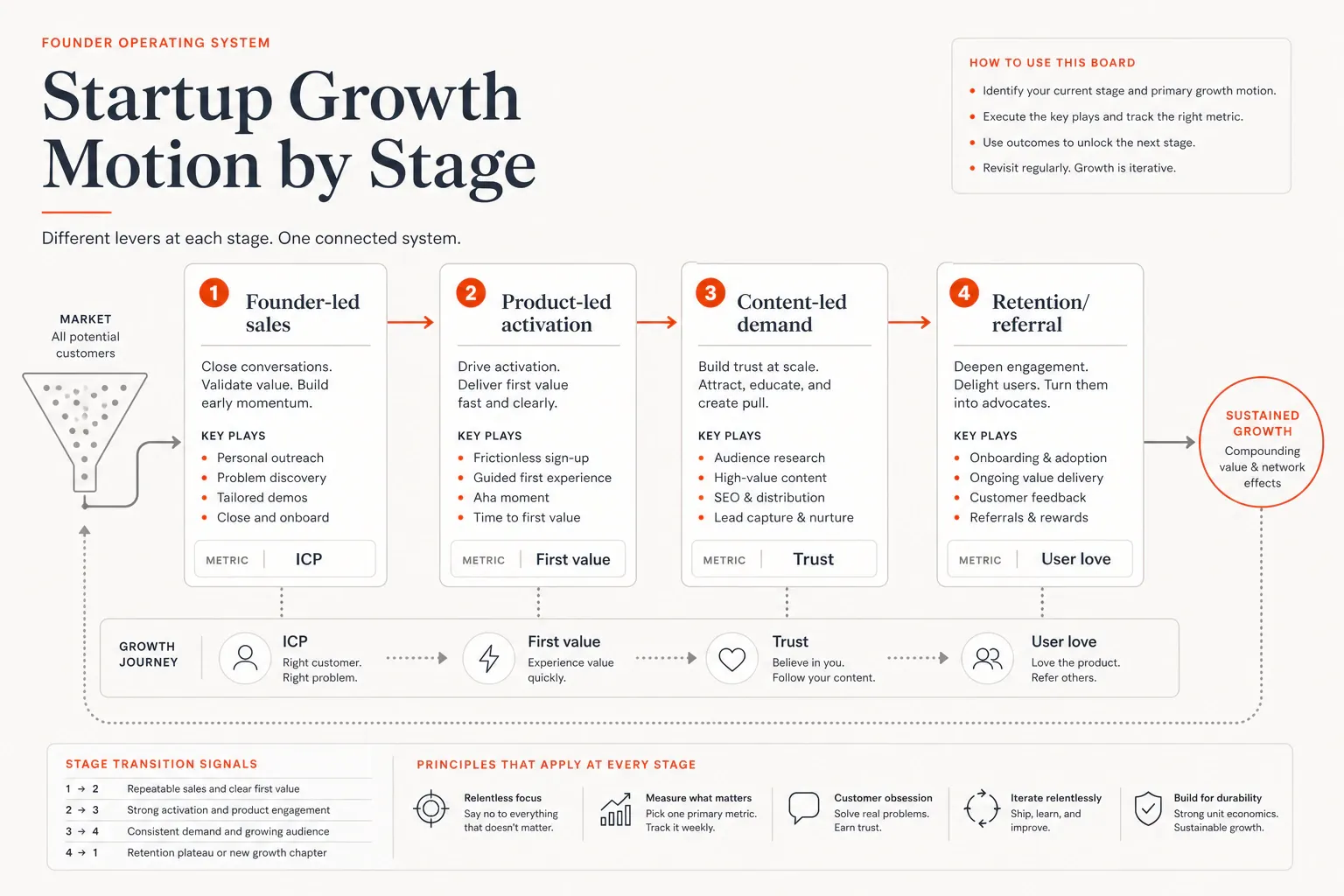
Most founders ask, “Which channel should we try next?” LinkedIn, SEO, outbound, ads, partnerships, referrals, communities. The better question is: which growth motion can your startup support right now? A channel is where attention comes from. A motion is the operating model that turns attention into learning, activation, revenue, retention, or referrals. If you choose the wrong motion too early, you can burn weeks building a machine around a signal you have not earned yet. This guide compares four practical motions for early-stage teams: founder-led sales and discovery, product-led activation, content-led demand, and retention or referral loops. It is about choosing the operating motion, not another growth asset, scoreboard, referral mechanic, architecture, or delegation model.
The mistake: choosing channels before choosing a growth motion
A startup growth strategy usually breaks when the team copies the visible tactic instead of the hidden operating model. A competitor posts daily, so you post daily. A peer launches a freemium plan, so you launch one. Another founder says outbound worked, so you buy a list. The tactic may be fine, but the motion may not fit your stage.
That mismatch matters because early-stage teams are not short on possible tactics. They are short on attention, clean learning, and runway. CB Insights analyzed 431 VC-backed startup shutdowns since 2023 and found that “ran out of capital” appeared in 70% of failures, while poor product-market fit appeared in 43%. That does not mean every startup fails for the same reason, and it applies to a VC-backed shutdown dataset specifically. But it is a useful warning: cash problems often show up after a team spends too long scaling weak market proof.
A growth motion should answer five questions before you pick the channel: Who are we trying to learn from? What behavior proves they reached value? How complex is the buying decision? How fast can the product show value? What can this team repeat every week without falling apart?
First, diagnose the leak: acquisition, activation, retention, referral, or revenue
Before comparing motions, map the current leak. The AARRR framework, also called pirate metrics, was devised by Dave McClure and breaks the customer journey into acquisition, activation, retention, revenue, and referral. PostHog’s explanation of AARRR frames it as a way to understand customer behavior and identify weaknesses across the journey; HubSpot also lists it as a startup-friendly framework for optimizing each step of the customer journey.
Use it lightly. You do not need a complex dashboard to make a better decision this week. Write one observable behavior for each stage:
- Acquisition: the right people discover you or respond.
- Activation: they reach the first useful outcome.
- Retention: they return at the natural cadence of the product.
- Revenue: they pay, expand, or commit budget.
- Referral: they tell someone else, invite a teammate, or introduce a buyer.
Then ask: which stage has the weakest evidence? If nobody responds, acquisition or positioning is the leak. If people sign up and disappear, activation is the leak. If users try the product once and never return, retention is the leak. If happy users do not pay, revenue or packaging is the leak. If users love it but growth is quiet, referral or proof capture may be the leak.
The four growth motions to compare
The four motions below can eventually coexist, but a tiny team should usually lead with one. Trying to run all four at once creates shallow work: a little outbound, a little onboarding, a little content, a little referral campaign, and not enough evidence from any of them.
Founder-led sales and discovery
Choose this when learning is still the constraint. You need sharper customer language, a clearer ICP, real objections, willingness-to-pay evidence, and direct feedback from people close to the problem. This is often the right motion before the product or messaging is stable enough to scale.
Product-led activation
Choose this when people show interest but fail to reach first value. The product can only become the growth engine if users can understand it, try it, and experience a meaningful outcome without heavy hand-holding.
Content-led demand
Choose this when buyers need education, comparison, trust, and repeated exposure before they act. Content-led growth is not “post more.” It is a motion for turning founder insight into useful assets that attract and qualify the right audience over time.
Retention or referral loop
Choose this when users already reach value and some of them come back, invite others, or express strong satisfaction. This motion makes repeat usage, proof capture, and word-of-mouth more deliberate.
Option 1: Choose founder-led sales when learning is still the constraint
Founder-led sales is the right starting point when you cannot yet explain the buyer, painful trigger, objection pattern, or buying process without guessing. At this stage, growth is less about scale and more about making contact with reality.
YC’s Startup School guidance is blunt on this point: founders should manually recruit early customers and learn sales because early products rarely take off by themselves. The practical version is simple: talk to the people who feel the problem, ask for commitment, learn the objections, and record the language they use.
Choose founder-led sales if you see these signals:
- You are pre-revenue or early revenue.
- The ICP still changes from week to week.
- Buyers need a conversation to understand the value.
- Your product has setup, migration, security, stakeholder, or workflow complexity.
- You do not know which objection will block a purchase.
- You need proof that someone will pay, not just praise the idea.
Avoid this motion if you already have clear self-serve demand and the founder is becoming the bottleneck for users who could activate without a call. The common failure mode is hiding from hard conversations by writing more code, polishing the website, or hiring sales before the founder knows what good sales sounds like.
Option 2: Choose product-led activation when first value is the bottleneck
Product-led growth works when the product can carry more of the customer journey. That does not mean “add a free plan.” It means a user can discover the product, understand what to do, reach first value, and see enough benefit to continue without needing the founder to explain everything.
Current PLG versus sales-led guidance repeatedly emphasizes the same decision variables: annual contract value, buyer complexity, and time-to-value. For example, recent PLG comparison content from Startup Yeti frames the decision around price, product complexity, buyer, and stage, including whether customers can self-serve and reach value quickly enough for a product-led motion to make sense.
Choose product-led activation if you see these signals:
- The end user can evaluate the product directly.
- The user and buyer are the same person, or the user has strong purchase influence.
- First value can happen in a first session or with light onboarding.
- The product has a clear activation event you can instrument.
- The price and purchase process do not require heavy procurement or negotiation.
Avoid this motion if your product needs deep implementation, multi-stakeholder approval, or a long consultative sale before value is visible. The common failure mode is calling the company “PLG” while new users still hit a blank dashboard, unclear next step, or slow first-value path.
Option 3: Choose content-led demand when trust and education are the bottleneck
Content-led demand fits products where buyers search, compare, ask peers, and need repeated exposure before they are ready. It is especially useful when the founder has a strong point of view, the problem is high-consideration, and the buyer needs help understanding why the old way is breaking.
The motion has more structure than random posting. A useful content-led motion includes a topic thesis, founder-led point of view, buyer-intent pages, distribution, internal links, audience questions, and refreshes when content decays. It should route readers toward a clearer product journey, proof point, waitlist, demo, or conversation.
Choose content-led demand if you see these signals:
- Buyers research before taking action.
- The problem is painful but not yet obvious to the market.
- Your founder has useful operating insight to share.
- Search, social, or community channels can create repeated exposure.
- You need trust before conversion, not just more traffic.
Avoid this motion if you cannot connect content to a buyer, pain, or next action. The common failure mode is publishing thought leadership that attracts vague attention but never improves activation, proof, or revenue.
Option 4: Choose retention or referral when you already have real user love
Retention and referral work should usually come after activation. If users do not reach value, a referral program just amplifies a leaky experience. If users reach value and return, the question changes: how do you make repeat usage, proof, and word-of-mouth easier to happen again?
Choose retention or referral if you see these signals:
- Users come back without being chased.
- Customers mention the product positively in support, calls, or replies.
- Users invite teammates or ask how to share it.
- A small group completes meaningful actions repeatedly.
- Customers are willing to provide proof, quotes, introductions, or use-case details.
Avoid this motion if you only have signups, waitlist names, or polite compliments. The common failure mode is measuring invites, shares, or referral clicks without checking whether referred users activate and retain.
Decision table: which growth motion should you choose?
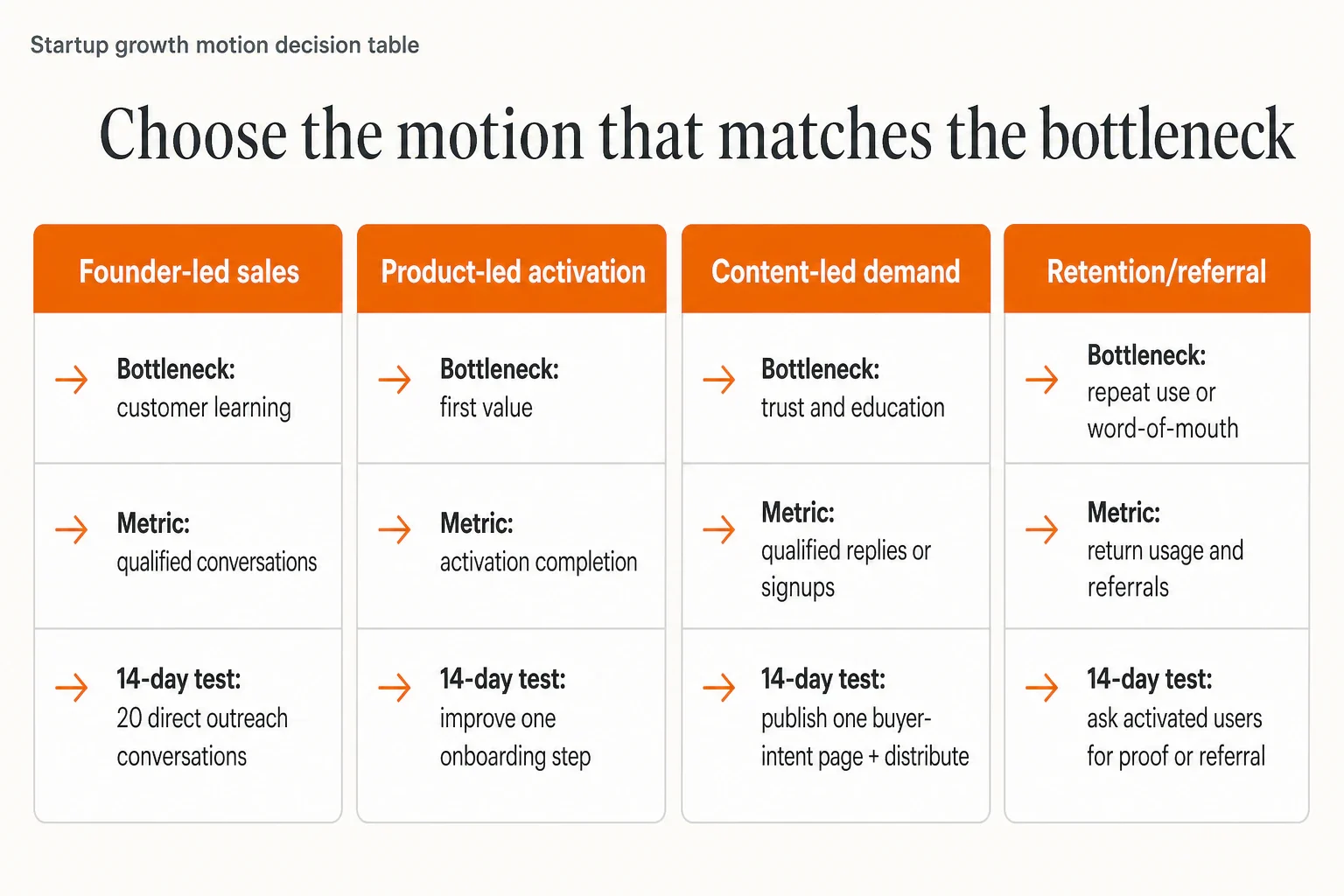
Use the comparison below as a buyer’s guide for your next operating choice. The goal is not to find the most impressive motion. The goal is to pick the motion that fits your current proof, buyer complexity, time-to-value, and team capacity.
The infographic below summarizes the fastest way to match a bottleneck to a motion, a primary metric, and a first 14-day test.
Founder-led sales/discovery
- Choose this if: You still need ICP, pain, objections, and willingness-to-pay evidence.
- Avoid this if: Users can already self-serve and the founder is slowing them down.
- Primary metric: Qualified conversations, commitments, paid pilots.
- First 14-day experiment: Run 20 direct outreach conversations with one narrow ICP.
- Founder workload: High founder involvement.
- Common failure mode: Avoiding sales by building more product.
Product-led activation
- Choose this if: Signups or interest exist, but users fail to reach first value.
- Avoid this if: Value requires long implementation or a buying committee.
- Primary metric: Activation completion, first-value rate, return usage.
- First 14-day experiment: Improve one onboarding step and measure activation.
- Founder workload: Medium product and analytics work.
- Common failure mode: Adding freemium without a first-value path.
Content-led demand
- Choose this if: Buyers need education, comparison, and repeated trust.
- Avoid this if: Content has no buyer intent or next action.
- Primary metric: Qualified replies, signups, self-reported attribution.
- First 14-day experiment: Publish one buyer-intent page and distribute it through founder channels.
- Founder workload: Medium writing and distribution work.
- Common failure mode: Publishing volume without routing demand.
Retention/referral
- Choose this if: Activated users return, invite, or express strong satisfaction.
- Avoid this if: Users are not yet reaching value.
- Primary metric: Return usage, proof captured, activated referrals.
- First 14-day experiment: Ask activated users for proof, use cases, or introductions.
- Founder workload: Medium customer follow-up work.
- Common failure mode: Asking for referrals before users love the product.
A useful rule of thumb: if you cannot name the buyer and pain clearly, start founder-led. If signups do not activate, fix the product journey. If buyers need education, build content-led trust. If users love it but growth is quiet, design retention and referral.
A 14-day growth-motion test for tiny teams
A 1–3 person team does not need a quarterly growth plan to make a better decision. It needs one focused test that creates evidence quickly.
Use this 14-day cadence:
- Day 1: Diagnose the AARRR leak. Pick the weakest stage: acquisition, activation, retention, revenue, or referral.
- Day 2: Choose one motion. Do not run four half-tests at once.
- Days 3–10: Ship one experiment. Keep it small enough to complete while still building product.
- Days 11–12: Collect evidence. Look for behavior, objections, activation, replies, payment intent, or repeat usage.
- Day 13: Decide keep, adapt, or kill. Do not let a weak test become a permanent operating habit.
- Day 14: Preserve the learning. Record the hypothesis, audience, asset, distribution path, conversion behavior, objections, proof snippets, and next decision.
Example tests: run 20 founder-led outreach conversations; improve one onboarding step and measure activation; publish one buyer-intent content page and distribute it through founder channels; or ask activated users for proof, use cases, and introductions. Each test should create a decision, not just activity.
Where FounderHQ fits in the growth-motion decision
FounderHQ is built for early-stage product teams that need a focused operating system for product journeys, founder-led content, and company context. That matters because growth-motion decisions create reusable learning: buyer language, objections, proof, positioning, activation paths, content ideas, and follow-up needs.
For a product-led activation motion, product journeys give the team a place to shape and improve the path toward first value. For content-led demand, founder-led content work can help turn company context into clearer market narratives. For founder-led sales, company context gives the team a place to preserve the patterns that show up in calls, replies, and objections.
The point is not to automate judgment away from the founder. The point is to reduce blank-page work and preserve what the team learns so the next motion starts from sharper context.
Conclusion
To grow a startup, do not choose the motion that sounds most scalable. Choose the motion that preserves the most learning for your current stage. This is a different decision from picking a growth asset, building a scoreboard, engineering a referral mechanic, redesigning your growth architecture, or delegating growth work. Ask five questions before the next sprint: What do we know? Where is the leak? Which motion fits our buyer, product, and team capacity? What experiment can we run in 14 days? What learning will we preserve for the next loop? The right answer may be founder-led sales, product-led activation, content-led demand, or retention and referral. The wrong answer is pretending every channel deserves your attention at once.
Recommended Videos
A practical companion for founders choosing a founder-led sales motion, with clear guidance on getting early customers, learning sales, and working backward from concrete goals.
Related articles
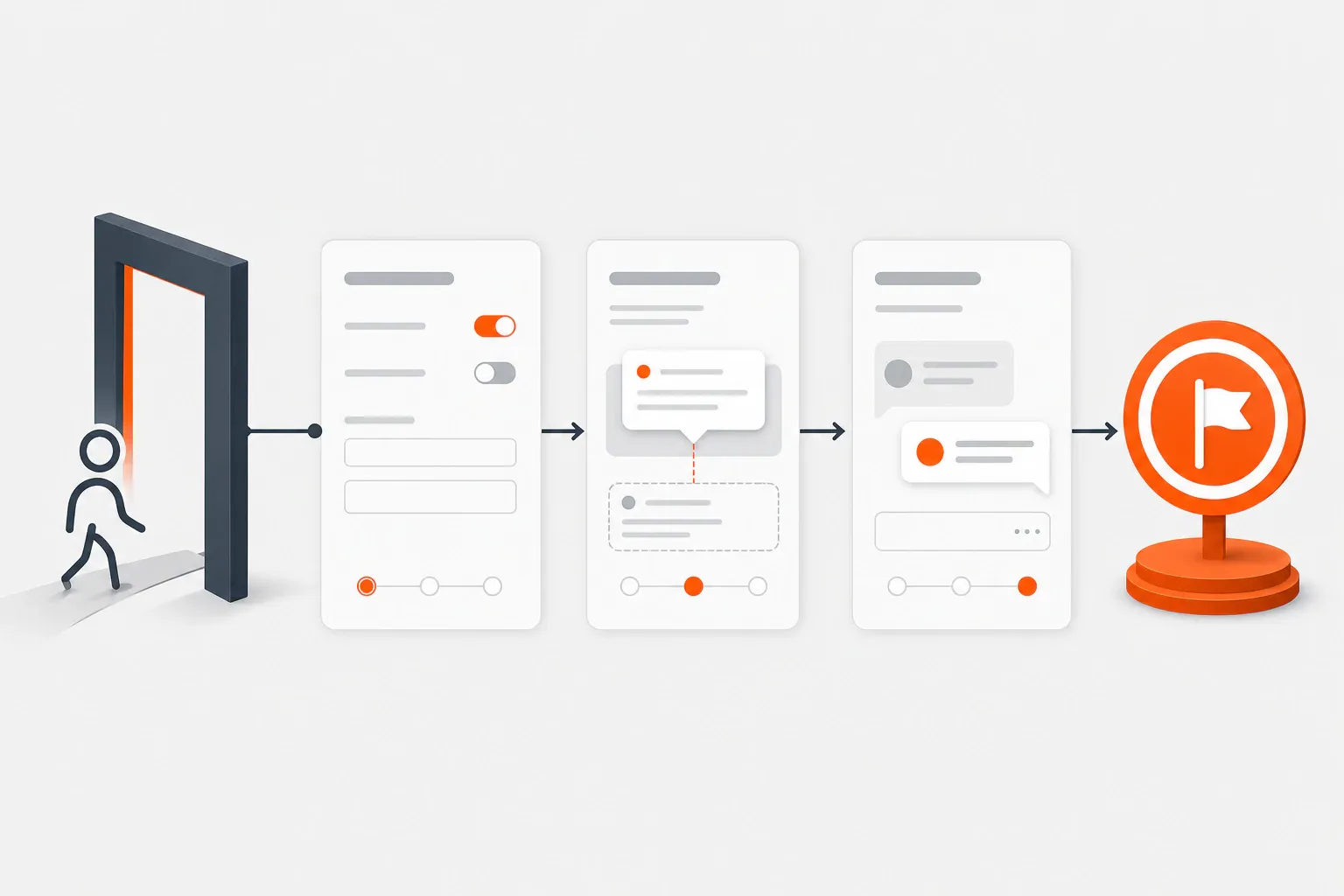
Application Onboarding Process: Definition, Steps, and When to Use It
A practical seven-step application onboarding process for moving new users from signup to first meaningful value without unnecessary setup or generic tours.
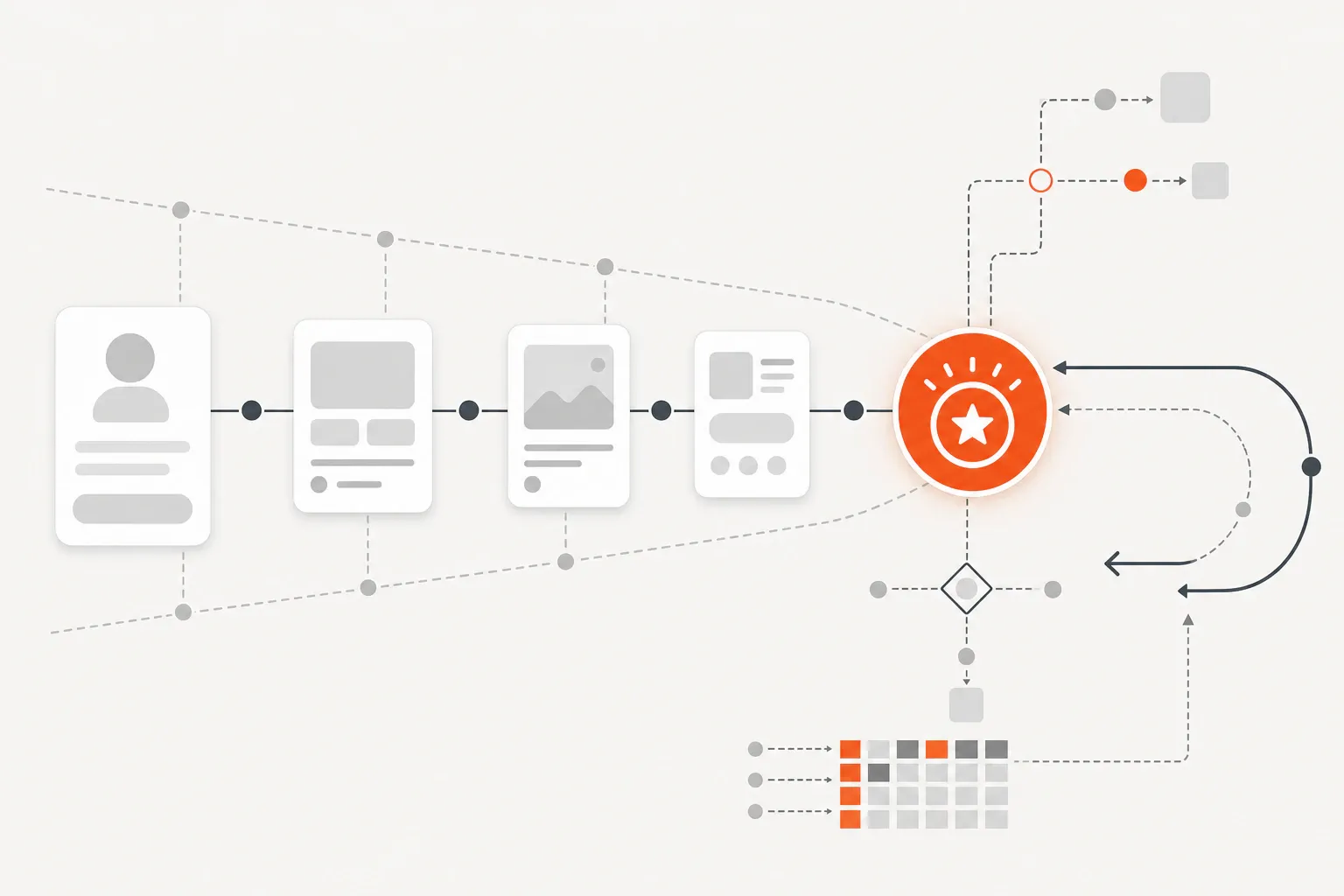
In-App Analytics for Onboarding: Definition, Metrics, and When to Use It
In-app analytics for onboarding turns events, funnels, segments, and user feedback into decisions about the path from signup to first value.
In-App Guidance for Onboarding: Definition, Examples, and When to Use It
In-app guidance helps users complete meaningful tasks inside a product. This guide explains the main patterns and how to match each one to an onboarding blocker.