FounderHQJul 10, 202611 min read
How to Grow a Startup: Choose Who Owns Growth Before You Add More Tactics
Before adding another channel, contractor, or growth tool, decide who should own the growth loop right now: the founder, a fractional strategist, an agency, or a first in-house...

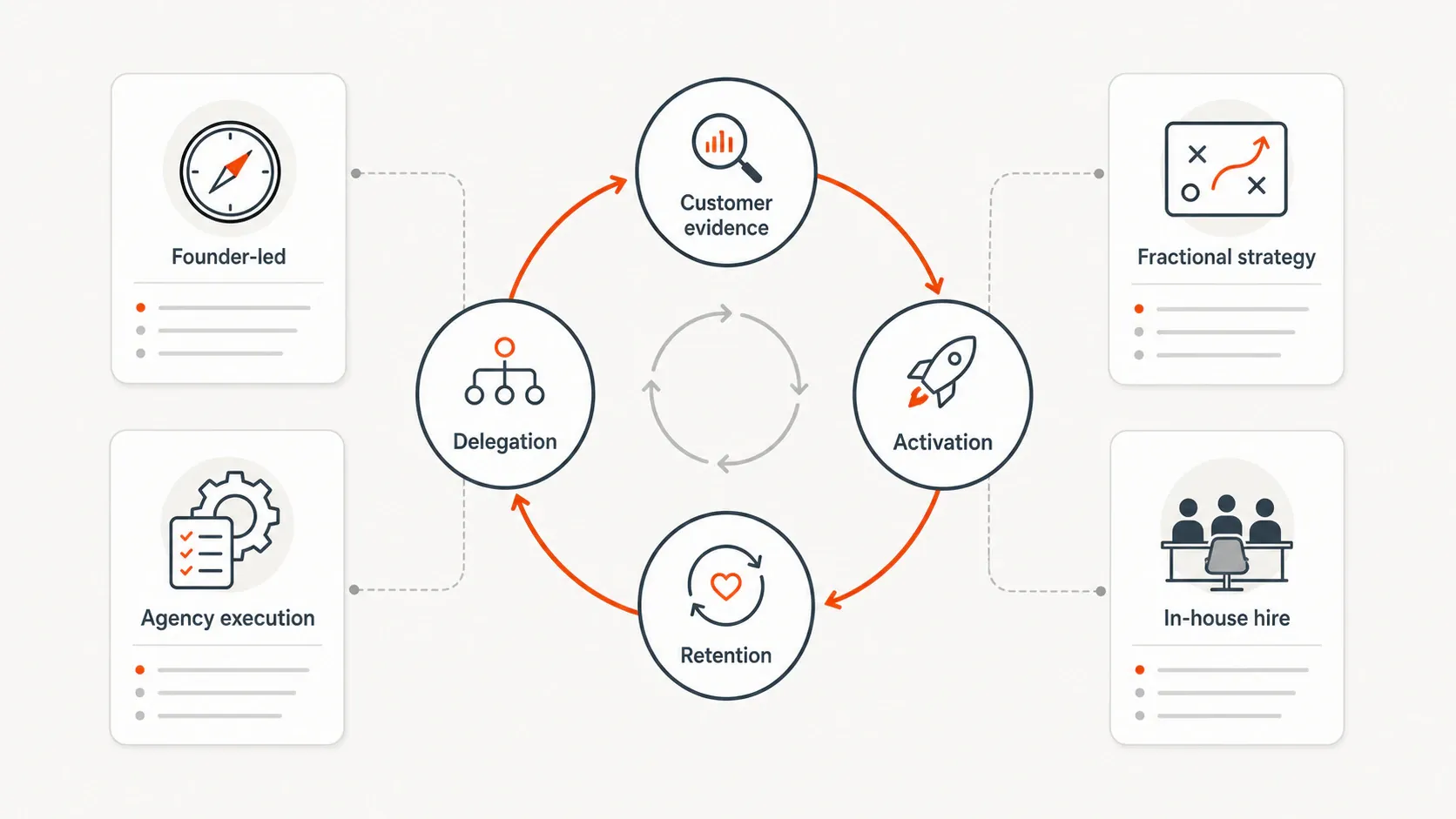
Most early-stage founders trying to grow a startup add more: another channel, another contractor, another tool, another campaign. The harder question is usually not what tactic should we try next? It is who should own the growth loop right now? If ownership is fuzzy, customer learning gets separated from product decisions, messaging drifts from reality, and outside help produces more output than insight. This guide compares four practical ownership models — founder-led growth, fractional strategy, agency or specialist execution, and the first in-house growth hire — so you can choose the current owner of learning, prioritization, execution, or operations before you add more to the system.
First, define what growth work must protect
Early growth is not just demand generation. It is a loop: customer evidence, first-value journey improvements, distribution, messaging, follow-up, and weekly decisions. If that loop breaks, more traffic can simply expose the same weak activation, unclear promise, or scattered customer context at a higher volume.
A useful diagnostic model is the AARRR framework: Acquisition, Activation, Retention, Referral, and Revenue. PostHog describes AARRR as a way to understand customer behavior across those stages, while Amplitude defines it as a startup framework for product-led growth covering acquisition, activation, retention, referral, and revenue (PostHog, Amplitude). The point is not to worship the acronym. The point is to ask which stage is leaking before you decide who should own the work.
For most small product teams, activation and retention deserve special attention before scaling acquisition. RevenueCat’s guidance on pre-product-market-fit metrics emphasizes behavioral activation, time to first value, early retention, and qualitative feedback over vanity metrics such as downloads or signups (RevenueCat). If new users do not reach value or return, delegating acquisition can make the founder feel busier without making the company healthier.
This is where operating context matters. FounderHQ helps early-stage product teams build product journeys, compose founder-led content, and keep company context in one focused operating system. That matters because the decision to delegate growth is safer when journey notes, founder messaging, customer language, and decisions live somewhere reusable instead of disappearing across docs, chats, and drafts.
The four ownership models for growing a startup
There are many growth tactics, but there are only a few realistic ownership models for a tiny team. You can keep the loop founder-led, bring in fractional strategy, hire an agency or specialist, or make a first in-house growth hire. Each model can work. Each model fails when it is used to solve the wrong bottleneck.
Model 1: Founder-led growth
The founder owns customer conversations, product journey changes, positioning, content, distribution cadence, and the weekly review. This is the right default when the company is still learning who buys, why they care, what first value looks like, or why users churn.
Model 2: Fractional growth leader or fractional CMO
A senior part-time operator helps prioritize, shape positioning, design the operating cadence, and make stop/scale/fix decisions. Recent fractional CMO guidance consistently distinguishes strategy from hands-on execution: fractional leaders are strongest when there is enough signal to prioritize and enough internal capacity to ship (Graystone Consulting, MarketerHire).
Model 3: Agency or specialist contractor
An agency or specialist adds execution capacity for a defined channel, campaign, creative asset, paid test, SEO project, lifecycle flow, or content package. GuidantCMO describes agencies as a fit when a business needs fast execution or channel testing without hiring full-time (GuidantCMO). The catch is that agencies need a strong brief, success criteria, and company context.
Model 4: First in-house growth hire
A first in-house hire takes day-to-day ownership of a repeatable motion. This is strongest when the company has enough validated work to justify permanent ownership: a clear ICP, a known first-value journey, a distribution or sales motion with evidence, and enough decision history for the role to inherit.
Comparison table: choose the model by bottleneck, not ego
The fastest way to choose the wrong growth model is to make the decision about status. Hiring a senior strategist can feel mature. Hiring an agency can feel like momentum. Hiring in-house can feel like commitment. None of that matters if the bottleneck is still customer learning.
Use the table below as a buying filter before you spend budget or add another person to the loop.
Ownership model | Best when | Dangerous when | What the founder still owns | What to measure | Avoid |
|---|---|---|---|---|---|
Founder-led | ICP, messaging, activation, or retention is still unclear | The founder never turns learning into reusable assets | Customer conversations, promise, first-value definition, weekly decisions | Qualified conversations, activation events, early retention, objections | Doing everything manually forever |
Fractional strategy | There is signal, but prioritization is hard | The team needs hands-on shipping more than advice | Final calls on positioning, resourcing, and trade-offs | Decision velocity, clearer priorities, experiments shipped | Strategy decks with no internal operator |
Agency or specialist | Channel and brief are clear | You expect the agency to discover the strategy from scratch | Positioning, customer language, success criteria | Channel-specific leading indicators and downstream activation | Output detached from product learning |
First in-house hire | A motion is repeatable enough for daily ownership | Every week is a new strategy | Company context, role scope, decision standards | Cadence consistency, learning captured, motion improvement | Hiring a generalist into chaos |
Use activation and retention as the delegation gate
Before you delegate acquisition, inspect activation. Can a new user or prospect understand the promise, take the first meaningful action, and experience value without the founder personally rescuing the journey every time? If not, the next growth owner may simply push more people into the same leak.
That does not mean you need perfect retention benchmarks before doing any marketing. It means you need a baseline you trust. Track a small set of indicators your team can actually review: signup completion, first key action, time to first value, returning users, qualified replies, sales objections, support questions, and self-reported reasons for buying or leaving.
The goal is not to compare your tiny product against a generic benchmark from a different category. The goal is to compare each week against your own baseline. If activation improves after a journey change, you learned something. If a founder-led post creates qualified replies but those users stall in onboarding, you learned something. If an agency increases traffic but activation stays flat, you learned something expensive.
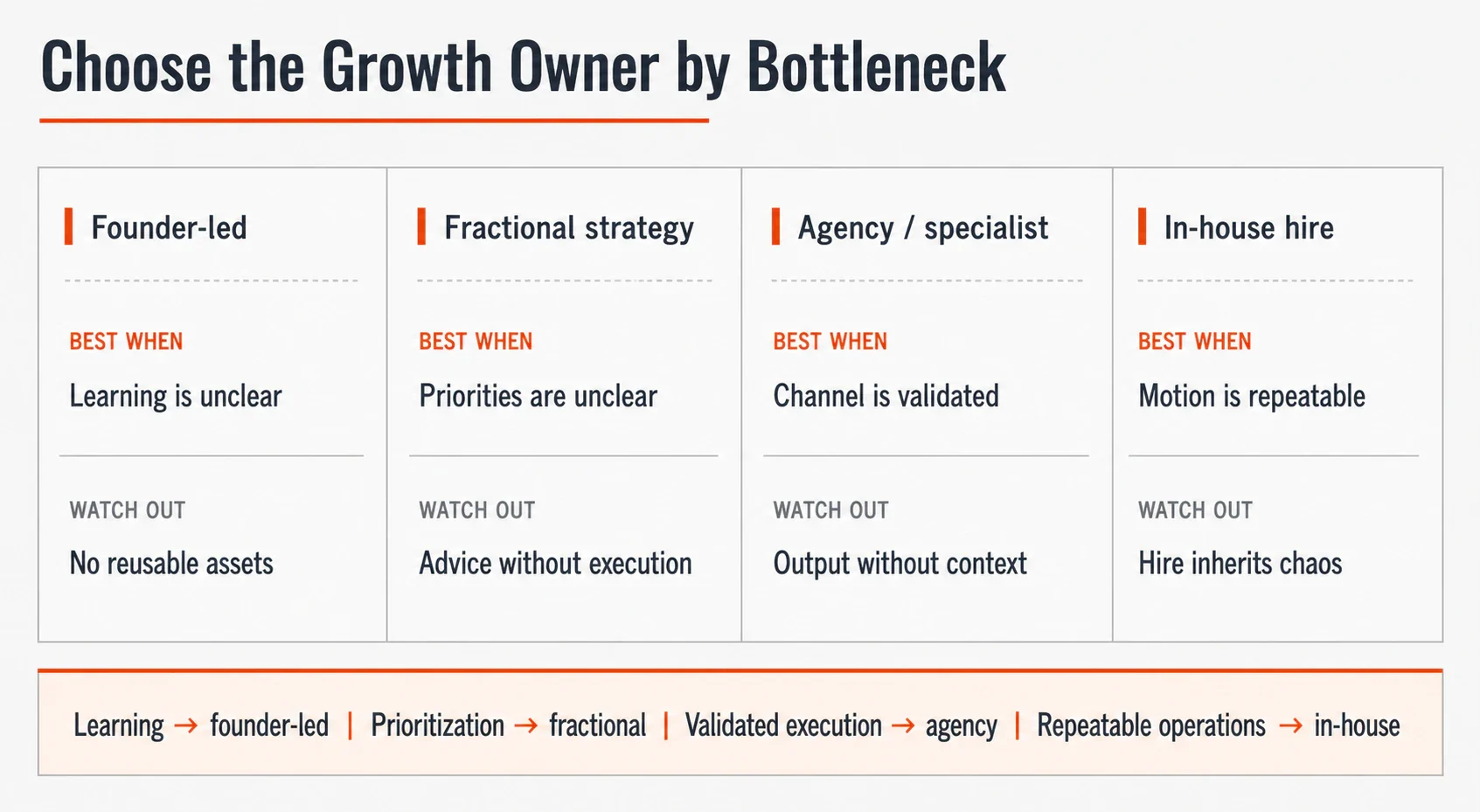
The infographic below summarizes the practical decision rule: the owner should match the bottleneck, not the founder’s anxiety.
When to stay founder-led
Stay founder-led when the company is still learning the basics: who the best customer is, what promise earns attention, what first value actually means, why users hesitate, and why customers stay or churn. This is not a moral argument that founders should do everything. It is a sequencing argument. Some learning is too close to product and positioning to outsource early.
A founder-led growth loop can be simple:
- Talk to customers or high-intent prospects every week.
- Improve one step in the first-value journey.
- Publish one useful founder-led insight from real operating work.
- Log objections, phrases, questions, and activation signals.
- Review what changed before adding another channel.
This is also where reusable context matters. A founder who captures journey decisions, drafts, objections, and customer language is not trapping growth inside their head. They are creating the materials a future strategist, agency, or hire will need. The related FounderHQ guide on building a proof loop before adding more channels is useful if your next bottleneck is turning customer evidence into stronger assets.
Do not confuse founder-led with founder-buried. Founder-led growth should produce reusable assets: positioning notes, journey changes, content drafts, customer-language libraries, and decision logs. If every week starts from a blank page, the founder is not leading a growth loop; they are absorbing all the coordination cost.
When to bring in fractional strategy
Bring in fractional strategy when you have enough customer signal to make decisions, but the founder is the bottleneck on prioritization. This often shows up as a team that has conversations, early users, content ideas, maybe a few channel signals — but no clear way to decide what to stop, what to scale, and what to fix.
A fractional growth leader or fractional CMO should help with judgment: ICP sharpening, positioning, channel sequencing, operating cadence, measurement, and hiring or agency decisions. External guidance on fractional CMO models repeatedly frames the role as senior direction and system design, not a replacement for execution capacity (Graystone Consulting, MarketerHire).
Use this checklist before you buy fractional strategy:
- You can describe your ICP in plain language.
- You have at least rough activation or retention signal.
- Someone inside the company can execute weekly.
- The founder is willing to make trade-offs instead of adding every idea.
- The scope is specific: positioning, channel prioritization, operating cadence, hiring plan, or agency oversight.
The failure mode is advice without shipped work. If there is no internal operator, no weekly review, and no decision owner, a fractional leader may create a better plan that still dies in the same execution gap.
When to hire an agency or specialist contractor
Hire an agency or specialist when the channel, deliverable, and success criteria are already clear. This might be a paid search test, a landing page package, a technical SEO cleanup, lifecycle email setup, founder-led content editing, analytics implementation, or creative production.
The agency advantage is speed and specialization. You can access skills that would be hard to hire full-time, start faster than a recruiting process, and test a defined motion without permanently expanding the team. GuidantCMO notes that agencies are often useful when a business needs fast execution or wants to test new marketing channels without hiring full-time (GuidantCMO).
The agency risk is context loss. If your positioning, customer language, product journey notes, and success criteria are scattered, the agency will fill the gaps with assumptions. That may produce polished output that sounds plausible but does not move the actual growth bottleneck.
A strong agency brief should include: the target customer, the current AARRR leak, the offer or promise, the customer language you want preserved, what counts as success, what counts as a false positive, and who inside the company reviews results. Keep strategy and learning close to the founder even when execution is external.
When to make the first in-house growth hire
Make the first in-house growth hire when the loop is repeatable enough that day-to-day ownership matters more than outside advice. The best first hire does not magically discover the whole growth strategy alone. They inherit a focused problem, a body of customer context, a working cadence, and enough evidence to improve the motion.
Good signs you are ready include a clear ICP, a known first-value journey, a repeatable distribution or sales motion, documented objections, a simple measurement habit, and a founder who can explain which decisions the hire owns. If every week is a different strategy, the hire inherits chaos instead of a role.
In-house ownership is strongest when institutional knowledge matters. The person learns the product, customers, founder voice, sales objections, onboarding friction, and decision history over time. That depth is hard for an external partner to match, but it only compounds if the company already preserves context instead of forcing the hire to rediscover it.
A practical decision worksheet for founders
Use these five questions before choosing a growth owner:
- What is the current growth bottleneck? Is it learning, prioritization, execution capacity, or repeatable operations?
- What customer evidence supports that diagnosis? Look for conversations, behavior, objections, activation data, retention patterns, or qualified replies.
- Which AARRR stage is leaking? Acquisition, Activation, Retention, Referral, or Revenue?
- Who can execute weekly? Founder, internal operator, contractor, agency, or new hire?
- What context must not be lost? Customer language, product journey notes, positioning decisions, content angles, objections, or follow-up rules?
Then apply a simple rule: if the bottleneck is learning, stay founder-led. If the bottleneck is prioritization, consider fractional strategy. If the bottleneck is execution on a validated channel, consider an agency or specialist. If the bottleneck is repeatable operations, consider an in-house hire.
For example, a 2-person SaaS team with ten active design partners, messy onboarding notes, and no clear activation baseline probably does not need a paid acquisition agency yet. The better owner is still the founder, with a narrow weekly loop: interview users, fix one onboarding step, document objections, and only then decide whether fractional strategy or execution help would compound.
The “do not buy yet” rule is just as important: if you cannot define the customer, first-value moment, current leak, or weekly review cadence, do not solve the discomfort with a bigger commitment. Run the loop manually long enough to know what kind of help would actually compound.
How FounderHQ fits into the ownership decision
FounderHQ helps early-stage product teams keep product journeys, founder-led content, and company context connected while they decide what to delegate. That makes it useful when the founder still owns judgment, but needs a more focused operating layer for the work that surrounds that judgment.
That distinction matters. If growth stays founder-led, the founder needs less blank-page work and a better way to turn customer learning into journeys, drafts, and reusable memory. If a fractional strategist joins, they need context to make better prioritization calls. If an agency executes, they need a clear brief and customer language. If the company hires in-house, the new owner needs a decision history instead of a pile of disconnected docs.
The practical benefit is continuity. Product journey changes, founder-led messaging, and customer context should not reset every time the team adds help. When the operating context is preserved, delegation becomes less risky because the next person is joining a living growth loop, not guessing from scratch.
Conclusion
To grow a startup, make the ownership call before the tactic call. Ask who should own the current growth loop: learning, prioritization, execution, or repeatable operations. Keep it founder-led while customer learning, activation, or retention is unclear. Bring in fractional strategy when prioritization is the bottleneck and someone can execute. Hire an agency when the channel and brief are already defined. Make the first in-house hire when the motion is repeatable enough for permanent ownership. The best model is the one that protects learning, ships consistently, and preserves the context future growth decisions depend on.
Related articles

Application Onboarding Process: Definition, Steps, and When to Use It
A practical seven-step application onboarding process for moving new users from signup to first meaningful value without unnecessary setup or generic tours.

In-App Analytics for Onboarding: Definition, Metrics, and When to Use It
In-app analytics for onboarding turns events, funnels, segments, and user feedback into decisions about the path from signup to first value.

In-App Guidance for Onboarding: Definition, Examples, and When to Use It
In-app guidance helps users complete meaningful tasks inside a product. This guide explains the main patterns and how to match each one to an onboarding blocker.