FounderHQJul 5, 202614 min read
Grow a Startup by Building a Customer-Proof Loop, Not Another Tactics List
To grow a startup, tiny teams should stop choosing channels first. Use this buyer’s guide to identify the customer proof you are missing, then route that evidence into a journey...

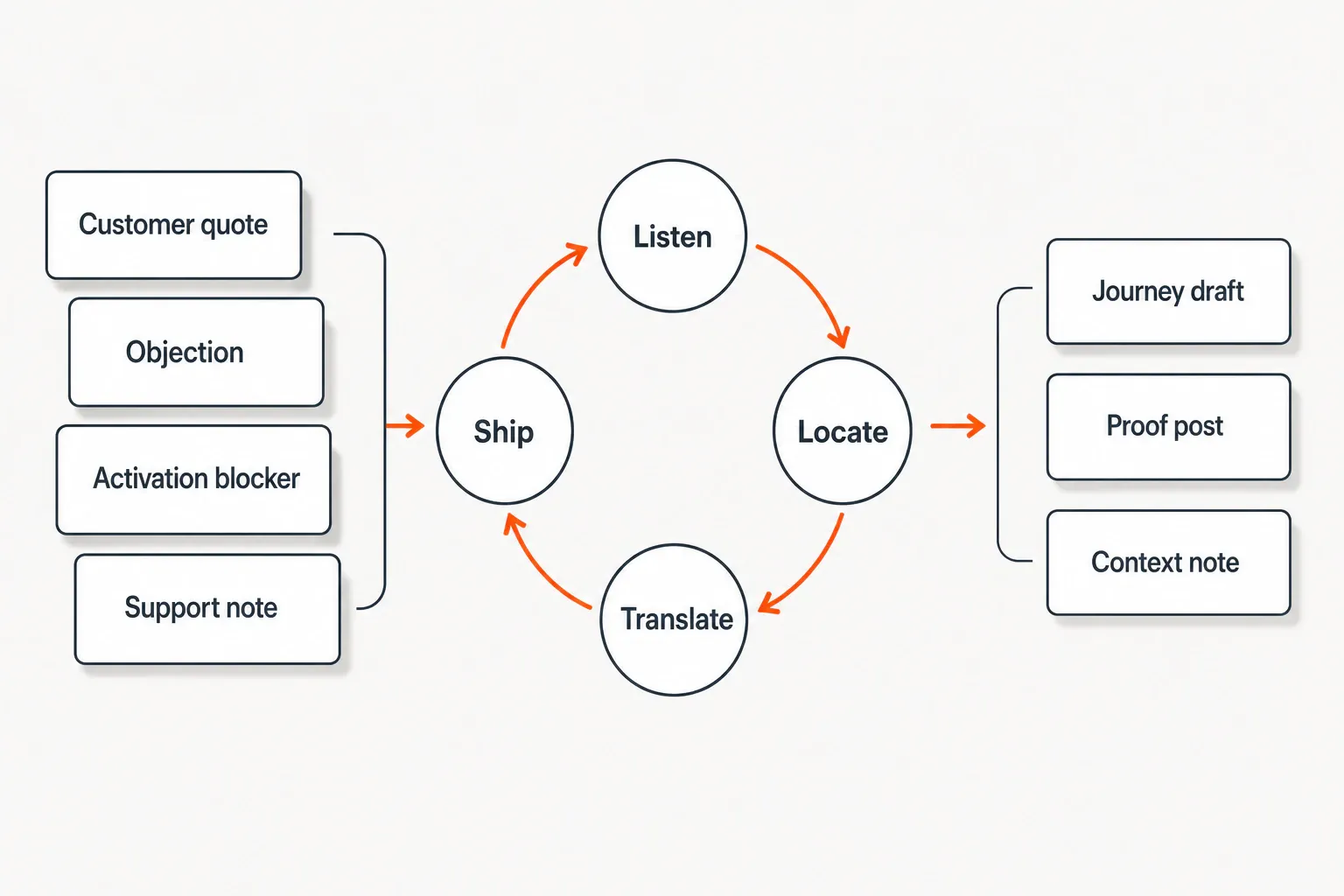
When growth feels stuck, the easiest move is to add something: another channel, another tool, another content calendar, another campaign. But for a solo founder or 2–3 person team, the bottleneck is often not effort. It is unprocessed customer proof. Useful signals are already scattered across calls, support threads, onboarding confusion, churn notes, sales objections, and founder DMs, but they are not being captured, validated, reused, or routed into the next growth asset. This guide reframes how to grow a startup as a customer-proof loop decision: collect the raw evidence, decide which proof gap it exposes, turn one signal into a shipped journey, message, or context note, and repeat weekly.
Why most grow-startup advice breaks for tiny teams
Most startup growth advice is written as if the reader has a growth pod: someone for analytics, someone for lifecycle marketing, someone for content, someone for product experiments, and someone to keep the operating cadence alive. Tiny teams do not have that. The founder is usually the product owner, researcher, copywriter, distribution lead, and reviewer.
That is why broad tactics lists underperform. “Do SEO,” “post on LinkedIn,” “try referrals,” or “run paid tests” may all be valid later, but they do not answer the first operating question: what proof are we missing right now? If the team cannot explain what customers value, where users drop off, which objections keep repeating, or what evidence should change next week’s asset, more distribution usually amplifies the confusion.
The pressure is real. ChartMogul’s SaaS Go-To-Market Report found that, in its dataset, companies below $1M ARR saw new business ARR growth rates fall 34 percentage points since early 2022 and were seeing a median 24% year-over-year decline in new business ARR (ChartMogul). That does not mean every startup should panic-buy tools or chase more channels. It means early teams need a tighter way to turn customer learning into growth assets they can actually maintain.
A better startup growth strategy starts with the smallest loop that connects learning to action: customer evidence, first-value journeys, founder-led proof content, and reusable company context.
The customer-proof loop: the simplest growth system a founder can run
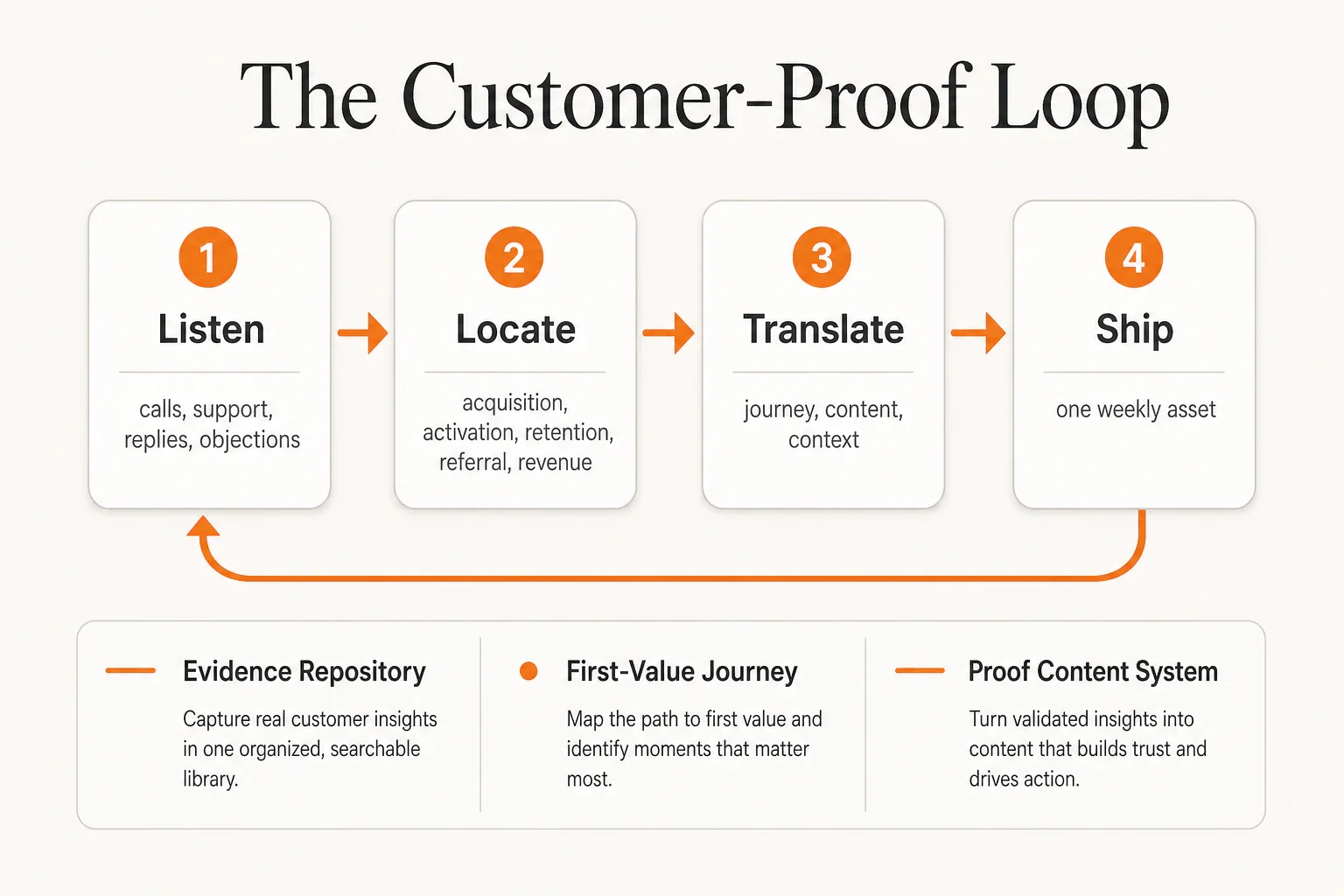
A customer-proof loop is a weekly operating system for turning real user evidence into sharper growth assets. It is intentionally lighter than a growth department and more durable than a one-off campaign.
Use the loop like this:
- Listen: collect customer calls, support notes, onboarding confusion, churn reasons, sales objections, social replies, and moments where users describe value in their own words.
- Locate: map the evidence to the stage where growth is leaking: acquisition, activation, retention, referral, or revenue.
- Translate: turn the strongest proof into one asset: a clearer product journey, a founder-led post or page, or a reusable company-context note.
- Ship: make one improvement per week, then capture what the next batch of users reveals.
The AARRR framework is useful here because it keeps the conversation full-funnel. Amplitude defines AARRR as acquisition, activation, retention, referral, and revenue (Amplitude); Mixpanel similarly describes the five startup metrics as acquisition, activation, retention, referral, and revenue (Mixpanel). The point is not to build a complex dashboard on day one. The point is to stop treating “growth” as only top-of-funnel reach.
The visual below shows the loop as a practical founder cadence: listen, locate, translate, and ship, with the three most common outputs underneath.
Before you choose a system, diagnose the proof gap
A customer-proof loop only works if you know which proof gap you are solving. Before buying a tool or committing to a channel, compare your current symptom with the evidence you do not yet have.
Symptom | Likely proof gap | Next system to build |
|---|---|---|
People sign up, book demos, or try the product, but few reach the value moment | Activation proof: you do not know where users stall or what helps them succeed | Guided first-value journey |
Users like the product in calls, but the market does not understand why it matters | Message proof: you have value, but not enough reusable customer language | Founder-led proof content system |
The founder keeps rewriting the same positioning, onboarding notes, and customer language | Memory proof: learning is scattered across calls, docs, chats, and drafts | Customer-evidence repository |
Content gets engagement but few useful conversations | Intent proof: the content is interesting, but not tied tightly enough to buyer pain | Evidence-backed founder-led content |
Acquisition is growing but retention is weak | Value proof: the promise attracts users before the product reliably delivers first value | First-value journey before more acquisition |
Use a simple decision rule when the symptoms overlap. Message proof is missing when prospects repeat the same “what does this do?” or “how is this different?” question before they try the product. The artifact to create that week is a reusable message note: exact customer words, the misconception, the clearer explanation, and one proof-backed post or page section. Do not build a bigger content calendar yet.
Intent proof is missing when people engage with the topic but do not reveal buying pain, urgency, or a next-step question. The artifact to create is a reply-and-objection log that separates curiosity from real problem language. Do not scale the channel yet.
Activation proof is missing when users understand the promise but stall before the first meaningful action. The artifact to create is a one-path activation note: entry point, expected first-value moment, actual blocker, and the next journey change. Do not add more acquisition until the path is clearer.
Memory proof is missing when the team has heard the same evidence before but cannot find it when writing, building, or reviewing. The artifact to create is a tagged proof card that can be reused in a journey, post, sales note, or positioning decision. Do not create another unstructured doc.
This diagnosis prevents a common early-stage mistake: choosing the system that feels most urgent instead of the system that creates and routes the proof you are missing.
Option 1: Build a customer-evidence repository
A customer-evidence repository is a lightweight home for call notes, support snippets, churn reasons, objections, user language, screenshots of product behavior, and follow-up actions. It is not a research archive for its own sake. It is the memory layer that keeps your growth work from restarting every week.
Choose this if
Choose a customer-evidence repository first if you already talk to users but lose the learning. Common signs include: the team debates positioning from memory, the founder rewrites the same launch copy repeatedly, sales objections disappear into call recordings, or onboarding problems are discussed but never converted into product changes.
What to capture
Keep the capture format small enough to use during a busy week. For each signal, record: exact customer words, job-to-be-done, current workaround, trigger event, objection, activation blocker, proof of value, and the next action it should inform.
A compact example makes the loop concrete. A founder hears this support note: “I signed up because I need to compare vendor options, but the blank workspace made me think I had to build the whole comparison from scratch.” The team tags it as activation proof and message proof: the user has intent, but the first screen fails to show the promised shortcut. The chosen action is not “redesign onboarding.” It is smaller: add one starter template to the first screen, rewrite the empty-state copy around “compare your first three options,” and save the exact phrase “build the whole comparison from scratch” as a future founder-led post angle about blank-page friction. One raw signal becomes a journey change, a reusable context note, and a content prompt.
Pros and trade-offs
The upside is consistency. A repository makes founder-led content more specific, gives product decisions more context, and reduces the cost of re-researching the same problem. The trade-off is that it does not directly fix onboarding or distribution. It only compounds if the team turns notes into shipped assets.
For teams that want product journeys, founder-led content, and company context in one focused operating layer, FounderHQ is relevant because it is positioned around helping early-stage product teams build product journeys, compose founder-led content, and keep company context together.
Option 2: Build a guided first-value journey
A guided first-value journey moves a new user from signup, demo interest, waitlist, quiz, onboarding flow, or first product touch to the earliest meaningful value moment. It is the right system when you have attention but cannot prove users consistently experience the thing you promised.
Choose this if
Choose this system if signups are not the problem, but activation is. Users arrive, click around, ask the same setup questions, abandon the product before completing a key action, or need founder hand-holding to understand the value.
CRV’s guide to growth marketing makes the same sequencing point in broader terms: growth extends through activation, retention, referral, and revenue, not just awareness, and early-stage startups often need to focus on activation and retention before scaling acquisition (CRV). First Round Review’s founder-led growth playbook also emphasizes mapping the customer journey, finding drop-off points, and using customer motivations to identify bottlenecks (First Round Review).
How to build it
Start with one user segment and one first-value moment. Remove setup steps that are not required before value. Add defaults, templates, examples, or empty states that point to the next action. If the user’s intent changes the path, branch the journey instead of forcing everyone through the same checklist. Then review where users still hesitate.
For example, a founder might notice that three demo prospects all say they “just want to see what the final output looks like,” while the current signup flow asks them to configure a full workspace first. That is activation proof, not a demand problem. A useful first-value journey could show a sample output, ask one intent question, and route the user to the shortest relevant setup path before asking for deeper configuration.
Pros and trade-offs
The upside is leverage before scale. A better first-value journey can make every acquisition channel more useful because more users understand and experience the product. The trade-off is that you need enough qualitative or behavioral evidence to know which journey matters. If you guess, you may polish the wrong path.
Option 3: Build a founder-led proof content system
A founder-led proof content system turns customer language, product decisions, activation lessons, and market objections into posts, launch narratives, comparison pages, and useful articles. It is different from generic content marketing because it starts from evidence, not a blank calendar.
Choose this if
Choose this system if the product has a clear value moment but the market is not hearing the story often enough or specifically enough. You may hear users say “I wish I had this earlier,” while your public content still sounds broad, category-level, or interchangeable with every other startup in the space.
What proof content looks like
Proof content can be simple: a founder post that explains a misconception from user calls, a launch note built around the exact problem language customers use, a product lesson from an onboarding blocker, or a comparison page grounded in the objections buyers raise before they convert. You do not need to invent customer metrics or publish private details. The value comes from specificity.
A realistic pattern: three sales conversations include the objection, “We already have a spreadsheet for this.” Instead of writing a generic “why spreadsheets are bad” post, the founder captures the objection, tags it as message proof, and writes a proof-backed post about the moment a spreadsheet stops being a system: when decisions, follow-up, and customer context live in different places. The same signal can also become a comparison-page section and a sales follow-up note.
Pros and trade-offs
The upside is trust. Founder-led proof content helps early teams distribute learning without pretending to be a scaled marketing department. It also feeds future sales, onboarding, SEO, and product messaging. The trade-off is that the system is weak if the evidence layer is thin or if the product journey still fails to deliver value.
Comparison table: which growth system should you choose first?
Use this buyer’s-guide table to choose the next proof system your team should build or buy. Do not use the measures as universal benchmarks. Set a baseline from your own product, audience, and stage.
Growth system | Best for | Choose this if | Avoid this if | Weekly input required | Main proof produced | Buying or building criteria | What to measure |
|---|---|---|---|---|---|---|---|
Customer-evidence repository | Teams losing customer learning | Calls, replies, support, and objections are scattered | You already have clean evidence but users still do not reach value | 5–10 captured signals, tagged by theme | Reusable customer language and decision context | Must make capture fast, support tagging by proof type, preserve exact words, and let notes be reused in journeys, content, and decisions | Proof notes captured, repeated objections, customer-language reuse |
Guided first-value journey | Teams with interest but weak activation | Users sign up or book demos but stall before value | You do not yet know who the product is for | Review of one activation path and one shipped improvement | Evidence of where users reach or miss first value | Must support a clear first-value path, branching by intent, fast copy or step edits, and weekly review of where users hesitate | First-value completion, activation blockers removed, qualitative onboarding feedback |
Founder-led proof content system | Teams with value but weak market understanding | Customer calls are strong, but public messaging is vague | You have no real customer proof to draw from | One proof-backed post, page, or launch note | Market-facing proof and sharper narrative | Must connect drafts to source evidence, reuse customer language, keep founder voice consistent, and route replies back into the evidence layer | Useful replies, content-to-conversation signals, objection clarity |
If you are buying software, evaluate the workflow before the feature list. The useful question is not “Does it have AI?” or “Does it have every growth feature?” It is whether the system reduces the distance between raw evidence and shipped assets. Look for five practical capabilities: fast evidence capture, proof-type tagging, journey creation or editing, founder-led content drafting from saved context, and a weekly review view that makes the next action obvious.
If you are building the system manually, keep the same bar. A spreadsheet can work if it preserves exact customer words, tags signals consistently, and makes reuse easy. A doc can work if it does not become a graveyard. A point-tool stack can work if the handoff from evidence to journey, content, and context is clear. If the system requires a founder to re-read everything from scratch each week, it is not a proof loop yet.
If two systems look equally urgent, choose the one closest to the user’s current failure point. If users do not understand the product before signup, start with proof content. If they understand it but fail after signup, start with the first-value journey. If the team cannot remember what users said last week, start with the evidence repository.
The lightest 30-day implementation plan
You do not need a complex growth stack to begin. You need one month of disciplined proof capture and one shipped improvement per week.
Week 1: capture and tag proof
Gather evidence from 5–10 recent user interactions: calls, support threads, demos, onboarding sessions, churn notes, founder DMs, sales replies, or product analytics notes. Copy exact phrases where possible. Tag each signal by proof type: message, intent, activation, value, or memory. Do not summarize everything into generic labels too quickly; the user’s wording is part of the asset.
Week 2: validate the pattern
Sort the evidence into acquisition, activation, retention, referral, and revenue. Then identify the stage where the strongest pattern appears. Validate the pattern with one lightweight check: replay the signup path, review recent support notes, ask one follow-up question, or compare the signal with a second user segment. A single repeated activation blocker is more useful than a spreadsheet full of vague engagement numbers.
Week 3: route proof into one asset
Turn the strongest signal into one concrete asset: a rewritten onboarding step, a guided first-value flow, a founder-led proof post, a better comparison section, or a reusable context note. Write down the route explicitly: raw signal → proof type → chosen action → asset shipped. Keep it small enough to ship inside the week.
Week 4: review reuse
Review what changed. Did users move faster? Did replies get more specific? Did sales calls require less explanation? Did a repeated objection become clearer? Capture the new proof, then decide whether to deepen the same system or move to the next one.
A simple end-of-month review can be enough: Which proof type repeated most often? Which shipped asset reused real customer language? Which signal should influence the next journey or founder-led post? Which signals are still too weak to act on? That review is what turns the month from a batch of notes into a working customer-proof loop.
Where FounderHQ fits in the decision
FounderHQ fits when the founder wants one focused place to connect the work that usually gets scattered: product journeys, founder-led content, and company context. That matters because the customer-proof loop is not just a research exercise. It needs to become journeys users experience, content the market can understand, and reusable context the team can carry forward.
The right buying question is not “Can this tool magically grow the company?” It is: will this operating layer reduce the weekly friction between what we learn, what we build, what we publish, and what we remember?
For an early team skeptical of adding another tool, that is the honest bar. If your current docs, spreadsheets, and point tools already preserve proof and help you ship weekly assets, keep them. If the system keeps fragmenting, a unified workspace for journeys, founder-led content, and company context may be worth evaluating.
Final decision rule: choose the system that creates the proof you are missing
The fastest way to waste founder time is to scale a tactic before you know what proof it is supposed to create. Use this decision rule instead:
- If you do not know what users value, build the customer-evidence repository first.
- If users do not reliably reach value, build the guided first-value journey first.
- If the market does not hear the value clearly, build the founder-led proof content system first.
The best startup growth system is not the most sophisticated one. It is the one a small team can run every week without restarting from scratch.
Conclusion
To grow a startup, stop treating growth as a channel shopping exercise. Treat it as a proof loop. Capture what real users reveal, locate the leak, translate that evidence into a journey or narrative, and ship the next asset. When the loop is small enough to run weekly, growth work becomes less about chasing tactics and more about compounding customer understanding into sharper execution.
Related articles

Application Onboarding Process: Definition, Steps, and When to Use It
A practical seven-step application onboarding process for moving new users from signup to first meaningful value without unnecessary setup or generic tours.

In-App Analytics for Onboarding: Definition, Metrics, and When to Use It
In-app analytics for onboarding turns events, funnels, segments, and user feedback into decisions about the path from signup to first value.

In-App Guidance for Onboarding: Definition, Examples, and When to Use It
In-app guidance helps users complete meaningful tasks inside a product. This guide explains the main patterns and how to match each one to an onboarding blocker.