FounderHQJun 29, 202611 min read
How to Grow Twitter Followers Without Chasing Empty Reach
A practical guide for early-stage founders who want to grow Twitter/X followers by building a repeatable content and reply system instead of chasing vanity reach.


Growing Twitter followers, or X followers, only helps if the right people decide you are worth hearing from again. For an early-stage founder, that usually means buyers, builders, operators, investors, category peers, and future collaborators—not random accounts collected through follow-for-follow tactics, engagement pods, bought followers, shallow viral takes, or automated mass DMs. X still has enormous reach: X Business cites 535 million global monetizable monthly active users from Q1 2024, while DataReportal reported 586 million ad-reachable users in January 2025 and cautioned that ad reach is not the same as monthly active users (X Business, DataReportal). The useful founder question is not “How do I reach everyone?” It is “How do I become easy to understand, easy to find, and worth following by the people I want more conversations with?”
What Actually Makes Someone Follow You on X
Follower growth usually moves through three moments: someone discovers a post or reply, clicks into your profile, and decides whether future posts from you are likely to be useful. If any step is weak, more posting will not fix the system. A great reply with a confusing profile loses people. A polished profile with scattered posts gives them no reason to stay. A viral post that has nothing to do with your market can bring attention without trust.
X’s own documentation supports this broader view. The For You timeline can include recommended posts from accounts someone does not follow, and X says it uses a variety of signals, including popularity, network interaction, followed accounts, Topics, relevance, credibility, and safety (X Help: For You timeline). X also says Top search results are algorithmic and consider relevance, popularity, keywords, reposts, replies, and other factors (X Help: Search results).
That means a founder account should send a consistent signal to both people and the platform: who you help, what you understand, what conversations you belong in, and what kind of insight someone can expect if they follow you. Follower growth comes from repeated relevance, not one-off reach.
Step 1: Choose the Audience You Want More Of
Before you try to grow Twitter followers, define what “more” means. More followers from your target market is useful. More followers who will never buy, recommend, reply, or learn from your work is mostly noise.
Use this quick positioning worksheet before you post for another week:
- Who should follow you? Be specific: “B2B SaaS founders improving activation,” not “startup people.”
- What problem do they care about? Name the repeated tension they feel.
- What do you see that they do not? Pull from product decisions, customer conversations, or market learning.
- What should they remember you for? Choose a narrow but expandable lane.
- What conversations should your replies appear in? List the topics, not just the accounts.
For a founder building a product-led company, useful lanes might include app onboarding teardown notes, launch messaging decisions, activation experiments, build-in-public lessons, product journey examples, or founder-led content systems. The lane should be narrow enough that a visitor understands you quickly, but broad enough that you can write from real work for months.
Step 2: Make Your Profile Convert Before You Post More
Your profile is the conversion page for your X account. If someone clicks through after seeing a post, they are asking one question: “Will this person keep being relevant to me?”
Buffer’s guide to growing an X/Twitter following recommends starting with a profile audit, including the profile photo, cover image, 160-character bio, website link, and pinned post (Buffer). For founders, translate that into a practical checklist:
- Photo or mark: clear enough to recognize in replies.
- Bio: who you are, who you write for, and what people will learn.
- Credible context: what you are building, researching, or operating.
- Link: one useful next step, not a cluttered maze.
- Pinned post: your thesis, best thread, product story, or “what I’m building and what I write about” post.
Do not over-optimize for cleverness. A clever bio that makes people decode your work is usually weaker than a clear one. If you write about onboarding for developer tools, say that. If you share founder lessons from building a vertical SaaS product, say that. The profile should make the follow decision easy.
Step 3: Build 3–5 Content Pillars You Can Sustain
Most founders do not need a massive content calendar. They need a few repeatable lanes that turn real work into useful posts. Buffer’s 2026 X guide recommends defining a content plan around what you will post, how often, when, and which formats you will use, starting with three to five content pillars (Buffer).
A founder-led X content strategy can start with these pillars:
- Lessons from building: what changed, broke, shipped, or surprised you.
- Customer or problem insight: objections, repeated language, or misunderstood pain.
- Useful frameworks: checklists, decision rules, teardown structures, or mini playbooks.
- Product and market opinions: what you believe about your category and why.
- Behind-the-scenes decisions: positioning changes, onboarding choices, launch tradeoffs, and constraints.
- Curated resources: a small number of high-signal links, tools, or examples with your explanation attached.
X rewards conversation more naturally than a polished essay format. Mix standalone insights, short stories, lightweight threads, questions that invite useful replies, and native screenshots or diagrams when they clarify an idea. The goal is not to sound like a media company. It is to become consistently useful in the conversations your market already cares about.
Step 4: Use Replies as a Discovery Engine
Posting and leaving is a weak strategy for a small account. X is a public conversation network. Replies are not a side activity; they are one of the fastest ways to show expertise where your future followers already spend attention.
X describes replies and mentions as core ways to join conversations, and says replies may be ranked using factors such as whether the original author has replied, whether the reply is from someone the viewer follows, and other relevance signals (X Help: Replies and mentions). That does not mean you can engineer the system with a simple formula. It means thoughtful, relevant replies have a real role in discovery.
Build a daily reply list of 10–20 relevant founders, operators, investors, customers, category writers, or product leaders. Then reply with something that adds value:
- A specific example from your work.
- A useful counterpoint.
- A short framework.
- A clarifying question.
- A customer-language observation.
- A tradeoff the original post did not mention.
Weak reply: “Great point.” Stronger reply: “We saw this in onboarding too. Users did not need another tutorial; they needed one clearer first action. The activation rate only made sense once we separated ‘understood the product’ from ‘took the first useful step.’”
The stronger reply gives readers a reason to click into the profile. It shows judgment, not just agreement.
Step 5: Post Consistently, But Do Not Turn the Account Into a Chore
There is no universal posting frequency that works for every founder. A solo founder with customer calls, product work, support, hiring, and fundraising cannot run the same cadence as a full-time creator. Choose a rhythm you can keep for 30 days before you optimize it.
A practical starting cadence is one useful post per weekday plus one or two daily reply blocks. That is enough to create visible repetition without turning X into the whole job. If you have more capacity, add threads or deeper posts later. If you have less capacity, protect the reply habit and the weekly review.
Use one weekly creation block:
- Capture raw decisions, customer phrases, objections, and product notes.
- Draft several posts from those notes.
- Rewrite for clarity and specificity.
- Schedule or save drafts.
- Leave room for real-time replies when conversations appear.
This is where company context matters. FounderHQ helps early-stage product teams build product journeys, compose founder-led content, and keep company context in one focused operating system. For X growth, the useful idea is simple: your best posts often come from decisions you already made, not from staring at a blank compose box.
Step 6: Create Posts From Real Founder Work
Generic advice is easy to ignore because it sounds detached from constraints. Founder-led content works best when it carries the texture of real decisions: what you tried, what you learned, what changed, and what you would do differently.
Use these sources for posts:
- Product decisions you debated.
- Customer objections that repeated.
- Onboarding friction you noticed.
- Pricing questions that exposed confusion.
- Launch lessons.
- Support tickets that revealed a pattern.
- Failed experiments.
- Internal frameworks your team uses.
- Before-and-after messaging edits.
- Tradeoffs between speed, clarity, quality, and scope.
Turn those inputs into simple templates:
- “We changed X after seeing Y.”
- “A mistake we made while building Z…”
- “If I were onboarding users again, I would start with…”
- “The unpopular thing about [category] is…”
- “Here is the checklist I use before shipping…”
- “This looked like a growth problem, but it was actually a positioning problem.”
Specificity is the advantage. “Talk to customers” is forgettable. “The third onboarding screen was answering a question users did not have yet” is useful. The more clearly you show the constraint, the more credible the lesson becomes.
Step 7: Turn Engagement Into Better Followers, Not Just More Notifications
Follower count is a lagging indicator. It tells you something happened, but not whether the right people are becoming more interested. A founder should care more about follower quality, profile visits, replies from target accounts, relevant reposts, useful DMs, and conversations that reveal market signal.
Buffer’s Twitter analytics guide recommends comparing impressions with engagement rate and new followers, treating profile clicks as a sign of interest, and mapping follower spikes or dips to posts from the previous 24–48 hours (Buffer). That is the right mindset for founders: connect the metric back to the behavior that caused it.
Run a weekly review with a table like this:
Post topic | Format | Hook | Impressions | Replies | Reposts | Profile visits | New followers | Relevant conversations | Next decision |
|---|---|---|---|---|---|---|---|---|---|
Onboarding friction | Short story | “Users did not need education…” | Review | Review | Review | Review | Review | Which accounts replied? | Expand, repeat, or cut |
Launch positioning | Opinion | “The homepage promise was too broad…” | Review | Review | Review | Review | Review | Did buyers engage? | Rewrite pillar |
Founder workflow | Checklist | “Before shipping, I check…” | Review | Review | Review | Review | Review | Did builders save or reply? | Turn into thread |
Double down on posts that attract the right conversations, not just broad reach. A post that brings five serious replies from your target market may be more valuable than a post that earns thousands of impressions from people who will never care about your product.
A 30-Day Founder-Led X Growth Loop
A 30-day loop gives you enough time to see patterns without pretending social growth is predictable. Treat the month as a learning sprint, not a guaranteed follower-count challenge.
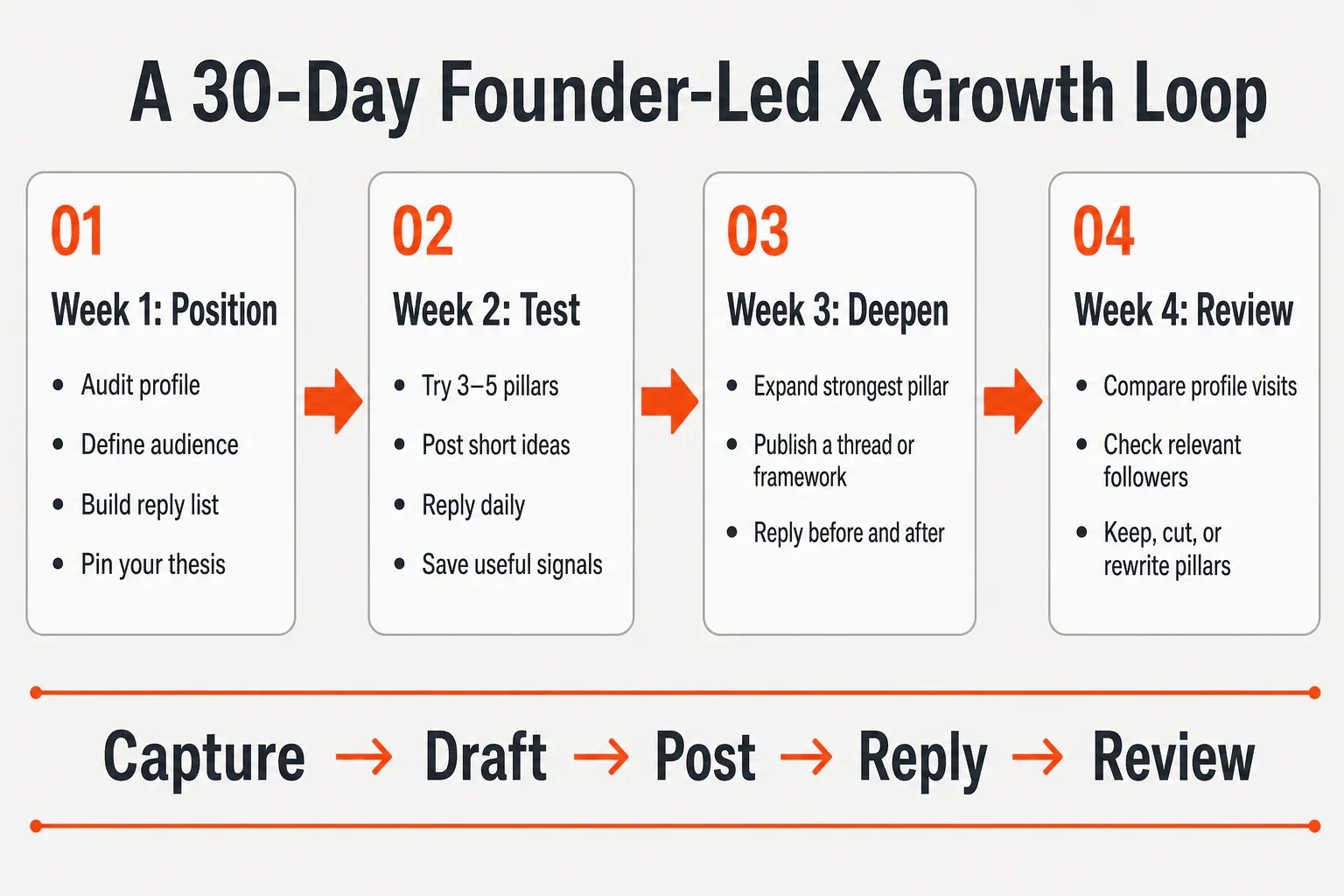
Use the loop below as a simple operating rhythm. The point is to reduce random posting and make every week answer one question: what made the right people stop, click, reply, or follow?
Week 1: Position
Audit your profile, define the audience, build your reply list, and publish or pin a post that explains what you are building and what you write about. Do not wait for the perfect brand voice. Make the account understandable first.
Week 2: Test
Publish short posts across three to five content pillars. Reply daily to relevant conversations. Save the posts, replies, and topics that produce useful profile visits or conversations.
Week 3: Deepen
Turn the strongest pillar into a thread, diagram, teardown, or mini-framework. Keep replying before and after you publish so the post is part of a live conversation, not a broadcast dropped into the feed.
Week 4: Review
Compare profile visits, engagement rate, relevant replies, reposts, new followers, and follower quality. Keep the pillars that attracted the right people. Cut or rewrite the ones that created noise.
Common Mistakes That Slow Twitter Follower Growth
The biggest mistake is treating X like a lottery. Viral posts can happen, but a founder cannot build a dependable growth habit around hoping the next post takes off.
Avoid these patterns:
- Posting links as the main event. If you share a link, make the post itself useful first.
- Writing for everyone. A broad audience often creates weak signal.
- Confusing impressions with trust. Visibility is not the same as credibility.
- Using AI to mass-produce generic posts. AI-assisted drafting can help, but founder-specific context is what makes posts worth reading.
- Replying only to huge accounts. Smaller, more relevant conversations can create better followers.
- Changing topics every few days. Scattered topics make the account harder to categorize and harder to remember.
- Ignoring the profile. If the profile does not convert, every good post leaks potential followers.
The better habit is boring in the right way: choose a lane, post useful work, reply with substance, review the signals, and keep improving.
Where FounderHQ Fits for Founders Who Want a Repeatable Content System
A founder-led X system depends on reusable context. The same product decisions, customer objections, onboarding lessons, launch notes, category beliefs, and high-signal replies can become posts, threads, articles, product journeys, and follow-up ideas if they are captured instead of scattered across docs and drafts.
FounderHQ helps early-stage product teams build product journeys, compose founder-led content, and keep company context in one focused operating system. For X specifically, that matters because many of the best content ideas start as small signals: a reply that reveals better customer language, a profile visit after a positioning post, a repeated objection, or a content pillar that keeps attracting the right accounts.
Used well, a repeatable content system does not replace the founder’s point of view. It gives that point of view a better place to compound: save the reply insight, connect it to a content pillar, draft the next post from real context, and bring the lesson into the next weekly review.
Conclusion
If you want to grow Twitter followers as a founder, start with relevance before reach. Make the profile easy to understand, choose a topic lane you can sustain, publish from real work, use replies as a discovery engine, and review follower quality every week. The best X growth system is not a bag of hacks. It is a lightweight operating loop that helps the right people keep seeing useful proof that you understand their world.
Related articles

Application Onboarding Process: Definition, Steps, and When to Use It
A practical seven-step application onboarding process for moving new users from signup to first meaningful value without unnecessary setup or generic tours.

In-App Analytics for Onboarding: Definition, Metrics, and When to Use It
In-app analytics for onboarding turns events, funnels, segments, and user feedback into decisions about the path from signup to first value.

In-App Guidance for Onboarding: Definition, Examples, and When to Use It
In-app guidance helps users complete meaningful tasks inside a product. This guide explains the main patterns and how to match each one to an onboarding blocker.