FounderHQJul 10, 202610 min read
How to Grow My App by Fixing the First-Value Loop Before Buying More Installs
Growing an app is not about stacking more tactics. Use this first-value loop to find the leak, improve activation and retention, then scale the channels that bring qualified users.

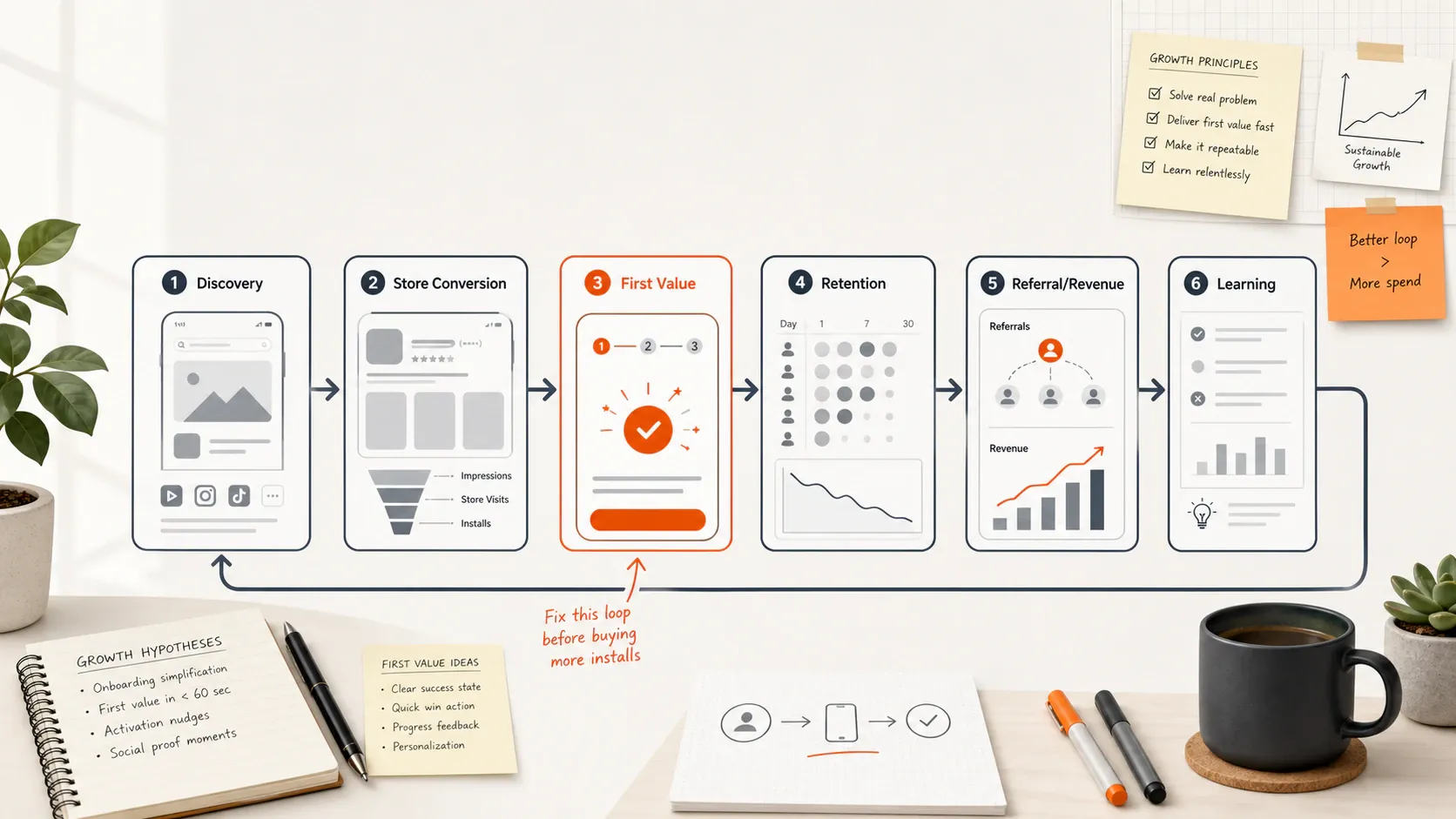
If you are asking “how to grow my app,” the tempting answer is usually a tactic: improve ASO, post more short-form videos, buy ads, recruit creators, add referrals, send push notifications, or rewrite the landing page. Those can all help in the right moment. But for an early-stage app, growth usually breaks because one stage of the loop leaks: the wrong users discover it, the store page does not convert them, onboarding delays first value, activated users do not return, or happy users never create a signal you can reuse. The useful question is not “Which growth tactic should I copy?” It is “Where is the first-value loop breaking?”
Start with the leak, not the tactic
An app grows when more right-fit users discover it, install it, reach a meaningful first value moment, return because the app solves a recurring problem, and eventually convert, invite, review, or share. That is a loop, not a checklist.
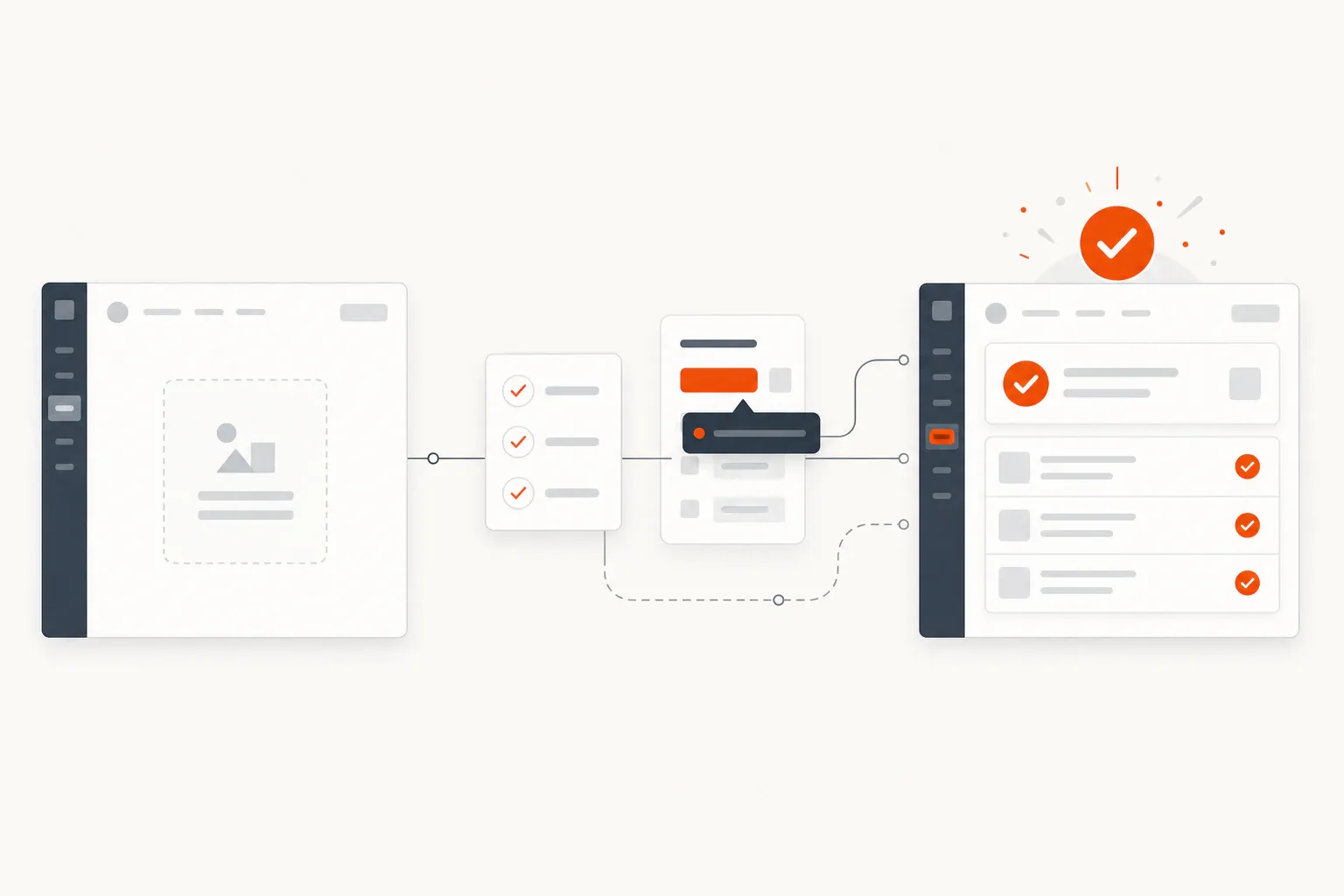
The loop looks like this: Discovery → Store conversion → First value → Retention → Referral or revenue → Learning back into product and messaging. If any stage is weak, adding more installs can simply push more users into the same leak.
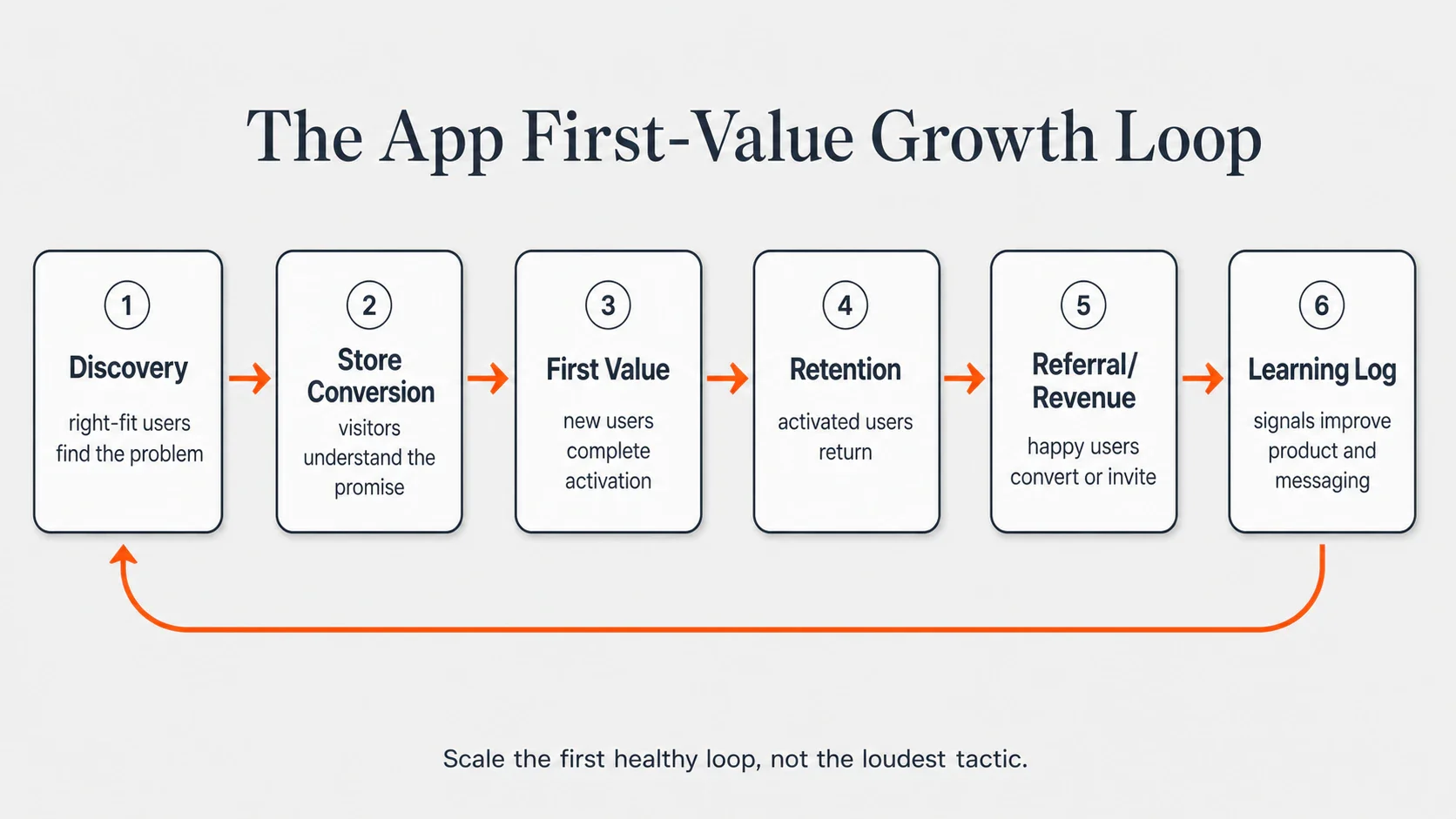
This is why activation-first thinking matters. Business of Apps argues that sustainable mobile app growth should focus on activation before acquisition, because acquisition is only one part of the broader AARRR funnel of activation, retention, revenue, and referral (Business of Apps). For a founder with limited time and budget, that framing is practical: fix the stage closest to value before spending harder at the top.
Define what “growth” means for your app before choosing channels
Installs are not a sufficient growth metric. An install that never completes a meaningful action does not prove the channel, the store listing, or the product is working. Before choosing channels, define the user behavior that means the app has delivered value.
Pick one current objective: more qualified installs, higher store-page conversion, higher install-to-signup conversion, faster first value, stronger D1/D7/D30 retention, more trials or subscriptions, better review volume, or more referrals. Trying to improve all of them at once usually creates noise.
Then define one activation event. For different apps, that could be creating a first project, logging a first workout, saving a first item, completing a lesson, scanning a first document, inviting a teammate, setting up a first automation, or receiving a personalized result.
Use this simple template: Our app grows when [target user] discovers us through [channel], installs because [promise], reaches first value by [activation event], and returns because [recurring job]. If you cannot fill that in clearly, the next sprint should clarify the loop before adding more acquisition.
Diagnose your app growth bottleneck with a five-question scorecard
Use this scorecard before picking a channel. The goal is to find the lowest unhealthy stage in the funnel. If store visitors are not installing, do not start by rewriting push notifications. If activated users are not returning, do not start by tripling paid spend.
1. Are the right users finding the app?
Look at app store search terms, Google queries, social search phrases, creator comments, Reddit or community threads, referral sources, and paid or organic source quality. The question is not only “Are people arriving?” It is “Are the people arriving likely to need this problem solved now?”
2. Are store visitors converting?
Review the app name, subtitle, icon, first three screenshots, preview video, description, category fit, ratings, and reviews. A store listing should make the user’s desired outcome obvious before it explains every feature.
3. Are new users reaching first value?
Inspect onboarding steps, login walls, permission prompts, empty states, paywall timing, and first-session copy. If the app asks for too much before showing value, users may leave before they understand why the app exists.
4. Are activated users coming back?
Read retention by cohort and source: D1, D7, D30, activation-completed versus not, and channel quality. Adjust’s retention guide reports global benchmark context where retention falls sharply after install: about 26% on day 1, 13% by day 7, and roughly 7% by day 30 (Adjust). Your category may differ, but the pattern is clear: the first days matter.
5. Are users creating growth signals?
Look for reviews, referrals, shares, saved outputs, invites, user-generated content, support messages, social proof, and repeated customer language. These signals improve app store screenshots, landing pages, founder-led posts, onboarding questions, lifecycle messages, and roadmap decisions.
For example, a subscription fitness app might score discovery as healthy because search traffic and creator posts are producing installs, but score first value as weak because many users stop before logging a first workout. In that case, the next growth sprint should not be “more creators.” It should shorten the path from install to a completed first workout, then compare retention for users who complete that action versus users who do not.
Fix discovery: make the app findable by people already looking for the problem
Discovery is not just “get more traffic.” It is helping people who already feel the problem recognize that your app is relevant. For app growth, discovery can come from app store search, Google search, social search, founder-led content, creator content, communities, referrals, partnerships, or small paid tests.
Start with customer language. Pull phrases from reviews, support messages, churn reasons, onboarding surveys, user interviews, Reddit threads, and social replies. Then map those phrases to app store keywords, screenshot copy, content hooks, and outreach messages.
A lightweight discovery sprint can look like this: list 10 problem phrases users actually say, group them by intent, choose one app store listing improvement, publish one off-store content angle, and compare not only installs but activation quality. ASO and content work best when they attract users who are likely to complete the first meaningful action.
Fix app store conversion: show the outcome before the features
Your app store listing is the bridge between discovery and install. It has to answer three questions quickly: Who is this for? What outcome will I get? Why should I believe this app can help?
Use screenshot storytelling. A practical sequence is: first screen equals outcome or promise, second screen shows how it works, third screen shows the first value moment or use case, and later screens cover differentiators, trust details, or workflow depth. Screenshots should be readable on mobile and written in user language rather than internal feature names.
Run a simple before-and-after test: rewrite the first screenshot and value proposition, then compare store page conversion and downstream activation quality. Do not judge the change by installs alone. A listing that brings fewer but better-fit users may be more valuable than a broader message that creates low-quality installs.
Fix onboarding: get users to first value faster
Onboarding is often the highest-leverage growth surface because it determines whether acquisition becomes retained usage. Adjust’s retention benchmark context shows why: many users do not return after the first day, so the first session has to prove value quickly (Adjust).
A useful onboarding audit asks: can login wait until after value? Are permissions requested only when the user understands why they matter? Does personalization change the experience, or does it only collect data? Is the empty state actionable? Does each screen help the user complete the activation event?
There is a difference between onboarding questions that create relevance and onboarding friction that only collects data. A fitness app asking for a goal may personalize a first plan. A productivity app asking for a workspace name before showing anything useful may simply delay value.
For teams that need to prototype first-value paths before hard-coding product changes, FounderHQ supports product journeys as part of a focused operating system for early-stage product teams, alongside founder-led content and company context.
If you want a deeper activation-specific walkthrough, the FounderHQ guide to app onboarding covers how to design a lean path from first visit to first meaningful value.
Fix retention: design the reason to come back before you scale acquisition
Retention depends on whether the app solves a recurring problem or creates a durable habit, workflow, record, status, or social loop. A user may love the first session and still churn if there is no reason to return tomorrow, next week, or next month.
Read retention by cohort, not only as a blended average. Compare users who completed activation versus those who did not. Compare channels. Compare first-session paths. Compare users who opted into useful reminders versus those who did not. The goal is to identify which behavior predicts return usage. Benchmark comparisons should stay category-specific and stage-specific; a consumer habit app, B2B workflow app, game, and subscription learning app should not be judged by the same retention target.
Retention loops can include saved progress, weekly reports, collaborative invites, habit reminders, personalized recommendations, streaks where appropriate, lifecycle emails, behavior-aware push notifications, and prompts after success moments. The important part is relevance. Generic push blasts often train users to ignore you; behavior-aware follow-up helps them continue a job they already started.
For subscription apps, the first session can also shape trial behavior. RevenueCat’s 2025 report says 82% of trial starts occur the same day a user installs an app, with p90 apps showing a 20.3% trial start rate versus a 6.2% median trial start rate (RevenueCat). That does not mean every app should force an immediate trial. It means subscription apps should be deliberate about when value, trust, personalization, and paywall timing appear.
Choose one acquisition motion only after the first-value loop is usable
Once users can reach first value and at least some activated users return, choose one acquisition motion for a focused sprint. Small teams do not need a full channel portfolio at the beginning. They need one channel that creates useful learning.
Beginner-friendly motions include ASO and content-led discovery, founder-led social posts, community participation, direct outreach, creator partnerships, small paid tests, referral prompts, and partnerships. For each, measure activation rate, D1/D7 retention, cost or founder time per activated user, and quality of user feedback.
A two-week sprint is enough to learn if the motion deserves more attention. Use one hypothesis, one channel, one message, one activation event, and one review meeting. Pre-retention apps should prioritize channels that create conversations and qualitative signal. Apps with healthier activation and retention can test scalable channels more aggressively.
Turn user signals into better messaging, product journeys, and growth assets
Your users are constantly writing your next growth assets. Reviews reveal language for screenshots. Support questions reveal onboarding confusion. Churn reasons reveal broken expectations. Social replies reveal demand language. Referral messages reveal what users think is worth sharing.
Create a simple growth log and tag each signal by funnel stage: discovery language, store objection, onboarding confusion, activation win, retention reason, referral trigger, or pricing concern. Review it weekly before rewriting store copy, launching a channel, or changing onboarding.
This is where a focused operating layer helps. FounderHQ helps early-stage product teams build product journeys, compose founder-led content, and keep company context in one focused operating system. The value is not replacing founder judgment; it is preserving the context that makes each next asset sharper.
A 30-day app growth plan for a solo founder or tiny team
Use this plan when you need progress without turning growth into a sprawling marketing project.
Week 1: Instrument the loop
Define the target user, activation event, funnel stages, baseline store conversion, install-to-activation rate, D1/D7/D30 retention where available, and top drop-off points. Do not overbuild analytics; capture enough to see where the leak is.
Week 2: Fix first value
Reduce onboarding friction, improve the empty state, rewrite the first-run promise, delay unnecessary asks, and test one first-value journey. The question for the week is simple: can more new users complete the activation event?
Week 3: Improve discovery and conversion
Refresh app store screenshots or copy using customer language. Publish one founder-led problem/solution post or article. Run one small outreach, community, creator, or ASO test that maps to the same promise.
Week 4: Review and decide
Compare activated users by source, retention by cohort, qualitative signal, and the amount of founder time required. If users do not activate, fix onboarding. If activated users do not return, fix retention. If retention is healthy but volume is low, scale discovery. If users love the app but do not share it, build a referral or proof loop.
Common mistakes that keep apps from growing
The most common app growth mistakes are not exotic. They usually come from scaling before the loop is clear:
- Buying installs before defining the activation event.
- Copying another app’s onboarding screens without understanding the job each screen performs.
- Optimizing for views, followers, or downloads that do not create activated users.
- Adding more channels when the store listing or first session is confusing.
- Sending generic notifications instead of behavior-aware follow-up.
- Treating ASO, onboarding, lifecycle messaging, content, and customer learning as separate work instead of one connected growth loop.
The better pattern is slower at first and faster later: diagnose the leak, fix the stage closest to first value, test one acquisition motion, preserve the learning, and repeat.
Conclusion
The practical answer to “how to grow my app” is not “do every growth tactic.” It is to build a loop that turns the right discovery into installs, installs into first value, first value into return usage, and return usage into revenue, referrals, reviews, or sharper learning. Once that loop works at a small scale, acquisition has something to amplify. Until then, more installs may only make the leak easier to see.
Related articles
Application Onboarding Process: Definition, Steps, and When to Use It
A practical seven-step application onboarding process for moving new users from signup to first meaningful value without unnecessary setup or generic tours.
In-App Analytics for Onboarding: Definition, Metrics, and When to Use It
In-app analytics for onboarding turns events, funnels, segments, and user feedback into decisions about the path from signup to first value.
In-App Guidance for Onboarding: Definition, Examples, and When to Use It
In-app guidance helps users complete meaningful tasks inside a product. This guide explains the main patterns and how to match each one to an onboarding blocker.