FounderHQJul 18, 202611 min read
Lifecycle Marketing: Definition, Examples, and When to Use It
Lifecycle marketing is a stage-based system for moving prospects and users to the next meaningful action across awareness, signup, activation, retention, referral, and reactivat...

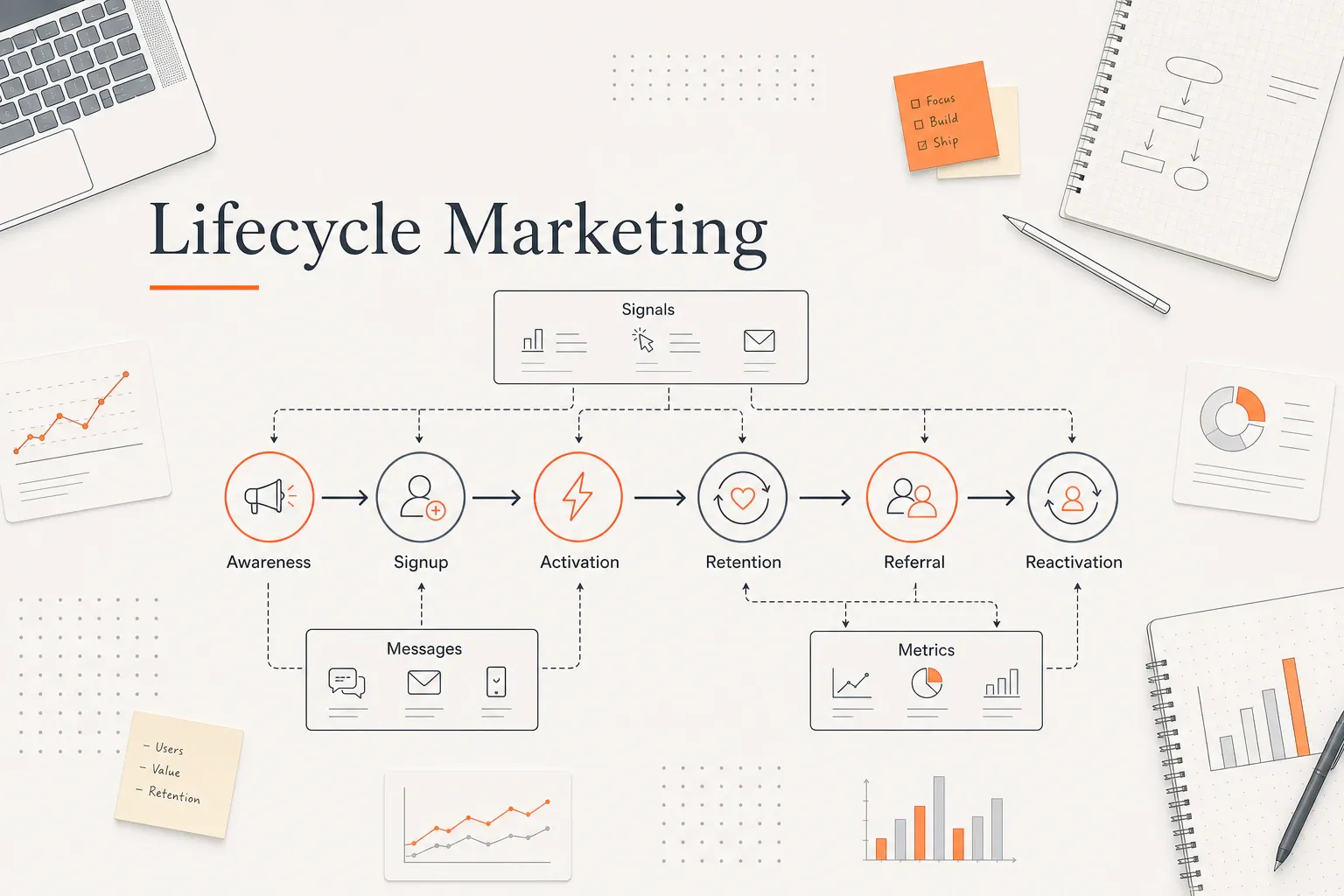
TL;DR: Lifecycle marketing is the practice of matching messages, product prompts, and follow-up to where someone is in the customer relationship so they take the next meaningful step. For founders, the useful version is lean: pick one lifecycle leak, one segment, one next action, and one review loop. Retention matters because HBR cites Bain research showing a 5% retention increase can lift profits 25% to 95%.
Key takeaways
- Lifecycle marketing works best when it moves one clearly defined segment toward one next action, not when it adds more campaigns to a calendar.
- Early-stage teams should map six practical lifecycle stages first: awareness, signup, activation, retention, referral, and reactivation.
- Behavior and intent are better segmentation inputs than demographics because they show what the user has already done, skipped, answered, or requested.
- Onboarding and activation deserve early attention because acquisition does not compound when new users fail to reach first value.
- A lean lifecycle marketing workflow needs exit rules and weekly review so users stop receiving irrelevant messages after they progress.
Lifecycle marketing is how a small team turns scattered interest into steady user progress. I’d define it as a signal-based system for sending the right message, prompt, or journey at the right customer stage so someone takes the next meaningful step. This guide is for founders and lean product teams that own acquisition, onboarding, follow-up, and retention without a dedicated lifecycle team.
What lifecycle marketing means for an early-stage product team
Lifecycle marketing is stage-specific, context-aware marketing across the full customer relationship. Zapier defines lifecycle marketing as engaging customers with relevant, stage-specific messaging across the relationship, while Salesforce describes it as understanding and catering to customers at each journey stage from awareness to post-purchase engagement.
For an early-stage product team, the job is not to copy an enterprise automation map. The job is to reduce drop-off between interest, signup, first value, repeated use, paid conversion, referral, and reactivation.
A concrete example: a founder posts a product lesson, a reader joins the waitlist, answers one use-case question, gets routed to the right onboarding path, receives one reminder if they stall, and exits the sequence after completing the activation action. That is lifecycle marketing. A weekly newsletter sent to every contact regardless of behavior is not.
The lifecycle stages worth mapping first
The best lifecycle stage model is the one your team can use to decide the next action. Sources use different labels: HubSpot lists awareness, engagement, evaluation, purchase, support, and loyalty, while Appcues uses awareness, consideration, conversion, onboarding, retention, expansion, and advocacy.
I would not argue over the labels. I would map the stages where users actually move or stall.
Lifecycle stage | User signal | Next action | Message type | Channel | Metric |
|---|---|---|---|---|---|
Awareness | Reads a post, visits a page, hears about the product | Understand the problem and category | Problem education | Founder-led content, SEO, community | Qualified visits, saves, replies |
Signup | Joins waitlist or creates account | Commit to one clear next step | Confirmation and expectation setting | Landing page, email, journey | Visitor-to-lead or lead-to-signup |
Activation | Starts setup but has not reached value | Complete the first useful action | Guided checklist or contextual nudge | Product journey, email, in-app | Signup-to-activation |
Retention | Activated user returns or goes quiet | Repeat the useful behavior | Use-case prompt or progress reminder | Email, push, in-app, founder note | Activation-to-repeat use |
Referral | User shows value or positive intent | Share, invite, review, or introduce | Specific ask after value | Email, in-product, personal follow-up | Referrals, intros, shares |
Reactivation | User stalls or becomes dormant | Resume the last unfinished milestone | Specific return prompt | Email, SMS, retargeting, support note | Dormant-user-to-return |
Amazon Ads frames lifecycle marketing around customer progression and recommends stage-based segments plus metrics that reflect both customer movement and business outcomes. That is the right bias for founders: measure progression, not campaign busyness.
Why lifecycle marketing matters before you scale acquisition
Lifecycle marketing matters because more traffic does not fix a leaky user journey. If users fail onboarding, ignore follow-up, or churn before value is clear, acquisition mainly increases the number of people who experience the leak.
Retention is not a soft metric. Harvard Business Review reported in 2014 that Bain & Company research shows increasing customer retention rates by 5% increases profits by 25% to 95%; the same figure appears in Bain’s Loyalty Rules! chapter excerpt. That does not guarantee the same result for a startup, but it explains why retention deserves operating attention.
For founders, lifecycle marketing creates a learning loop: messaging changes what users expect, product experience changes what users do, behavior reveals where users stall, and follow-up helps the next segment move with less friction.
How does lifecycle marketing work in practice?
Lifecycle marketing works by connecting four decisions: who the user is, what they have done, what they should do next, and what message or experience helps them get there. The practical unit is not a campaign; it is a user movement.
Use the loop below when you need a simple operating cadence rather than a full automation rebuild.
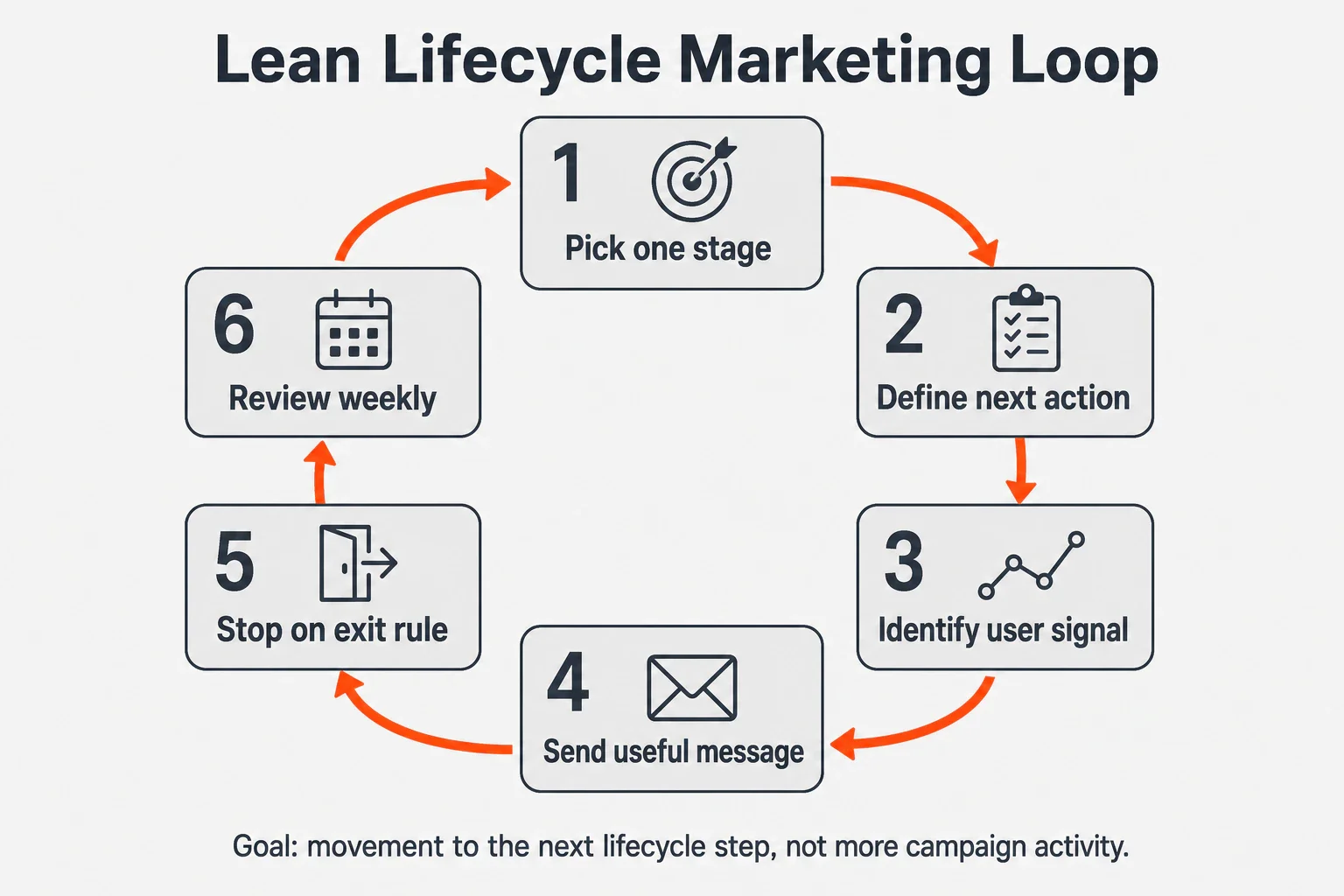
Step 1: Pick one lifecycle moment
Choose the stage with the clearest leak or highest strategic value. Examples include waitlist signup to qualified conversation, signup to first meaningful action, activated user to repeat use, or dormant user to resumed usage.
Step 2: Define the next meaningful action
The action should be observable. “Understand our value” is too vague. “Complete the setup checklist,” “invite one teammate,” “book the onboarding call,” or “return to the unfinished project” is usable.
Step 3: Identify the trigger signal
Trigger follow-up from behavior or intent: a form answer, product journey completion, signup, inactivity window, feature use, pricing-page visit, reply, or skipped step.
Step 4: Send useful help, then stop
Write 3 to 5 messages or journey steps that help the user progress. Add exit rules so the sequence stops after the user completes the action, replies, converts, becomes unqualified, or opts out.
Step 5: Review weekly
Review movement to the next step, replies, activation, retention, unsubscribes, complaints, and qualitative objections. The weekly question is simple: did this lifecycle motion help the right people move, or did it only create more activity?
Build lifecycle segments from behavior and intent
Lifecycle segmentation should start with what people do, not who you imagine they are. SAP Emarsys defines customer lifecycle marketing as engaging customers across every stage with content and offers tailored to each stage, and it emphasizes lifecycle stage and intent as segmentation inputs.
A small team does not need 27 segments. Start with 3 to 5 segments that change what you send or show: new leads, high-intent leads, new signups, unactivated users, activated users, dormant users, paying customers, or potential advocates.
The test is operational: if two segments receive the same message, same timing, same channel, and same next action, they are probably one segment.
Match each stage to the right message and channel
Lifecycle marketing improves when the channel fits the job. Appcues notes that lifecycle marketing is not just email; product experiences such as in-app tours, feature announcements, and contextual nudges can also be lifecycle touchpoints.
Stage | Strong message | Weak message |
|---|---|---|
Awareness | “Here is the problem and the tradeoff.” | “Book a demo now” before trust exists |
Signup | “Here is what happens next.” | A generic newsletter welcome with no path |
Activation | “Complete this one action to reach value.” | A full feature tour |
Retention | “Here is the next use case based on what you already did.” | Random product announcements |
Referral | “You got value; here is a specific person to invite.” | Asking cold or unactivated users to refer |
Reactivation | “Return to the milestone you left unfinished.” | “We miss you” with no context |
Email sequences and drip campaigns can support lifecycle marketing, but they are narrower tools. If you need the mechanics of a short follow-up sequence, the FounderHQ guide to email sequences goes deeper; if you need a simple timed nurture loop, the drip campaigns guide covers that layer.
Lifecycle marketing examples for early-stage founders
Good lifecycle marketing examples begin from a real user signal. The following examples are deliberately small because early teams learn faster from a clear motion than from an overbuilt map.
Example | Signal | Lifecycle motion | Exit rule | Success metric |
|---|---|---|---|---|
Waitlist lifecycle | Visitor answers a use-case question | Route to a relevant follow-up and invite to the right onboarding path | User books, joins, or says not relevant | Qualified waitlist-to-conversation |
Product onboarding lifecycle | New signup chooses a goal | Show a guided first-value path and remind only if stalled | User completes activation event | Signup-to-activation |
Content-to-conversation lifecycle | Reader replies to a founder post or article | Tag the problem and send a short educational sequence | User replies, books, or opts out | Replies and qualified conversations |
Reactivation lifecycle | Dormant user left an unfinished milestone | Reference the last known action and offer one return step | User returns or stays inactive after final attempt | Dormant-user-to-return |
A compact waitlist-to-onboarding scenario makes the logic easier to see. Suppose a founder is launching a collaboration tool and the waitlist form asks, “What are you trying to fix first?” Segment A chooses “handoffs after meetings.” Segment B chooses “unclear project ownership.” Message 1 confirms the answer and sends a 2-minute setup note for that use case. Message 2, sent only if the person has not started onboarding after 48 hours, points to the matching first step: “Create your first handoff note” for Segment A or “Assign one project owner” for Segment B. The exit rule is simple: stop the motion when the user starts onboarding, replies, books a call, or opts out. The weekly decision is whether one segment shows stronger qualified waitlist-to-onboarding movement than the other.
For onboarding-heavy products, lifecycle marketing overlaps with activation design. The FounderHQ guide to app onboarding covers the first-value path in more detail; this article treats onboarding as one stage in the broader lifecycle system.
Metrics to track without drowning in dashboards
Lifecycle metrics should show whether users moved to the next stage. Opens, clicks, and impressions are diagnostics; stage movement is the scoreboard.
A lean weekly review can fit in one table: | Stage | Observed leak | Hypothesis | Change shipped | Result | Next decision |
|---|---|---|---|---|---|---|
Signup to activation | 60 new signups, few complete setup | First step asks too much too soon | Replaced tour with one-action checklist | More users reached setup step | Keep, revise, or test next prompt |
Track one primary metric per stage: visitor-to-lead, lead-to-signup, signup-to-activation, activation-to-retention, retained-user-to-referral, and dormant-user-to-return. Add supporting signals such as replies, unsubscribes, completion rates, time to first value, feature adoption, churn signals, and repeated objections.
The FounderHQ article on choosing a growth system is a useful companion when the lifecycle metric reveals a bigger bottleneck than messaging alone can fix.
When should you use lifecycle marketing, and when should you not?
Use lifecycle marketing when you can see a repeatable user transition that needs help. Do not use it as a way to hide an unclear product, weak positioning, or a value proposition users do not understand.
Use it when users show intent but stall: waitlist signups that never convert, trials that never activate, activated users that go quiet, customers who miss renewal value, or dormant users with a clear unfinished action.
Do not overbuild lifecycle marketing when you have no meaningful behavioral data, no defined activation event, no clear next action, or too few users to learn from automation. In that case, talk to users manually first, then systematize what repeats.
How FounderHQ can fit into a lifecycle marketing operating cadence
FounderHQ fits lifecycle marketing only where the work depends on journeys, founder-led content, and preserved company context. FounderHQ describes itself as a focused operating system for early-stage product teams that helps them build product journeys, compose founder-led content, and keep company context in one place.
A practical cadence looks like this: use product journeys to capture intent and guide users, use founder-led content to educate each stage, use follow-up sequences for the next action, and preserve what you learn so future messages do not restart from a blank page. For onboarding use cases, FounderHQ Journeys can support quizzes, waitlists, onboarding flows, branching steps, and contact attributes for later segmentation.
That setup does not guarantee activation, retention, ranking, revenue, or conversion lift. It gives a lean team a cleaner place to connect lifecycle thinking to the assets they already need to ship.
Conclusion
My recommendation is to start smaller than the lifecycle marketing diagrams you see from mature teams. Pick the lifecycle stage where users are visibly stuck, define the next action, segment by behavior, send useful help, stop when the user moves, and review the result every week. Once one lifecycle motion works manually, automate the pieces that repeat.
Frequently asked questions
What is lifecycle marketing?
Lifecycle marketing is a strategy for engaging prospects and customers with relevant messages, product experiences, and follow-up based on their current stage in the relationship. Instead of sending the same campaign to everyone, lifecycle marketing asks what this person needs to do next: learn, sign up, activate, return, expand, refer, or come back after going dormant.
What are the main lifecycle marketing stages?
The labels vary by company, but a practical startup model is awareness, consideration or signup, onboarding and activation, retention and engagement, expansion or referral, and reactivation. HubSpot, Appcues, Salesforce, Amazon Ads, and SAP Emarsys use different stage names, but they all organize lifecycle marketing around customer progression and stage-relevant communication.
Is lifecycle marketing the same as email marketing?
No. Email is one channel inside lifecycle marketing. Lifecycle marketing can include email, in-app prompts, onboarding flows, SMS, push notifications, sales follow-up, founder-led content, support moments, and product nudges. The defining feature is not the channel; it is whether the message fits the user’s lifecycle stage and helps them take the next useful action.
When should a startup start lifecycle marketing?
A startup should start lifecycle marketing once it has enough user behavior to see where people stall: waitlist signup, account creation, first product action, trial conversion, repeat use, referral, or reactivation. The first version should be small. Pick one leak, one segment, one next action, and one metric before building a complex automation program.
What lifecycle marketing metrics should founders track?
Track movement between lifecycle stages: visitor-to-lead, lead-to-signup, signup-to-activation, activation-to-retention, retained-user-to-referral, and dormant-user-to-return. Supporting metrics include replies, completion rates, time to first value, unsubscribes, feature adoption, repeated objections, and churn signals. Opens and clicks are useful diagnostics, but they should not replace user movement.
Related articles
Application Onboarding Process: Definition, Steps, and When to Use It
A practical seven-step application onboarding process for moving new users from signup to first meaningful value without unnecessary setup or generic tours.
In-App Analytics for Onboarding: Definition, Metrics, and When to Use It
In-app analytics for onboarding turns events, funnels, segments, and user feedback into decisions about the path from signup to first value.
In-App Guidance for Onboarding: Definition, Examples, and When to Use It
In-app guidance helps users complete meaningful tasks inside a product. This guide explains the main patterns and how to match each one to an onboarding blocker.