FounderHQJul 5, 202610 min read
LinkedIn Ghostwriter: A Founder’s Guide to Hiring Without Losing Your Voice
A practical guide for founders deciding whether to hire a LinkedIn ghostwriter, build an AI-assisted workflow, or create a lightweight founder-led content system first.

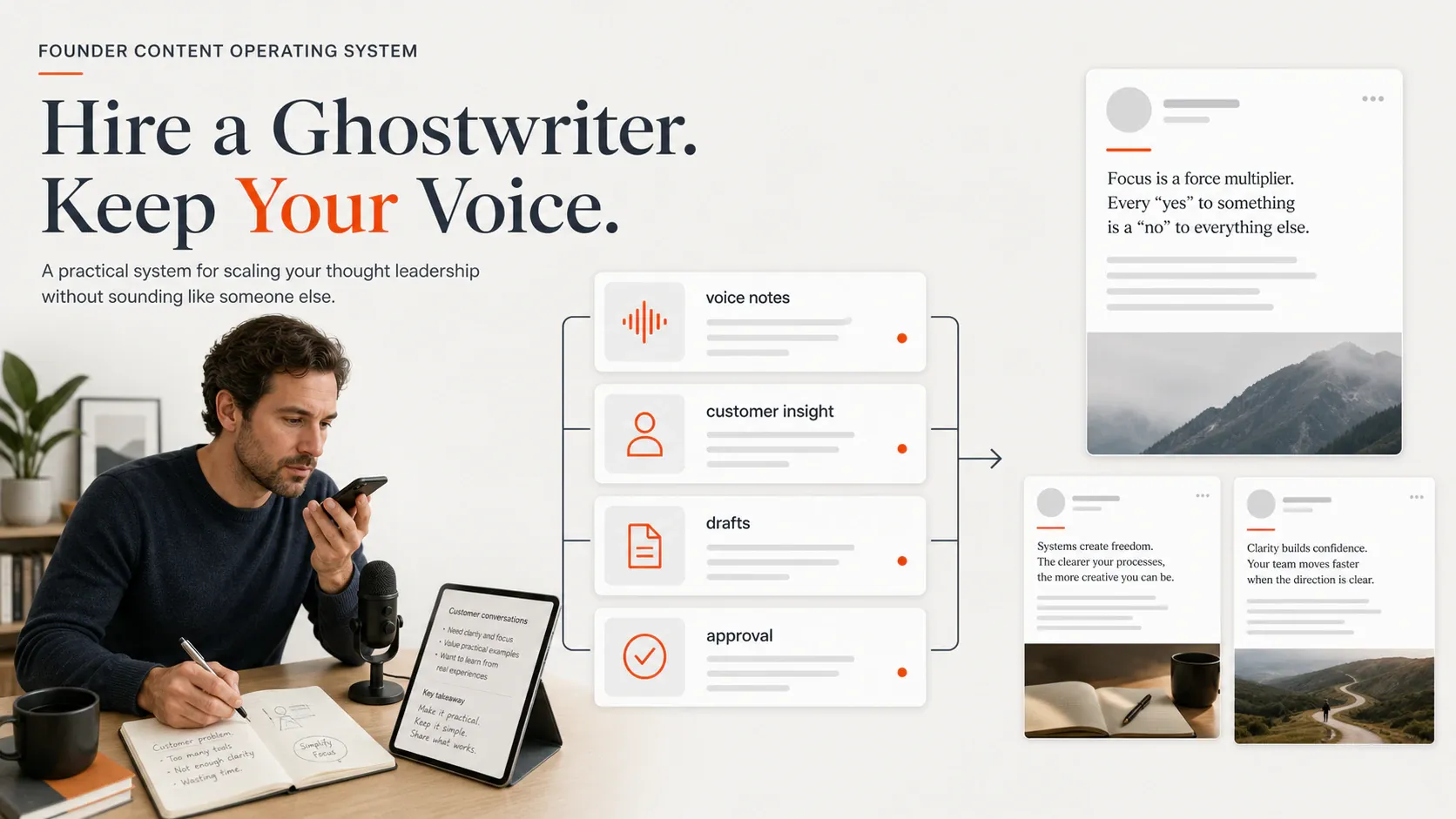
A LinkedIn ghostwriter can be useful leverage for a founder who has strong ideas but no repeatable writing cadence. The risk is hiring someone to produce polished posts that sound like every other executive on the feed. The best ghostwriting relationship does not replace the founder’s voice. It captures founder judgment, customer language, product decisions, and specific stories, then turns that raw material into posts that are easier to publish consistently.
What is a LinkedIn ghostwriter?
A LinkedIn ghostwriter is a writer or content partner who helps a founder, executive, or subject-matter expert publish LinkedIn content under their own name. The useful version of the role is not “make up opinions for me.” It is: extract the founder’s thinking, shape it into LinkedIn-native posts, and preserve the founder’s voice while improving structure, clarity, and cadence.
Several current ghostwriting guides define the work this way. Hey Sid describes LinkedIn ghostwriting as extracting a client’s thinking, experience, and point of view, then turning raw ideas into clear posts that fit the platform’s audience. Foundera similarly frames founder ghostwriting around capturing authentic voice, expertise, communication style, and company context rather than producing generic updates. Hey Sid Foundera
Common deliverables include content strategy, founder interviews, voice capture, post drafting, editing, scheduling support, performance review, and sometimes profile optimization or engagement support. The exact package matters because “LinkedIn ghostwriting service” can mean anything from a few post drafts per month to a full personal-brand operation.
Why founders consider hiring a LinkedIn ghostwriter
Most founders do not struggle because they have nothing to say. They struggle because the useful material is scattered across customer calls, product decisions, investor updates, sales objections, hiring conversations, and private notes. Turning that context into platform-ready content every week competes with product, hiring, fundraising, support, and sales.
LinkedIn’s own creator resources emphasize showcasing expertise, learning the basics of post creation, understanding analytics, and using creator tools to improve over time. Another LinkedIn-owned guide recommends balancing your expertise with what your network cares about, engaging reciprocally, and using topics from your feed and network to maintain publishing consistency. LinkedIn Creator resources LinkedIn feed post guidance
For an early-stage founder, that can support several jobs: educate a market, make the product’s point of view more visible, give sales conversations more context, attract talent, build trust with potential partners, and turn private thinking into reusable public assets. None of those outcomes are guaranteed by posting. They depend on the clarity of the offer, the relevance of the audience, the quality of founder input, and whether the content creates useful conversations.
When a LinkedIn ghostwriter is worth it—and when it is too early
A ghostwriter is worth considering when the founder has real signal but no sustainable system. If you already have repeated customer conversations, a defined audience, strong opinions, and lessons from building the product, a ghostwriter can help package those assets into a steadier cadence.
It is usually too early if the founder expects the writer to invent the strategy from scratch. If the ICP is vague, the offer is still changing weekly, customer language is thin, and the founder has not formed a point of view, outsourcing content can create a false sense of progress: posts go live, but the team learns little and the market hears nothing specific.
Too early: no raw material
You are too early for a serious ghostwriting retainer if the writer would need to guess your audience, invent your opinions, and write from generic industry takes. At this stage, the better move is to capture customer questions, founder decisions, onboarding friction, and product lessons for a few weeks before hiring.
Ready for support: clear thinking, weak cadence
You are ready for support when your problem is packaging, not substance. You know who you are writing for. You can name the objections you hear. You have opinions you repeat in sales calls. You have examples from product work. You just do not have a repeatable writing workflow.
Ready for full service: LinkedIn supports a broader motion
A full-service partner makes more sense when LinkedIn is part of a broader founder-led distribution motion: sales follow-up, hiring, investor trust, community building, or market education. At that point, you are not just buying posts. You are buying a content operating rhythm that needs research, interviews, approvals, reporting, and reuse.
What LinkedIn ghostwriting typically costs
LinkedIn ghostwriting pricing varies widely because the scope varies widely. Recent pricing guides show entry or productized writing at the low end, mid-market retainers in the low thousands, and premium founder-brand or executive programs reaching much higher monthly fees. Foundera reports freelancer retainers from about $500 to $3,000 per month and premium agency programs from $8,000 to $15,000+ per month. Trustypost describes a broad market from about $500 productized packages to $10,000+ founder-brand support, with many serious founder retainers landing around $1,500 to $6,000 per month. Foundera pricing guide Trustypost pricing guide
A practical way to compare proposals is by scope, not headline price:
Service level | Typical scope | Founder risk |
|---|---|---|
Commodity post bundle | Drafts from prompts or briefs; little strategy | Cheap posts that sound generic |
Entry productized service | A set number of posts, light voice capture, basic revisions | Useful if you bring the ideas; weak if you need strategy |
Boutique specialist | Interviews, content pillars, post drafts, revisions, reporting | Stronger fit if they understand your market |
Premium executive program | Positioning, deep research, multi-format content, engagement, analytics | Expensive if LinkedIn is not yet a priority channel |
Full-service founder brand system | Dedicated team, content strategy, repurposing, profile, reporting, sometimes outbound support | Can overbuild before the founder has enough signal |
The price changes with interview depth, number of posts, seniority of the writer, research requirements, revision load, scheduling, analytics, engagement management, profile work, multi-format content, and whether the provider is also supporting outbound or pipeline operations. Before comparing retainers, ask what is actually included and what still depends on you.
The founder input a ghostwriter still needs
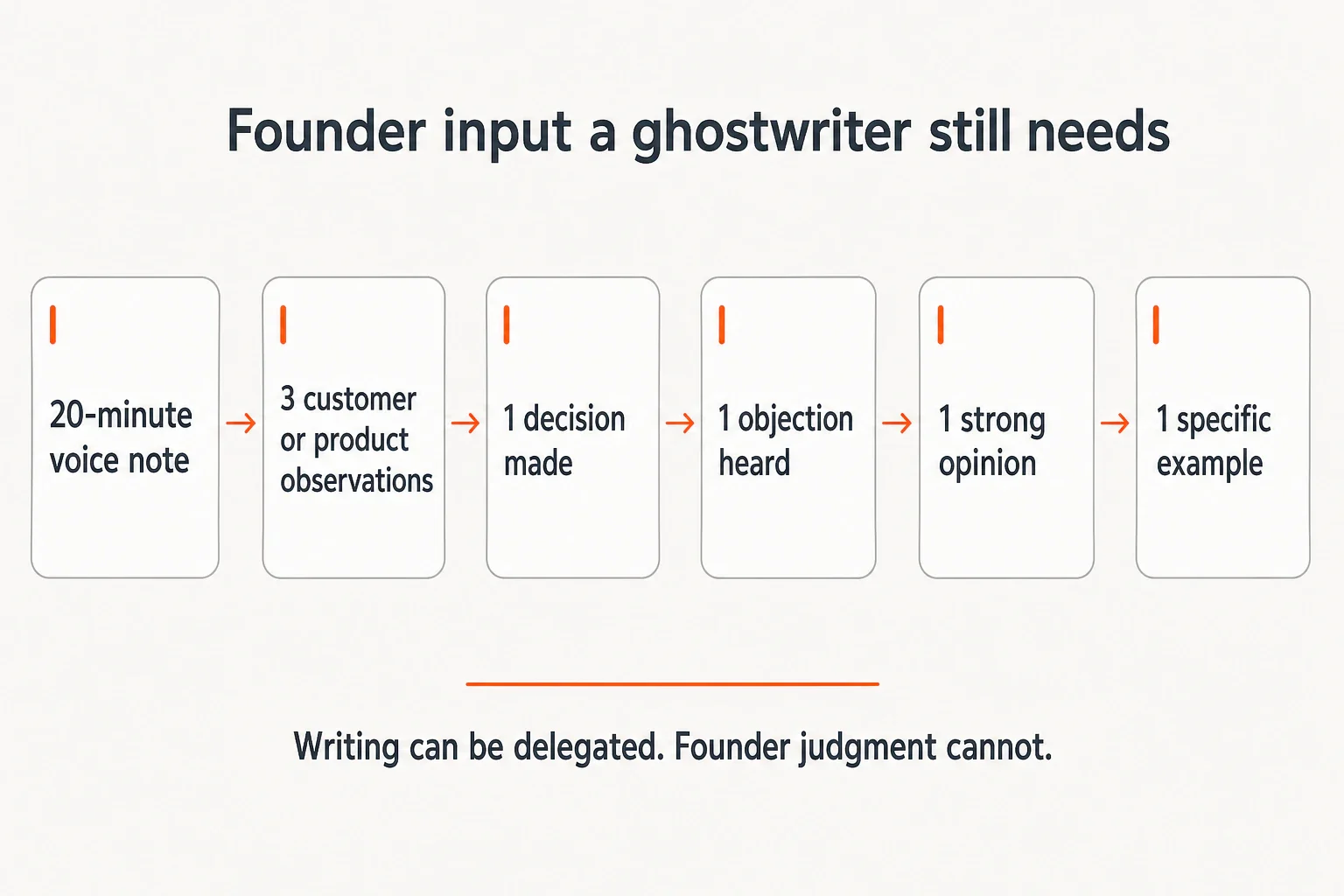
The strongest ghostwriting systems separate what can be delegated from what cannot. Drafting, editing, structure, formatting, and scheduling can be delegated. Judgment, stories, customer insight, product trade-offs, and point of view cannot be fully outsourced.
Use this weekly input loop before you hire, and keep using it after you hire. It gives a writer enough raw material to make posts specific instead of generic:
- 20-minute voice note or interview
- 3 customer or product observations
- 1 decision made this week
- 1 objection heard from a buyer, user, investor, or teammate
- 1 strong opinion you would defend in a room
- 1 specific example that proves the point
The workflow below is intentionally lightweight. A founder does not need a content team to create useful raw material; the first requirement is a repeatable way to preserve the context that already exists inside the company.
This is also where the right operating system helps. FounderHQ is built for early-stage product teams that need to compose founder-led content, build product journeys, and keep company context in one focused workspace. For ghostwriting, that matters because the best posts often come from the same material that improves onboarding, sales follow-up, launch messaging, and product narratives.
How to evaluate a LinkedIn ghostwriter before hiring
Evaluate a LinkedIn ghostwriter the way you would evaluate a product or growth operator: by process, judgment, and fit with your actual context—not by the loudest promise.
Ask for a paid trial before committing to a long retainer. A useful trial is not “write one viral-style post from a blank brief.” It is 3 to 5 posts created from a founder interview, existing company context, past writing samples, and a clear audience definition. The trial should reveal whether the writer can capture your voice, challenge weak angles, and preserve nuance.
Use these interview questions:
- How do you capture a founder’s voice?
- What do you need from me every week?
- How do you decide what not to post?
- How do you handle sensitive product, customer, investor, or hiring information?
- How do you measure quality beyond likes?
- What happens when I disagree with a draft?
- Can you show samples where different clients sound meaningfully different?
- What part of the workflow will still require founder approval?
Green flags include a clear voice-capture process, curiosity about your customers, willingness to push back on generic ideas, strong editing judgment, a simple approval system, and examples that do not all sound like the same person. Red flags include guaranteed leads, guaranteed follower growth, engagement-pod tactics, “no founder input required,” vague revision rules, ghostwritten opinions you do not hold, and a portfolio full of interchangeable executive takes.
A lean alternative: build a founder-led content system before hiring
If you are not ready to pay for a ghostwriter, build the system a good ghostwriter would need anyway. Capture context weekly, maintain a reusable idea library, draft with AI or internal support if useful, then have the founder edit for judgment, specificity, and risk.
A simple founder-led workflow looks like this:
- Collect raw context from calls, notes, demos, product decisions, objections, and support conversations.
- Tag each idea by audience pain point, product lesson, belief, proof point, or story.
- Turn one strong idea into 2 or 3 LinkedIn post angles.
- Draft quickly, but edit slowly for voice and specificity.
- Publish only what the founder would defend in a real conversation.
- Log useful replies, objections, DMs, and follow-up questions.
- Feed the best signal back into product messaging, onboarding copy, sales follow-up, or longer-form content.
This workflow is not anti-ghostwriter. It makes a future ghostwriter more effective. When you eventually hire, you will not be handing over a blank page. You will be handing over a living library of customer language, decisions, voice examples, and content signals.
How to measure whether LinkedIn ghostwriting is working
Do not judge ghostwriting only by impressions, likes, or follower count. Those metrics can be useful, but they do not tell the whole story for an early-stage founder whose real goals are trust, clarity, hiring, sales conversations, and sharper market learning.
Measure leading signals before revenue outcomes. Look for comments from the right people, ICP-relevant profile visits, useful DMs, sales-team reuse, objections surfaced in replies, saves, reposts from credible peers, and self-reported attribution in calls or forms. A post can have modest reach and still be valuable if it creates a qualified conversation or clarifies a message the team keeps reusing.
Run a monthly review with four questions:
- Which posts sounded most like the founder?
- Which posts created conversations with the right people?
- Which posts attracted the wrong audience or shallow engagement?
- Which ideas should become articles, onboarding copy, product journey steps, sales follow-up, or investor narrative material?
The best ghostwriting relationship compounds beyond the feed. It should make the company’s thinking easier to reuse across product, content, sales, onboarding, and follow-up—not just keep a posting calendar full.
LinkedIn ghostwriter checklist for founders
Before you hire a LinkedIn ghostwriter, make sure you can provide the raw material that makes the work defensible:
- Clear ICP
- Clear offer
- 3 to 5 content pillars
- Weekly context-capture ritual
- Voice examples from posts, emails, calls, or talks
- Sensitive topics list
- Approval process
- Success metrics
- 30-day paid trial plan
- A place to store ideas, edits, replies, and reusable context
Use this decision table if you are still choosing the right path:
Option | Choose this if | Avoid this if |
|---|---|---|
Hire a LinkedIn ghostwriter | You have strong founder insight but weak cadence | You expect the writer to invent your positioning |
Use an AI-supported internal workflow | You can capture context and edit for judgment | You will publish drafts without founder review |
Keep writing manually | Writing is already a high-leverage founder habit | It keeps restarting every busy week |
The best LinkedIn ghostwriter for founders is not the person who makes you sound more polished at any cost. It is the person who helps you preserve what is already specific: your customer insight, your product judgment, your language, your examples, and your point of view.
Conclusion
Hiring a LinkedIn ghostwriter is a leverage decision, not an abdication decision. If your founder thinking is clear but trapped in calls, notes, and private decisions, a good writer can help turn it into a consistent public rhythm. If the thinking is not yet clear, build the context-capture habit first. Founder-led content works best when the founder’s judgment stays in the loop and the system around it makes that judgment easier to publish.
Related articles
Application Onboarding Process: Definition, Steps, and When to Use It
A practical seven-step application onboarding process for moving new users from signup to first meaningful value without unnecessary setup or generic tours.

In-App Analytics for Onboarding: Definition, Metrics, and When to Use It
In-app analytics for onboarding turns events, funnels, segments, and user feedback into decisions about the path from signup to first value.

In-App Guidance for Onboarding: Definition, Examples, and When to Use It
In-app guidance helps users complete meaningful tasks inside a product. This guide explains the main patterns and how to match each one to an onboarding blocker.