FounderHQJul 19, 202611 min read
Sales Sequences Explained: Build Follow-Up Around Buyer Signals
A practical guide to sales sequences for early-stage founders: define the buyer signal, choose one next action, write useful follow-up, add exit rules, and review replies weekly.

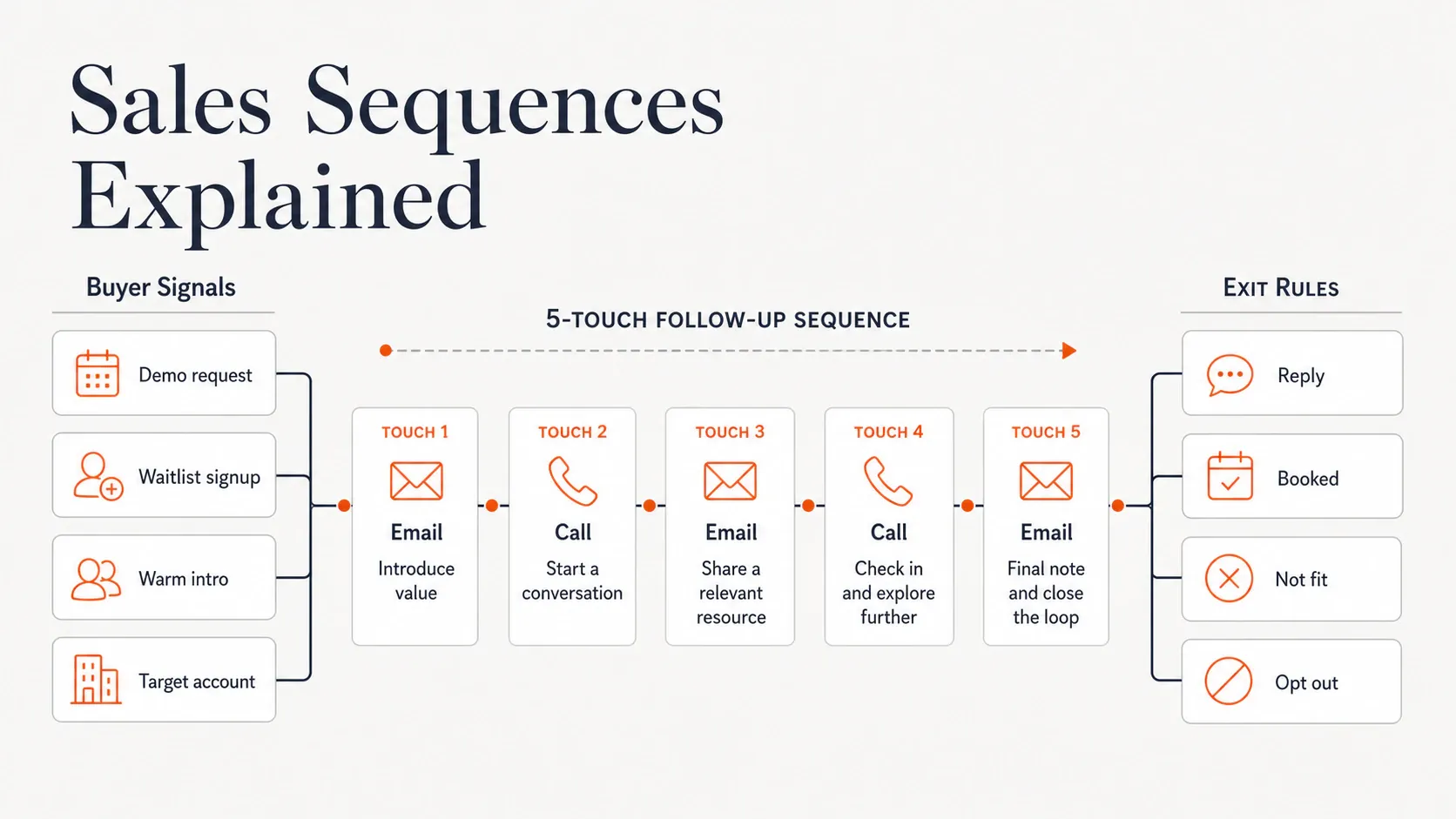
TL;DR: Sales sequences are planned, timed touchpoints that move one prospect toward one next action, such as a reply, demo, or decision. For founder-led sales, start with the buyer signal, build a small 4–6 touch sequence, vary the message angle, and stop when the prospect replies, books, opts out, or changes stage.
Key takeaways
- A sales sequence should start from a real buyer signal, such as a demo request, waitlist signup, warm intro, product action, or high-fit outbound account.
- A sales sequence defines the steps and message logic, while a sales cadence mainly describes the timing and rhythm between those steps.
- For founder-led sales, the best first sequence is usually 4–6 useful touches that a founder can review manually before adding more automation.
- Each follow-up should change the angle: context, clarification, alternate channel, proof or objection handling, direct ask, and close-the-loop.
- Exit rules prevent spammy follow-up by stopping or changing the sequence when someone replies, books, says no, opts out, becomes a customer, or no longer fits the segment.
Sales sequences work when they turn a real buyer signal into relevant follow-up, not when they blast the same “just checking in” note across every contact. I’d build the first version around one segment, one next action, 4–6 useful touches, and clear exit rules so the system creates conversations instead of cleanup work.
What are sales sequences?
A sales sequence is a planned set of timed touchpoints designed to move a prospect toward one next action: a reply, demo, qualification call, proposal review, purchase decision, or clear no. HubSpot defines a sales sequence as “a series of planned, timed touchpoints” across channels including email, phone, and social in its 2026 guide to sales sequences.
The useful word is planned. A one-off cold email is not a sequence. Five automated emails with no buyer context are not a good sequence. A founder note after a demo request, followed by a useful clarification, a call attempt, a relevant proof point, and a close-the-loop message is a sequence because each step has a job.
Term | What it means | Best use |
|---|---|---|
Sales sequence | The full plan: audience, steps, messages, channels, timing, and exit rules | Turning a prospect signal into a next sales action |
Sales cadence | The rhythm and timing of outreach steps | Deciding when each touch happens |
Email sequence | A planned series of emails only | Product-led follow-up, onboarding, nurture, or simple sales follow-up |
Drip campaign | Automated messages over time, often marketing-led | Education, waitlist nurture, re-engagement, or broad lifecycle follow-up |
If you need a deeper email-only workflow, I’d use the narrower email sequences founder guide. If the goal is a broader nurture loop rather than a sales conversation, the drip campaigns guide is the better companion.
Why buyer signals should shape the sequence
The signal that created the lead should decide the first message, channel mix, urgency, and exit rule. A demo request deserves fast, specific follow-up; a waitlist signup needs qualification and education; a warm intro deserves a personal note; cold outbound needs context and permission.
Ranking guides often treat sales sequences as reusable templates. That is only half right. Templates help with structure, but the buyer’s moment decides whether the message feels useful or automated.
Buyer signal | Likely intent | First message angle | Channels to consider | Exit rule |
|---|---|---|---|---|
Demo request | High intent | Confirm the request and ask one qualifying question | Email, phone if supplied, calendar link | Stop when booked, replied, or unqualified |
Waitlist signup | Medium intent | Confirm interest and ask what problem matters most | Email, optional reply prompt | Move to segment based on answer |
Warm intro | Relationship-led intent | Reference the person and reason for intro | Personal email, LinkedIn if already connected | Stop if they reply or decline |
Product signup | Usage intent | Point to the first meaningful action | Email, in-product prompt, onboarding task | Stop when activation happens |
Low-volume outbound | Unknown intent | Explain the specific reason for reaching out | Email, LinkedIn, phone for high-fit accounts | Stop after no response or no fit |
For product-led teams, product behavior matters too. A signup that stalls before first value should not get the same follow-up as a user who completed setup. The app onboarding guide covers that activation side in more depth.
How to build the first founder-led sales sequence
The first founder-led sales sequence should be small enough to inspect by hand. Pick one segment, one trigger, one next action, 4–6 touches, and one owner for replies.
Use this builder before writing copy. It keeps the sequence tied to buyer intent instead of drifting into generic automation.
Step 1: Choose one segment
A useful segment includes role, company type, source, pain point, urgency, relationship strength, and last action. “All leads” is not a segment. “Seed-stage B2B SaaS founders who requested a demo after viewing onboarding content” is.
Step 2: Choose one next action
Do not ask for five things. Choose the action the prospect can reasonably take now: book a call, answer one question, confirm interest, complete setup, review a proposal, or tell you they are not the right person.
Step 3: Map 4–6 useful touches
Outreach’s 2026 cold outreach research reported that a first response required 4.8 touches on average, booking a meeting required 7.4 touches, and 4–6 step sequences produced the strongest engagement in its dataset (Outreach, 2026). I would treat 4–6 as a strong starting range for early teams, then adjust based on reply quality.
A simple founder sequence can look like this:
- Immediate context: “You requested X / we were introduced by Y / I noticed Z.”
- Useful clarification: Ask one question that helps route the conversation.
- Alternate channel: LinkedIn view, call attempt, or short note where appropriate.
- Proof or objection: Share one relevant example, asset, or answer to a common concern.
- Direct next-step ask: Make the action obvious and low-friction.
- Close-the-loop: Give the prospect an easy way to say later, not now, or not a fit.
Pipedrive describes a sales cadence as a structured sequence of outbound touchpoints spaced over set intervals in its 2026 sales cadence guide. That timing should follow intent: demo requests move faster, cold outbound breathes more, and warm intros stay personal.
The signal-based sales sequence builder
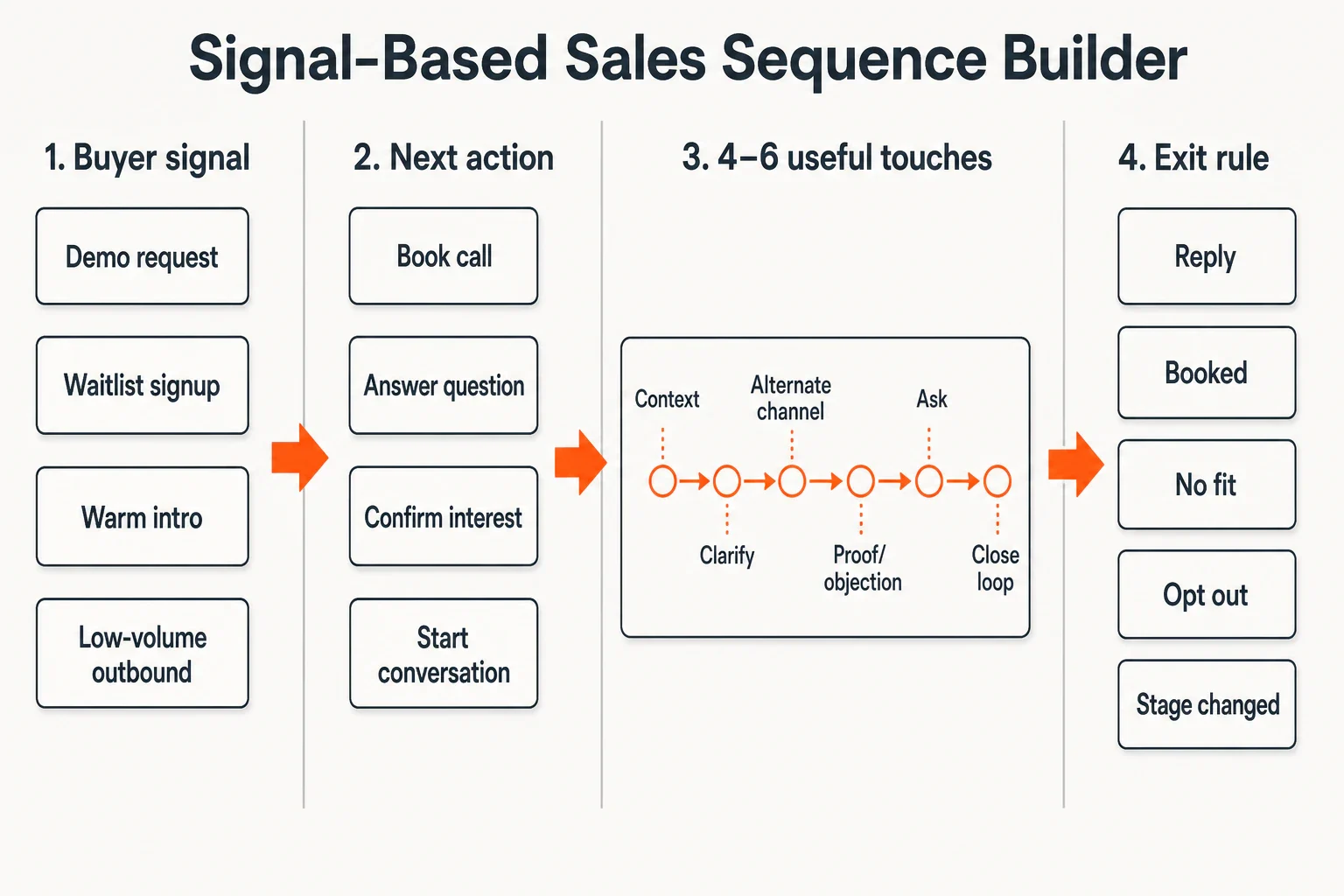
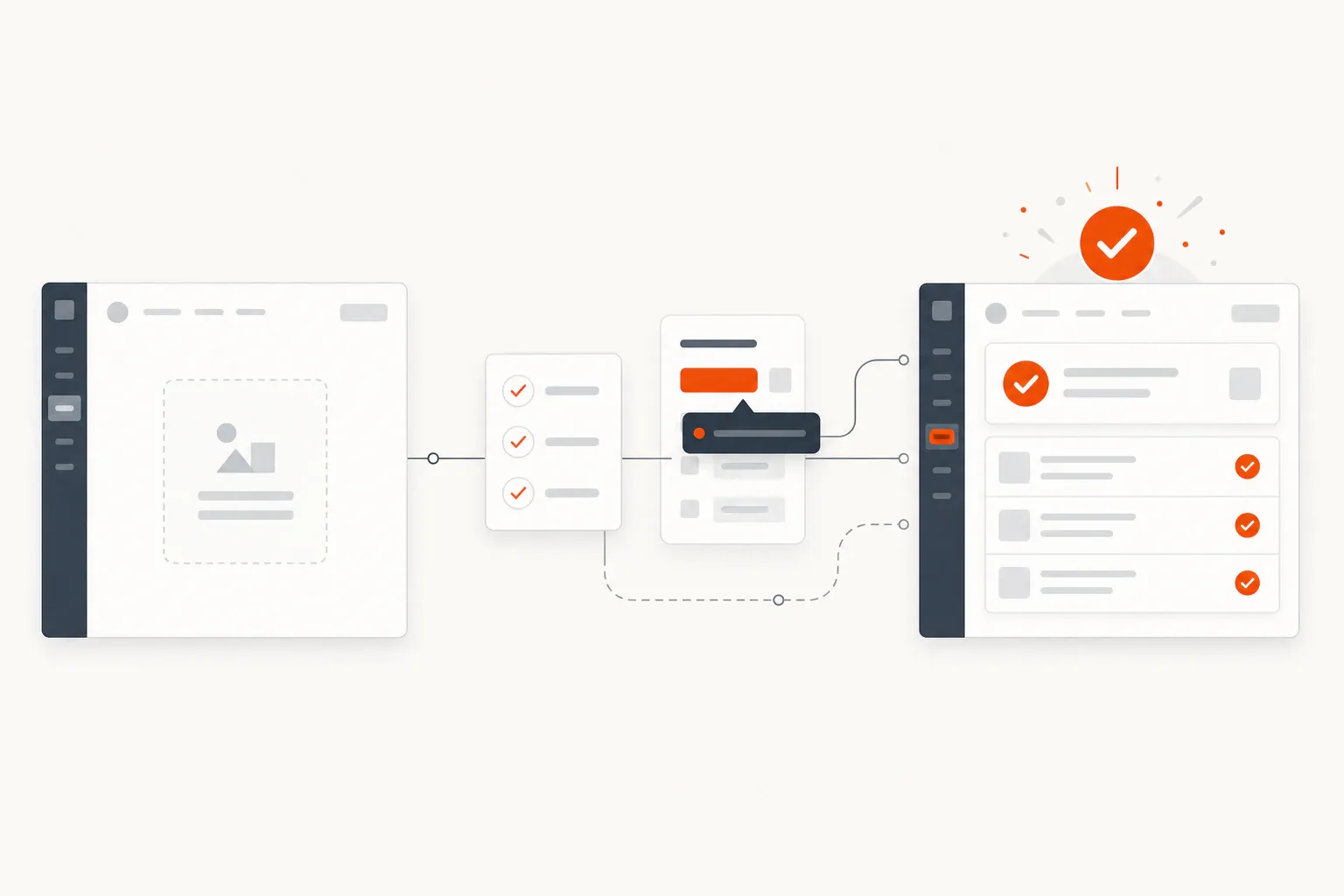
The cleanest way to audit a sales sequence is to trace it from signal to next action to useful touches to exit rule. If any column is vague, the sequence is not ready to automate.
The flow below is the operating artifact I would keep next to the draft sequence: buyer signal, next action, 4–6 touches, and exit rule.
How to write follow-up that does not sound automated
Good sales follow-up changes the angle at each touch. Bad follow-up repeats the same ask until the prospect ignores, unsubscribes, or forms a negative impression of the founder.
Use this progression:
- Context: Why you are reaching out now
- Problem: The likely pain or job-to-be-done
- Value: One useful resource, observation, or answer
- Question: One thing that helps qualify or route the prospect
- Proof: A concrete example, product note, customer language, or relevant use case you can support
- Decision prompt: A clear next step or permission to close the loop
Bad follow-up: “Just checking in to see if you had time to review my last email.”
Better follow-up: “You joined the waitlist from the onboarding teardown page, so I’m guessing activation is the problem you care about. Are you trying to shorten setup time, reduce drop-off after signup, or test a new first-value path?”
The better version works because it names the signal, offers plausible choices, and asks for a reply the founder can use. It also avoids fake urgency, fake personalization, and unsupported proof.
When not to use a sales sequence
A sales sequence is the wrong tool when the team does not know who the buyer is, lacks permission for the channel, cannot handle replies, or plans to send the same pitch to every contact. Manual founder follow-up is better until the pattern is clear.
Do not sequence your way around weak positioning. If prospects keep asking what the product does, who it is for, or why now, fix the message before adding more touches.
Do not use SMS, WhatsApp, push, or personal channels unless the relationship and permission justify it. Respect opt-outs, unsubscribe expectations, and local rules. This is operational guidance, not legal advice.
Do not keep sending after a prospect replies, books, becomes a customer, says no, opts out, or moves into another lifecycle stage. The fastest way to make automation feel careless is to ignore the clearest signal the buyer gave you.
What to measure in a weekly sequence review
A founder should review sales sequences by reply quality and next-step movement, not just sends, opens, or volume. Open rate can be directional, but the operating questions are: who replied, why, what moved forward, and what should change next week?
Outreach’s support guidance for reviewing sequences warns that reliable benchmarks require meaningful sample sizes and recommends looking at step mix, replies, and whether the final step still earns responses (Outreach support). Most early-stage founders will not have enterprise sample sizes, so qualitative review matters more.
A weekly review can stay simple:
- Which source produced the best conversations?
- Which step earned the most useful replies?
- Which message sounded generic?
- Which objection appeared more than once?
- Which segment should be paused?
- Which proof gap needs a better asset?
- Which product question should feed the roadmap or onboarding?
Save the language that prospects use. Repeated objections, exact phrases, pricing confusion, and use-case questions are not just sales notes; they are inputs for positioning, onboarding, product journeys, and founder-led content. The weekly signal log is a practical way to preserve those learnings instead of re-discovering them every week.
Sales sequence examples for founders
Sales sequence examples are useful only when they are treated as operating patterns, not copy-paste scripts. Adapt the timing, channel, and language to the buyer signal.
Use case | Touch 1 | Touch 2 | Touch 3 | Touch 4 | Touch 5 |
|---|---|---|---|---|---|
Demo request | Confirm request and ask one qualifying question | Call or calendar reminder | Share one relevant setup note | Ask if timing changed | Close loop or route later |
Waitlist signup | Confirm interest | Ask what problem they want solved first | Share a product decision or useful note | Invite a reply or early conversation | Segment by answer |
Warm LinkedIn prospect | Reference the conversation | Send one useful resource | Ask a low-friction question | Suggest a call if relevant | Close loop politely |
Low-volume outbound | Specific reason for outreach | Problem hypothesis | Alternate channel touch | Proof or useful observation | Ask whether to continue or close |
The founder-friendly constraint is quality. If you cannot write a specific first touch for a list of 25 high-fit accounts, the list is too broad or the value proposition is too vague.
Where FounderHQ fits in the follow-up operating loop
FounderHQ fits when follow-up depends on shared context across product journeys, founder-led content, and company memory. Its approved site copy describes FounderHQ as helping early-stage product teams build product journeys, compose founder-led content, and keep company context in one focused operating system.
That matters for sales sequences because the best follow-up rarely starts from a blank page. It starts from the context already created by a signup, waitlist answer, onboarding path, founder post, objection, or product decision. When that context stays organized, the next sequence can be more specific without pretending to be fully automated judgment.
I would still keep the founder in the loop. Sales sequences should create leverage, not remove responsibility for the message, the channel, the reply, or the decision to stop.
Conclusion
If I were rebuilding sales sequences from scratch, I would not start with a template library. I would pick one buyer signal, define the next action, write 4–6 useful touches, add exit rules, and review replies every week. Once that small system creates real conversations, then it is worth automating more of the work.
Frequently asked questions
What is a sales sequence?
A sales sequence is a planned series of timed touchpoints used to move a specific prospect toward one next action, such as replying, booking a call, reviewing a proposal, or making a decision. It can include email, phone, LinkedIn, SMS, video, or manual tasks, depending on the buyer context and channel permission.
What is the difference between a sales sequence and a sales cadence?
A sales sequence is the full follow-up plan: who receives it, what each message says, which channels are used, and what outcome it is meant to create. A sales cadence is the timing and rhythm of those touches. In practice, teams often use the terms together, but the sequence is broader than the schedule.
How many steps should a sales sequence have?
For a founder-led team, start with 4–6 purposeful touches before adding complexity. Outreach’s 2026 cold outreach research reported that 4–6 step sequences produced the strongest engagement in its dataset, while booking a meeting took an average of 7.4 touches. Treat that as directional context, not a universal rule.
What should be in a sales follow-up sequence?
A useful sales follow-up sequence should include the original buyer signal, one clear next action, a channel plan, message angles that change over time, and exit rules. A simple progression is: immediate context, useful clarification, alternate channel, proof or objection handling, direct next-step ask, and polite close-the-loop.
When should a founder not use a sales sequence?
Do not use a sales sequence when the audience is unclear, consent is missing, the founder cannot review replies, or the message is only a generic pitch. Use manual follow-up first when the list is tiny, the relationship is sensitive, the buyer is high-value, or the team still does not understand the prospect’s real problem.
Related articles
Application Onboarding Process: Definition, Steps, and When to Use It
A practical seven-step application onboarding process for moving new users from signup to first meaningful value without unnecessary setup or generic tours.
In-App Analytics for Onboarding: Definition, Metrics, and When to Use It
In-app analytics for onboarding turns events, funnels, segments, and user feedback into decisions about the path from signup to first value.
In-App Guidance for Onboarding: Definition, Examples, and When to Use It
In-app guidance helps users complete meaningful tasks inside a product. This guide explains the main patterns and how to match each one to an onboarding blocker.