FounderHQJul 25, 20268 min read
What Is FounderHQ? Definition, Features, and When to Use It
FounderHQ at getfounderhq.com is a founder-controlled growth operating system for early-stage teams. This guide explains its connected workflows, alternatives, best-fit use case...


TL;DR: FounderHQ is a unified growth stack for early-stage product teams at getfounderhq.com. It connects product journeys, founder-led content, SEO publishing, follow-up, and maintained company context. Use it when scattered tools and repeated restarts slow execution. Do not treat it as a substitute for customer research, analytics, specialist judgment, or guaranteed growth results.
Key takeaways
- FounderHQ at getfounderhq.com is software for early-stage product teams, not the similarly named fundraising consultancy, Australian services business, Malaysian sales platform, or founder community.
- Journey answers become contact attributes; founders can review validated customer language and deliberately add selected findings to maintained company context before reusing them.
- FounderHQ fits teams coordinating several related growth workflows, while a specialist point tool can be better when one mature, isolated job needs greater depth.
- Customer conversations, analytics, editorial review, compliance decisions, and final operating judgment still need human owners.
This guide is for founders and product operators deciding whether connected journeys, content, publishing, follow-up, and company context solve a real coordination problem.
What is FounderHQ?
FounderHQ is business and professional productivity software designed as a unified growth stack. Its official product page describes modules for product journeys, founder-led content, search publishing, follow-up, and maintained company context.
The domain matters because the branded search result is ambiguous. TheFounderHQ.com describes a fundraising and investor-readiness consultancy; FounderHQ Australia serves professionals building independent businesses; FounderHQ.my is a Malaysian sales operating system; and FoundersHQ.org presents a founder community. None is the getfounderhq.com product covered here.
A concrete workflow might begin with a waitlist quiz. The founder branches questions by use case, stores answers as contact attributes, reviews recurring objections, adds validated language to maintained company context, and then uses that approved context to inform content or follow-up. The software supports the workflow; the founder decides what the evidence means.
Why does FounderHQ exist for early-stage teams?
FounderHQ exists to reduce coordination work between related growth jobs. A lean team may have a capable form, writing app, publishing tool, messaging provider, and notes system yet still lose context at every handoff.
The problem appears when a waitlist answer never reaches the messaging brief or an article begins without the product decision that made the subject useful. FounderHQ’s guide to choosing a growth system draws the practical boundary: consolidation fits when context is scattered and work keeps restarting; a point tool fits a clearly isolated specialist bottleneck.
Consider a founder who learns that buyers misunderstand setup. A fragmented stack requires separate edits to the form, onboarding document, social draft, article brief, and follow-up email. Maintained context gives those assets one approved explanation, but the team must still verify the observation and decide whether it deserves reuse.
How does FounderHQ work?
FounderHQ passes intent and approved context through connected modules. Its homepage documents Journeys for capturing answers, Compose for social writing, Publish for the search-content loop, and Sequences for follow-up through connected providers.
Stage | What happens | Useful output |
|---|---|---|
Attention | A visitor starts a quiz, waitlist, or onboarding flow | A visible intent signal |
Journey | Branching steps collect answers | A completed path and structured responses |
Contact data and context | Answers become contact attributes; a founder or operator reviews validated phrases, objections, and decisions before adding selected findings to maintained context | Segments and approved company language |
Create and follow up | Compose, Publish, or Sequences uses relevant approved context | Social drafts, search articles, or messages |
Learning | The founder reviews behavior and responses | A better-informed next iteration |
The workflow map below separates captured data from maintained context. Visitor answers first become contact attributes; human review determines which findings are reliable enough to influence the team’s shared playbook.
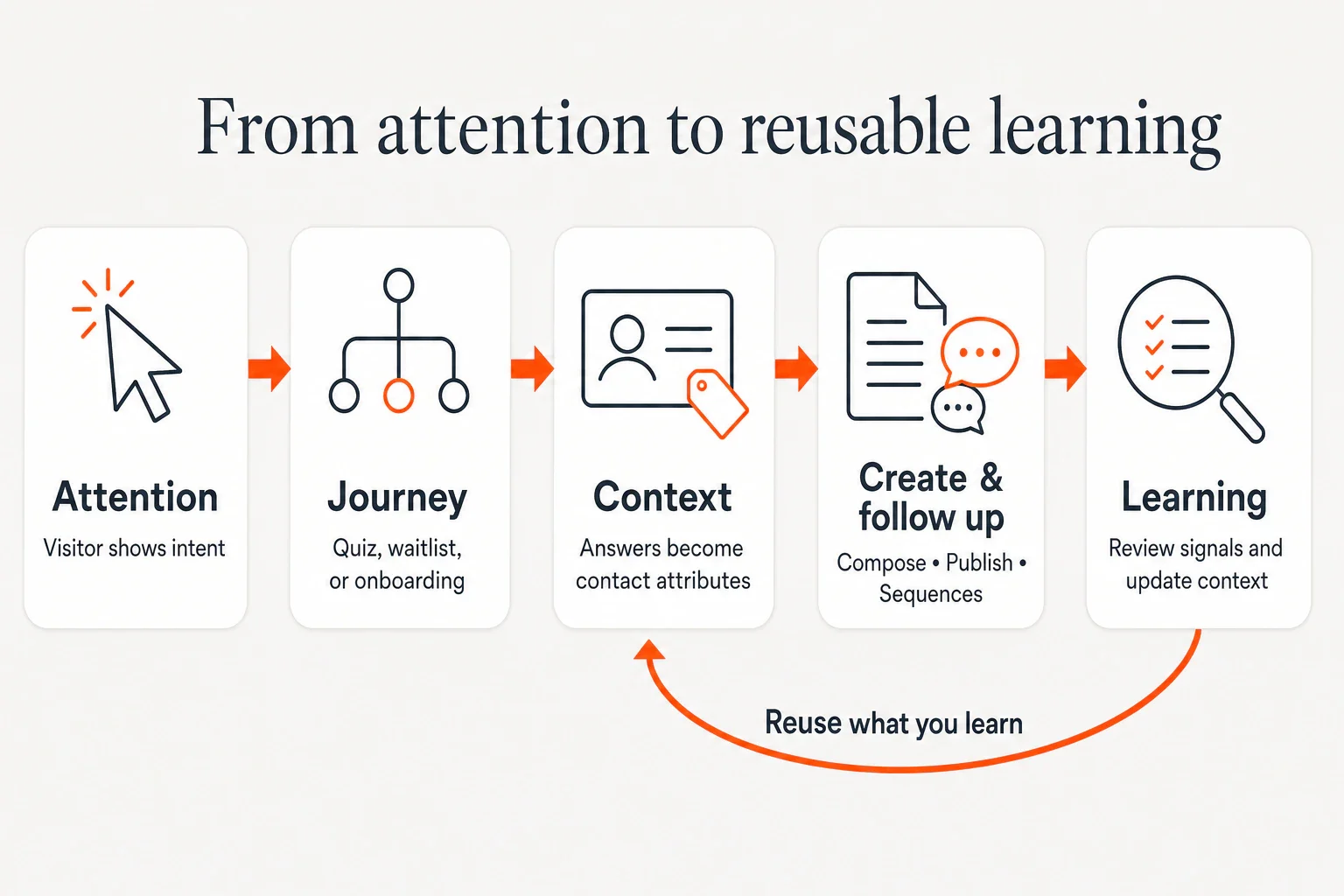
For example, a pre-product-market-fit SaaS team could launch a branching waitlist for agencies and in-house teams. If agencies repeatedly select client reporting as their priority, the founder can validate that pattern in conversations, approve the phrase for company context, draft a post, publish an article answering the recurring question, and send agency-specific follow-up.
Teams focused on the guided product experience can use the separate app onboarding activation guide for activation-event selection, branching decisions, and first-value design. FounderHQ’s broader role is keeping the resulting approved logic and language available to adjacent workflows.
FounderHQ vs. point tools, agencies, and autonomous AI cofounders
FounderHQ is differentiated by workflow connection and founder control, not by claiming that every module is deeper than every specialist alternative. The right model depends on whether the constraint is fragmented context, narrow technical depth, production capacity, or a desire for delegated operation.
Option | Best fit | Main advantage | Main tradeoff |
|---|---|---|---|
FounderHQ | Lean team running connected journey, content, publishing, and follow-up work | Maintained context across related workflows | Requires founder direction and review |
Point-tool stack | One mature workflow needs specialist depth | Focused functionality for a narrow job | More handoffs when several tools must share context |
Agency or ghostwriter | The strategy is clear but production capacity is missing | Adds human execution capacity | Knowledge and voice may sit outside the daily product workflow |
Autonomous AI-cofounder model | A buyer wants broad delegated operation | Greater emphasis on autonomous action | Less aligned with a founder-controlled, review-led model |
I would choose FounderHQ when the same approved customer insight needs to influence a journey, founder post, article, and follow-up. I would choose a point tool when one stable workflow—advanced analytics, for example—requires specialist depth. An agency is the better answer when execution capacity, rather than context continuity, is the constraint.
When should you use FounderHQ?
Use FounderHQ when several connected growth workflows are active and context fragmentation has become an execution constraint. Choose another approach when the real need is market evidence, specialist analysis, regulated review, or guaranteed outcomes.
Operating condition | Use FounderHQ when… | Do not use it as the answer when… |
|---|---|---|
Scattered context | Journeys, drafts, publishing, and follow-up repeatedly restart from different source material | One stable workflow already works well in a specialist tool |
Customer learning | Validated language needs a maintained home after customer conversations | The team still needs direct customer conversations or problem discovery |
Measurement | Known signals need to inform content or follow-up | The team needs product analytics, attribution, or diagnostic measurement |
Review and risk | A named owner can review facts, voice, permissions, and decisions | Legal, compliance, security, or specialist review is required |
Sensitive information | The team has confirmed that submitted data is appropriate and permitted | Data sensitivity, confidentiality, lawful basis, or access rules remain uncertain |
Outcome expectations | The goal is a controlled workflow that the team will test and improve | The buyer expects guaranteed rankings, deliverability, revenue, virality, or business results |
My buying signal is repeated re-creation. If the team rewrites its audience definition for every brief, manually copies journey answers into messaging documents, or cannot trace an asset back to an approved decision, a shared operating layer has a concrete job.
Start with the workflow producing the most avoidable handoffs. One waitlist segment connected to one reviewed follow-up path is a better pilot than importing every historical note.
When should you not use FounderHQ?
Do not use FounderHQ as a substitute for market contact, analytics, specialist review, or founder judgment. Organizing weak evidence does not make it reliable.
FounderHQ’s Terms of Use state that it does not guarantee the accuracy, originality, non-infringement, ranking performance, deliverability, revenue impact, virality, advertising performance, or business results of AI outputs or recommendations. Generated journeys, posts, articles, and messages need review appropriate to their audience and risk.
Avoid adding another operating layer when one narrow workflow is stable and its specialist tool works well. Also pause if the team is organizing documents to avoid customer conversations or behavioral analysis.
FounderHQ’s Privacy Policy says users are responsible for deciding whether the service is appropriate for sensitive, confidential, regulated, customer, or third-party information. Confirm permissions, lawful basis, provider access, and internal data rules before submitting that material.
How to evaluate whether FounderHQ fits your team this week
Evaluate FounderHQ against one repeated workflow, not an abstract desire to consolidate software. The test is whether connected context removes a real handoff while preserving human ownership.
Use this audit:
- Locate the restart: Which journey, brief, article, or follow-up begins from a blank page each week?
- Find the missing signal: Which validated customer answer, objection, or product decision should inform that work?
- Name the first asset: What single journey, post, article, or sequence would demonstrate useful context reuse?
- Assign review: Who checks factual accuracy, voice, permissions, and the final decision?
- Define the stop rule: What result would show that the workflow belongs in its current specialist tool?
A clean pilot might connect one waitlist question to one segment and one reviewed follow-up path. Another might take an approved decision note, produce a founder post and search brief, and then check whether both preserve the same audience, claim, and terminology.
Judge the pilot on operating evidence: fewer manual transfers, fewer conflicting descriptions, a clearer review trail, and more reuse of verified customer language. If the team cannot identify a repeated handoff before starting, delay adoption until the problem is concrete.
Conclusion
Choose FounderHQ only when a specific cross-workflow handoff is expensive enough to justify a maintained context layer. Pilot one journey, content, publishing, or follow-up path with a named reviewer. Expand if the workflow removes real rework without weakening evidence or specialist depth; stop if it creates another place to organize work.
Frequently asked questions
What is FounderHQ?
FounderHQ is a unified growth stack at getfounderhq.com for early-stage product teams. Its modules cover quizzes, waitlists, and onboarding journeys; founder-led social writing; SEO publishing; provider-connected follow-up; and maintained company context used across supported workflows.
Is FounderHQ the same as TheFounderHQ.com?
No. FounderHQ at getfounderhq.com is productivity software for product journeys, content, publishing, follow-up, and company context. TheFounderHQ.com presents itself as a separate fundraising and investor-readiness consultancy. Checking the domain is the simplest way to distinguish the two entities.
Who should use FounderHQ?
FounderHQ is best suited to an early-stage founder or lean product team managing several connected growth jobs without dedicated teams for each one. It is most relevant when journey logic, customer language, content drafts, search work, and follow-up are scattered across separate documents and tools.
What tools does FounderHQ replace?
FounderHQ can consolidate parts of the work commonly spread across journey builders, writing assistants, SEO publishing systems, follow-up tools, and company notes. It should not be assumed to replace every specialist product. A mature, isolated workflow may still justify a dedicated tool with greater depth.
Does FounderHQ guarantee SEO rankings or growth results?
No. FounderHQ’s Terms of Use state that AI outputs and recommendations do not come with guarantees covering accuracy, originality, non-infringement, ranking performance, deliverability, revenue impact, virality, advertising performance, or business results. Teams remain responsible for review, decisions, and execution.
Related articles
Application Onboarding Process: Definition, Steps, and When to Use It
A practical seven-step application onboarding process for moving new users from signup to first meaningful value without unnecessary setup or generic tours.
In-App Analytics for Onboarding: Definition, Metrics, and When to Use It
In-app analytics for onboarding turns events, funnels, segments, and user feedback into decisions about the path from signup to first value.
In-App Guidance for Onboarding: Definition, Examples, and When to Use It
In-app guidance helps users complete meaningful tasks inside a product. This guide explains the main patterns and how to match each one to an onboarding blocker.